
Overview
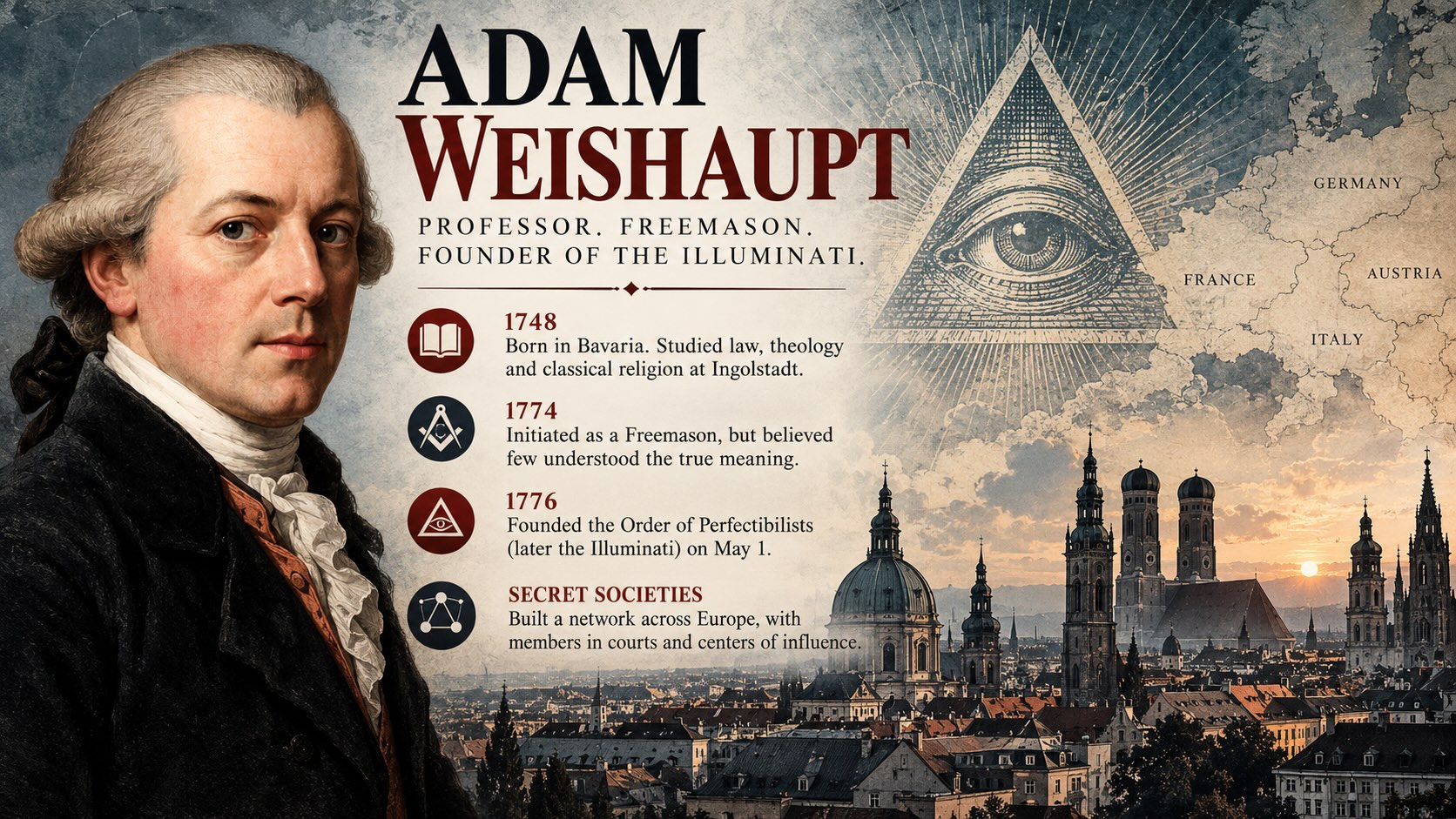
Adam Weishaupt was born in 1748 to Jewish parents, but he was raised in the Catholic faith. After his father, George Weishaupt, died in 1754, Adam was placed under the care of the Jesuits by his godfather, Baron Ickstatt, curator of the University of Ingolstadt in Bavaria.
Later, while studying law at Ingolstadt, he converted to Protestantism.
He also studied classical religion, theology, the Eleusinian and Mithraic mysteries, and the works of Pythagoras. Very little is known about his childhood or early life, and even his name has been treated as something of a mystery.
“Adam” means “the first man,” “Weis” means “to know,” and “haupt” means “leader,” giving his name the meaning “the first man to lead those who know.” He graduated from the University of Ingolstadt in 1768 and became a tutor and catechist. In 1772, he was appointed professor of law.
He was initiated as a Freemason in 1774, either in Hanover or Munich, but came away believing that no one in the order truly understood the occult meaning of its ceremonies. He then decided to found his own organization, which he did on May 1, 1776.
This group was first called “The Order of Perfectibilists,” but it later became known as the “Ordo Illuminati Bavarensis,” or simply the Illuminati.
Only five people attended the order’s first meeting, but it expanded quickly. Within only a few years, it reportedly had chapter houses throughout Germany, Austria, France, Italy, Hungary, and Switzerland.
Weishaupt and his associates, especially Baron Knigge and a lawyer named Zwack, are said to have built a network of agents across Europe. These agents allegedly infiltrated courts and centers of influence, sending useful gossip and intelligence back to Weishaupt.
The true aims of the Illuminati have always been shrouded in mystery. Because of Weishaupt’s anti-clerical and anti-monarchical views, some have regarded the Illuminati as a proto-communist movement dedicated to sparking a proletarian revolution.
Others have described them as anarchists, or as descendants of the Cathars, the Knights Templar, or even the Assassins of Hassan-en Sabbah, the “Old Man of the Mountain,” whom the Templars were rumored to have contacted.
Still others have portrayed them as satanic agents seeking nothing less than global domination and the establishment of the Kingdom of Satan on Earth.
It is true that Weishaupt’s plans appeared hostile to the Church of Rome and to the monarchies of Europe, and that he seemed to have what today might be called socialist leanings. Yet Weishaupt does not appear to have been an atheist or agnostic. There is little doubt that he was deeply religious in his own way.
Shortly before the French Revolution, Weishaupt reportedly said:
“Salvation does not lie where strong thrones are defended by swords, where the smoke of censers ascend to heaven or where thousands of strong men pace the rich fields of harvest.
The revolution which is about to break will be sterile if it is not complete.”
This statement has often been interpreted as evidence that Weishaupt was, in some sense, a communist. Some might even mistake it for something Trotsky would have said.
However, because the Illuminati’s true goals have always been disputed, it remains difficult to determine exactly what political or ideological purpose lay behind the order.
The simplest way to make an educated guess is to examine the order’s actions. In 1784, the Illuminati allegedly attempted a coup against the Habsburgs, but the plot was exposed by police spies who had infiltrated the organization on the king’s orders.
As a result, all secret societies were banned in Bavaria, and membership became punishable by death. This edict was signed in June 1784. Weishaupt fled to a neighboring province in February 1785, and in March another edict specifically outlawed the Illuminati.
Forced underground in Bavaria, the Illuminati had to redirect their revolutionary efforts elsewhere.
Then, in July 1785, disaster struck again when lightning allegedly killed an Illuminati courier named Lanz and the horse he was riding. It was said that both were burned black, while the saddlebags remained mostly intact.
Inside those bags, authorities supposedly found extensive documents outlining Illuminati plans for revolution and world domination, along with the names of several high-ranking members, including Zwack and Weishaupt.
Zwack was arrested, and his home was raided in October 1786. What Weishaupt did after 1790 remains disputed, and several conflicting accounts of his later life exist. In Robert Shea and Robert Anton Wilson’s Illuminatus! trilogy, for example, it is suggested that Weishaupt traveled to America and assumed the identity of George Washington.
Others claim he died in obscurity in 1830. The account here continues tracing the alleged influence of the Illuminati in later years, on the possibility—however unlikely to conventional historians—that Weishaupt continued directing events from behind the scenes.
The French Revolution of 1789 has often been attributed, to varying degrees, to the machinations of the Illuminati. Their role has been described as everything from negligible to decisive.
Both extremes are exaggerated, but it cannot be denied that several individuals deeply involved in the revolution were said to have been active members, including the Comte de Mirabeau, the famous author, orator, Freemason, and enemy of the Marquis de Sade.
Mirabeau is said to have declared at the international Freemason convention in Wilhelmsbad in 1782 that he belonged to an organization influenced by the Knights Templar, whose goal was to destroy the Church and the monarchy so that the “Religion of Love” could be established in France.
Of course, the Illuminati were not the only secret revolutionary group in existence. Many other conspiratorial movements were active during the turbulent years leading up to the revolution.
For example, the Marquis de Luchet, who opposed the Illuminati but supported the revolution, said in a speech:
“There exists a conspiracy in favor of despotism, against liberty, of incapacity against talent, of vice against virtue, of ignorance against enlightenment. This society aims to govern the world.”
These internal divisions among supporters of the revolution were reflected in other secret societies in France during the same period.
By 1788, it was claimed that nearly every Masonic lodge in Europe, as well as all royal courts, had been infiltrated by Illuminati agents.
Despite that, many French lodges remained loyal to the king, and only a few took part in the revolution. It is also noted that the first recorded appearance of revolutionaries wearing the Phrygian cap—said to symbolize both the Illuminati and the ancient Phrygian mysteries—occurred during the forced interruption of a performance of Le Suborneur by the Marquis de Sade on Monday, March 5, 1792.
Curiously, aside from a brief mention in Wilgus’s Illuminoids, few writers have suggested that the Marquis himself was an Illuminati member. At times it seems nearly every famous figure in history has been named as one.
As Ambrose Bierce wrote satirically about the Freemasons in The Devil’s Dictionary:
“An order with secret rites, grotesque ceremonies and fantastic costumes, which originating in the reign of Charles II, among working artisans of London, has been joined successively by the dead of past centuries in unbroken retrogression until now it embraces all the generations of man on the hither side of Adam and is drumming up distinguished recruits among the pre-Creational inhabitants of Chaos and the Formless Void.
The order was founded at different times by Charlemagne, Julius Caesar, Cyrus, Solomon, Zoroaster, Confucius, Tothmes and Buddha. Its emblems and symbols have been found in the Catacombs of Paris and Rome, on the stones of the Parthenon and the Chinese Great Wall, among the temples of Karnak and Palmyra and in the Egyptian Pyramids—always by a Freemason.”
The history of the Illuminati—or at least the history attributed to them by various writers—resembles Bierce’s satire in many ways.
Louis XVI was not unaware of the growing unrest and revolutionary activity among the French people. In June 1789, he attempted to introduce social reforms in hopes of calming the situation.
His greatest mistake was insisting that the monarchy be preserved and that the nobility retain veto power over future reforms. This helped ignite smaller rebellions that spread and eventually culminated in the storming of the Bastille.
Mirabeau reportedly said soon afterward:
“The idolatry of the monarchy has received a death blow from the sons and daughters of the Order of the Templars.”
This statement has been taken to suggest Illuminati ties to both the Cathars and the Knights Templar.
During the later phase of the revolution, the influence of the Illuminati is said to become more visible. The red Phrygian caps became symbols of the revolutionaries, and the Illuminati emblem—the eye in the triangle—appeared on a number of revolutionary documents.
Two years after Louis XVI’s failed escape attempt, he was executed on January 21, 1793. It is said that when the king’s head fell, an old man in the crowd cried out:
“De Molay, thou art avenged!”
De Molay was the leader of the Knights Templar, burned at the stake in March 1314 through the actions of Philip the Fair and Pope Clement V.
It is also worth noting that before his execution, De Molay had been imprisoned in the Bastille, making him, in a symbolic sense, the revolution’s first victim.
After the French Revolution, the Illuminati faced new difficulties, partly because of the chaotic political and social conditions in France, and partly because the rest of Europe’s royal houses panicked after seeing what had happened and moved to ban all secret societies.
Persecution of Freemasons and Rosicrucians followed, and in 1792 a former grand master of a Templar-inspired order was lynched by a mob in Versailles.
Suspicion toward secret societies became widespread and intensified further after the publication of Robinson’s Proofs of a Conspiracy in 1798. That book outlined the supposed survival of the order after its suppression, under the name of the German Union, and accused it of engineering the Revolution.
The book caused widespread fear in Europe and New England and became one of the chief reasons many secret societies were outlawed across Europe.
After Napoleon Bonaparte rose to power, the days of the Illuminati in France were effectively over. Most of the remaining Masonic lodges and other secret societies were infiltrated by Napoleon’s agents, who worked to eliminate any possible subversive groups and consolidate his rule.
Most conventional historians argue that if the Illuminati survived the events of 1785–86 at all, they were finally crushed at this stage.