
Overview
Franklin Roosevelt died at Warm Springs, Georgia, at 3:35 in the afternoon of 12 April 1945. He was sixty-three, eleven weeks into a fourth term, two months past Yalta and four weeks short of the German surrender. He had been sitting for a portrait. He said he had a terrific headache, slumped forward, and never regained consciousness.
No autopsy was performed. The doctor who had spent the previous year monitoring his decline was in the room; the doctor who had spent the previous year assuring the public he was fine was not.
That combination — a sudden death at a decisive moment, an official medical account that contradicted a year of official reassurance, and no post-mortem — is the whole of why the question has never closed. The competing explanations divide into two families that are often confused for each other: that Roosevelt was killed, and that he was dying of something nobody disclosed.
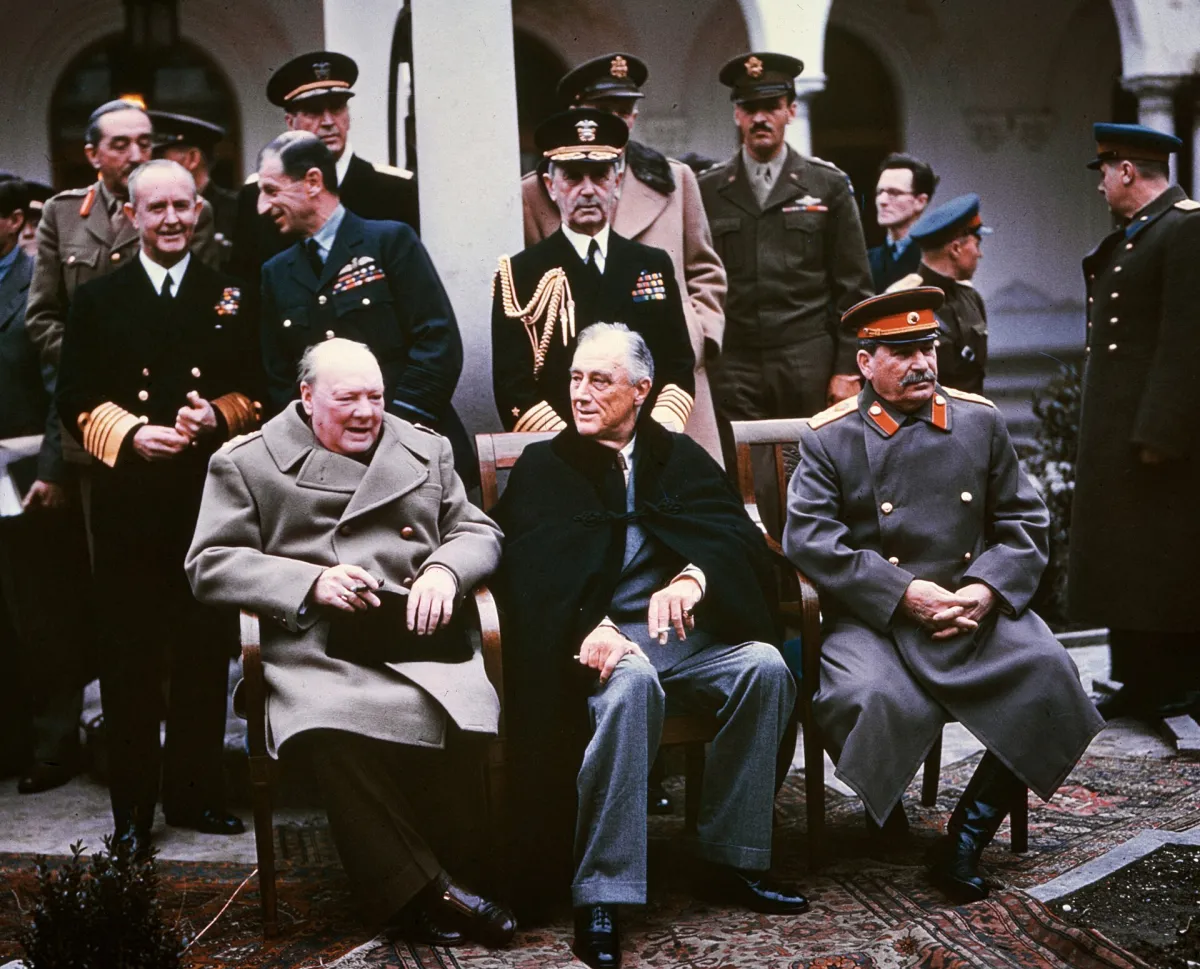
Wikimedia Commons — Photograph from the Army Signal Corps Collection in the U.S. National Archives., Public domain

What the clinical record shows
The attending physician at Warm Springs was Lieutenant Commander Howard Bruenn, a Navy cardiologist assigned to Roosevelt in March 1944. His diagnosis was a massive cerebral haemorrhage, and his estimate of Roosevelt's blood pressure during the collapse was in the region of 350 over 195.
Bruenn's own notes covering March 1944 to April 1945 survive, and his clinical account was eventually published in 1970 — twenty-five years after the death, and after the men whose reputations it complicated had died. His papers are held at the Roosevelt Presidential Library.
What those notes describe is not a healthy man who died without warning. They describe hypertension, congestive heart failure and a physician who understood he was managing a decline rather than treating a condition. On the medical evidence available, a haemorrhagic stroke in a patient with blood pressure at that level is not a surprising death. It is close to an expected one.
The gap the secrecy created
The difficulty is that this was not what the public had been told.
Roosevelt's personal physician was Vice Admiral Ross McIntire, an ear-nose-and-throat specialist who was also Surgeon General of the Navy. Through 1944 and into 1945 — through a presidential campaign — McIntire's public position was that Roosevelt was in good health for his age. He said so repeatedly, and he said it while Bruenn was recording something quite different.
When the collapse came, the country had been given no framework to absorb it. A man described as robust in October was dead in April, and the explanation arrived at the same time as the news.
Eleanor Roosevelt declined an autopsy. That decision is well documented and unremarkable in its own terms — she had no obligation to authorise one and no reason to expect the question to persist for eighty years — but its consequence is that the physical evidence which would settle every subsequent claim was never gathered.
The assassination claim
The political version holds that Roosevelt was killed, by poison or by covert interference in his treatment, because his approach to Stalin was thought to endanger the American position in the settlement being negotiated.
Its engine is Yalta. Within a few years the conference had become a byword among Roosevelt's critics for concession, and once that reading hardened it became possible to recast him from a president who had misjudged to an obstacle who was removed. In the stronger tellings the actors are unnamed hardliners; the vagueness is characteristic, because the claim rests on motive rather than on evidence of a mechanism.
What the claim has never produced is a witness, a document or a physical finding. It has an opportunity — a very ill man, attended privately, with no post-mortem — and a beneficiary, in the sense that policy did harden under Truman. Those are the materials it works with, and readers differ sharply on whether they amount to anything.
The cancer claim
The second family is medical rather than political, and it has been argued in journals rather than pamphlets.
Photographs from Roosevelt's first two terms show a dark, pigmented lesion above his left eyebrow. It appears to grow across those years, and around 1940 it disappears, leaving a small scar. In 1979 Harry Goldsmith, then a surgeon at Dartmouth, published a medical-journal argument that the lesion was a melanoma, that it had been removed without disclosure, and that the disease had spread — accounting for the abdominal pain Roosevelt suffered in his final months.
Goldsmith spent decades pursuing a memorandum written by Frank Lahey, the Boston surgeon who had examined Roosevelt in 1944. Lahey had left instructions restricting its release. Goldsmith obtained and published its text in a self-published book in 2007, and it was unveiled more widely in 2011; the reporting around it described a physician who had serious reservations about whether Roosevelt could survive another term and who documented them for his own protection.
A related argument was made in 2010 by the neurologist Steven Lomazow and the journalist Eric Fettmann, who assembled the photographic and documentary record into a case for undisclosed melanoma.
The objection to all of this is consistent and, so far, unanswered: in none of the surviving documents does any of Roosevelt's physicians use the word cancer. The lesion is real and its disappearance is real. The diagnosis is an inference drawn from images and from silence.
What separates the two claims
They are not variants of one another, and conflating them muddies both.
The assassination claim requires an act. The cancer claim requires only an omission — that a seriously ill man's condition was concealed from an electorate being asked to return him to office, which is a charge about political management rather than about murder. The second is compatible with the official cause of death; the first is not.
It is also worth noting that concealment is the one element nobody disputes. McIntire's public statements and Bruenn's private notes cannot both be accurate descriptions of the same patient. That much is established, and it is the foundation each theory builds on in a different direction.
Why it stays open
Because the thing that would close it was never done. A post-mortem in April 1945 would have confirmed or excluded the haemorrhage, found or failed to find metastatic disease, and detected or ruled out poisoning. It was not performed, at the request of the widow, for reasons that had nothing to do with any of the questions later asked.
What remains is a well-documented clinical picture of a man dying of untreated hypertension, a documented pattern of public reassurance that contradicted it, a photographic anomaly with no diagnosis attached, and a death that happened to fall at the precise hinge between the war and what followed. Different readers weight those differently, and the record does not adjudicate between them.