
Overview
The Dyatlov Pass Incident refers to the deaths of nine Soviet ski hikers in the northern Ural Mountains in February 1959. The group, led by Igor Dyatlov, perished under circumstances that investigators at the time described as resulting from an "unknown compelling force." The abandoned tent — its outer shell cut open from the inside — and the scattered, underdressed bodies found across a wide area of snow-covered terrain defied straightforward explanation for decades. The case was closed by Soviet authorities in 1959 without a definitive conclusion, and it remained classified for decades before resurfacing as one of the 20th century's most discussed unsolved mysteries. A formal Russian re-investigation was opened in 2019 and concluded in 2021, focusing on a natural explanation involving a specific type of avalanche.
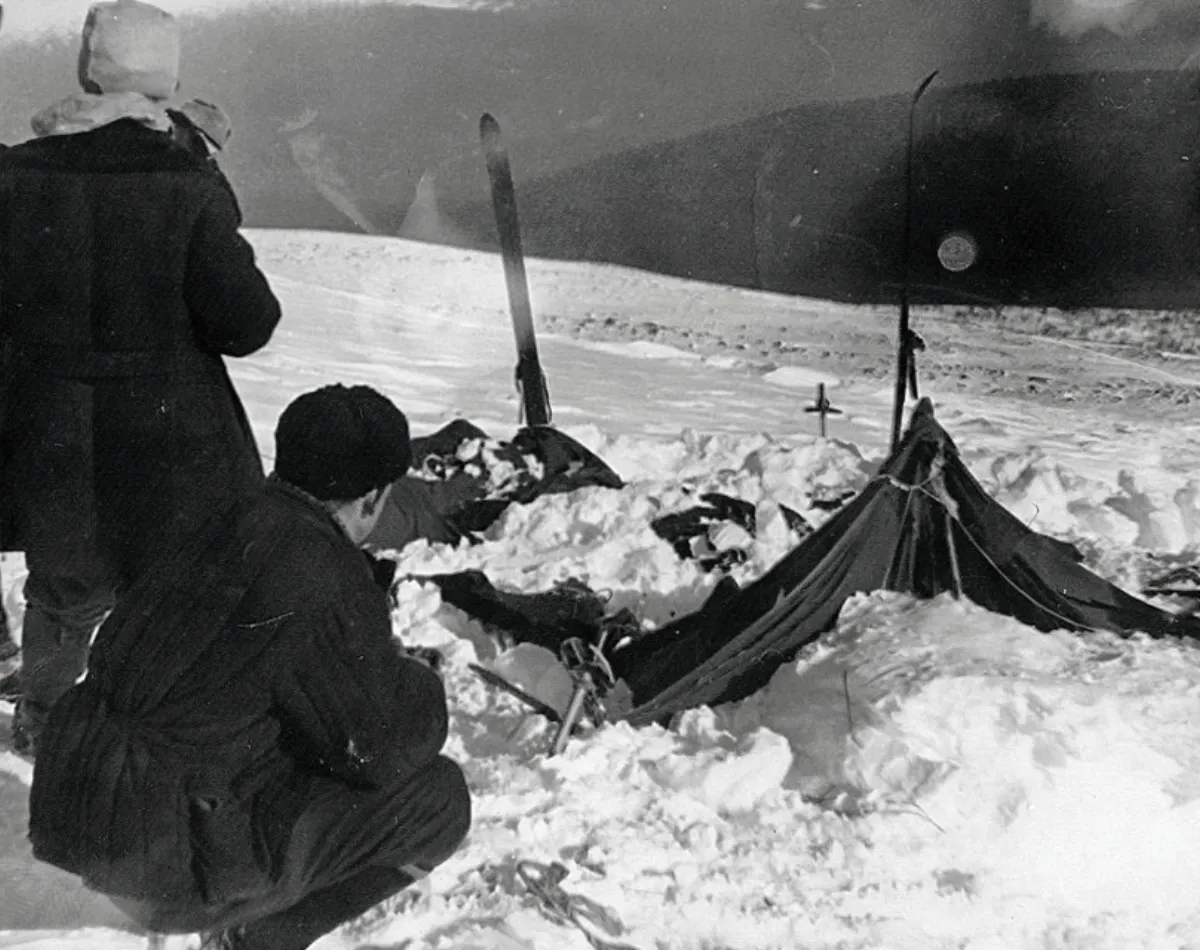
Wikimedia Commons — AnonymousUnknown author / Soviet investigators, Public domain

Background
In January 1959, a group of ten experienced hikers set out from Sverdlovsk (now Yekaterinburg) on an expedition through the northern Urals, aiming to reach the summit of Otorten mountain. The route crossed terrain in a region inhabited by the indigenous Mansi people, who called the area Kholat Syakhl — a name that translates roughly as "Dead Mountain" in local folklore, though its origins are mundane and unrelated to any supernatural history.
The group consisted of students and graduates of the Ural Polytechnic Institute. All were experienced with winter trekking. One member, Yuri Yudin, turned back due to illness early in the journey, becoming the sole survivor. The remaining nine pressed on.
The Expedition
The group set up camp on the eastern slope of Kholat Syakhl on the night of February 1–2, 1959. Based on their diaries and photographs recovered afterward, the journey had been proceeding normally. What happened that night has never been established with certainty.
When the hikers failed to return on schedule, a search party was dispatched. On February 26, rescuers found the tent, partially buried in snow. It had been cut open from the inside, suggesting a rapid, panicked exit. The hikers' belongings — boots, warm outer clothing, food — were still inside. Footprints in the snow led away from the tent toward the tree line.
Discovery of the Bodies
Two of the hikers were found first, near the remains of a small fire in the forest, dressed only in underwear. Three more bodies, including Igor Dyatlov himself, were discovered within a few hundred meters of the tent over the following days, positioned as if they had been attempting to return to it. The remaining four were not recovered until May, when snowmelt revealed them buried beneath several meters of snow in a ravine.
The injuries found on several of the bodies drew particular attention. Two hikers had fractured ribs; one had a crushed skull. One woman was missing her tongue, though investigators attributed this to postmortem decomposition in the water of the ravine. Some of the recovered clothing showed elevated levels of radioactivity, which investigators ascribed to contaminated clothing the hikers had borrowed. The Soviet inquiry concluded that the deaths resulted from a compelling natural force, but the specific mechanism was left unstated.
Theories and Explanations
Because the official investigation left so many questions open, the case has attracted a wide range of proposed explanations over the following decades.
Avalanche has always been among the most scientifically plausible explanations. Proponents argue that a sudden avalanche or snow slab could have struck the tent at night, causing panic and the rapid, disoriented evacuation into the extreme cold. Critics of this theory have historically pointed to the relatively shallow slope of the campsite and the absence of visible avalanche debris in the original photographs.
Katabatic wind, a powerful downslope wind that can descend with great speed and force in mountainous terrain, has been proposed as a cause of hypothermia and disorientation without causing the blunt-force injuries.
Infrasound is a theory suggesting that specific topographical features created low-frequency sound waves capable of inducing panic and psychological distress — sometimes called "fear frequency." This explanation remains speculative and lacks direct physical evidence at the scene.
Military or weapons testing theories have circulated for decades, often pointing to the elevated radiation levels and the severe internal injuries as evidence of an explosion or test nearby. Soviet military activity in the region during the late 1950s is documented, though no specific connection to the Dyatlov group has been established.
Ball lightning, UFOs, and hostile encounters with Mansi people have also appeared in popular accounts but are not supported by credible physical or testimonial evidence.
Recent Scientific Analysis
In 2019, Russian prosecutors reopened the investigation, narrowing their inquiry to three natural causes: avalanche, snow slab collapse, and hurricane-force wind. In 2021, they formally concluded that a slab avalanche was the most likely cause.
Separately, a study published in 2021 in the journal Communications Earth & Environment by researchers from Switzerland and Norway used computer modeling to simulate snow conditions consistent with a delayed slab avalanche on the slope where the tent was pitched. The researchers demonstrated that a relatively small slab of snow, released hours after the group had settled in — potentially after they had cut into the slope to level the tent — could have produced the blunt-force injuries documented on several victims, and would have been consistent with the topography that earlier critics had argued was too gentle for a traditional avalanche. The study did not claim to definitively resolve the case, but provided a mechanism that addressed many of the long-standing objections.
Legacy
The Dyatlov Pass Incident has become a significant reference point in popular culture and in discussions about wilderness survival, Cold War secrecy, and the limits of forensic investigation. The remote mountain pass where the group camped was officially named Dyatlov Pass in the years following the tragedy. The Dyatlov Foundation, established by survivors and relatives, has continued to press for a complete accounting of what happened.
The case has inspired numerous documentaries, books, fictional adaptations, and a dedicated online community of researchers. It illustrates how the combination of incomplete evidence, Cold War opacity, and the inherently dramatic circumstances of the deaths can sustain decades of speculation. Most investigators working from the physical record have converged on natural causes — primarily a rare avalanche event under unusual conditions — while acknowledging that certainty remains out of reach.