
Overview
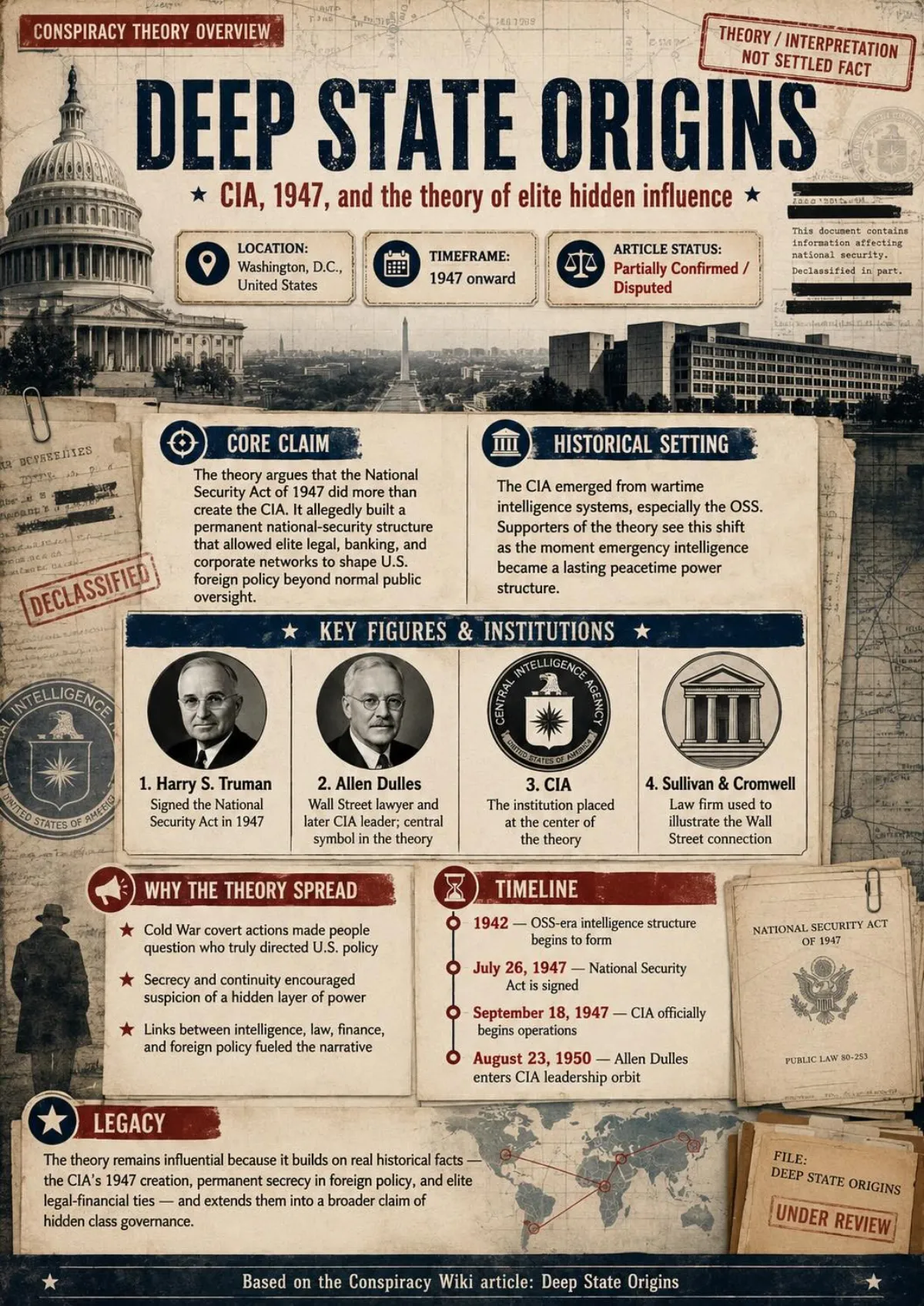
The "Deep State Origins" theory places the birth of the CIA at the beginning of a hidden system of elite foreign-policy control. According to this view, the National Security Act of 1947 did more than create new bureaucratic institutions. It created a structure through which financial and legal elites, especially those connected to eastern corporate law firms and banking networks, could shape policy at a distance from public oversight.
The theory did not emerge only from later cynicism. It drew on visible features of the early national-security state: the rapid growth of permanent intelligence institutions, the prominence of privately connected men in intelligence and diplomacy, and the increasing overlap among law, finance, covert action, and Cold War strategy.
Historical Setting
The CIA was created by the National Security Act of 1947 and grew out of wartime intelligence precedents, especially the OSS and smaller postwar transitional bodies. Officially, the purpose was coordination, evaluation, and centralized intelligence support for national security. In practical and symbolic terms, however, the Act marked the creation of a lasting national-security architecture that outlived wartime emergency.
The theory’s Wall Street component arose from personnel and background. Men who later became central to intelligence, especially Allen Dulles and his wider milieu, had strong ties to elite corporate law and finance. Allen Dulles had worked at Sullivan & Cromwell, and his brother John Foster Dulles moved through the same world. To conspiracy writers, this was not incidental. It meant that the American intelligence system had been seeded with people who carried private class interests into public power.
Central Claim
The core claim was that the CIA’s creation represented a coup in slow institutional form. Rather than an overt overthrow, it was a bureaucratic seizure. Foreign-policy decision-making shifted into a permanent apparatus whose leaders, advisers, and allied networks were closely linked to banking, law, and corporate capital. In this view, elections could change administrations, but not the deeper operational logic of American external power.
Some versions focused narrowly on Wall Street “bankers.” Others widened the category to include lawyers, industrial planners, oil interests, and internationalist policy circles. The common point was that intelligence became a vehicle for class continuity in foreign policy.
National Security Act and Structural Power
The National Security Act itself was public law, openly debated and enacted. The theory therefore did not treat the CIA as a secret institution in origin, but as a publicly chartered shell whose long-term implications were not fully understood. Once intelligence became permanent, secret, and executive-centered, conspiracy writers argued, it became uniquely available to elite capture.
This structure mattered more than any one personality. The deep state in this theory was not one cabal meeting in one room. It was an institutional design that privileged continuity, secrecy, expertise, and access—qualities that often align naturally with elite networks.
Allen Dulles and the Wall Street Reading
Allen Dulles became one of the most important symbolic figures in this theory. His Wall Street background, wartime OSS service, later CIA leadership, and postwar reputation as a master of covert power made him an ideal bridge between finance and clandestine statecraft. Even though he did not create the CIA in 1947 single-handedly, later readers used him as proof that the intelligence state and the world of corporate law were deeply intertwined.
This helped move the theory from generic suspicion to a more concrete social map: Wall Street lawyers become strategists, strategists become intelligence chiefs, intelligence becomes foreign policy.
Why the Theory Spread
The theory spread because later Cold War covert actions encouraged people to ask who truly controlled American policy. Once intelligence agencies were seen influencing coups, elections, propaganda, and alliances abroad, the question of origin became more urgent. The 1947 founding moment then came to look less like administrative housekeeping and more like the installation of a durable hidden layer.
It also spread because official histories themselves often emphasize continuity between the wartime OSS and the later CIA. For those already suspicious of elite continuity, that was enough to suggest that wartime emergency networks had simply been given peacetime permanence.
Legacy
The "Deep State Origins" theory remains one of the most durable narratives about the early Cold War United States. It persists because the CIA really was created in 1947, secrecy really did become a standing feature of foreign policy, and some of the men most associated with its rise did come from elite legal and financial backgrounds. The theory extends those facts into a broader claim: that the national-security state institutionalized a hidden class governance over American foreign affairs.