
The belief
Cigarettes were part of the American war. They went into ration packs, arrived in care parcels, and were handed out by companies competing for the loyalty of men who would be smoking for the next forty years. Lucky Strike ran one of the best-known campaigns of the period, retiring its green packaging with the slogan that Lucky Strike green had gone to war.
Out of that came a suspicion that circulated among servicemen and long afterwards: that the cigarettes issued to soldiers were not ordinary cigarettes. That something had been added — to deepen the habit, to steady the hands, to take the edge off fear, to make men readier to go forward.
No evidence has ever been produced for it. No procurement record, no formulation document, no order, no participant account. The military did not need to chemically modify tobacco to make soldiers smoke; it was supplying free cigarettes to young men under extreme stress in a culture that already regarded smoking as calming and sociable, and that was entirely sufficient.
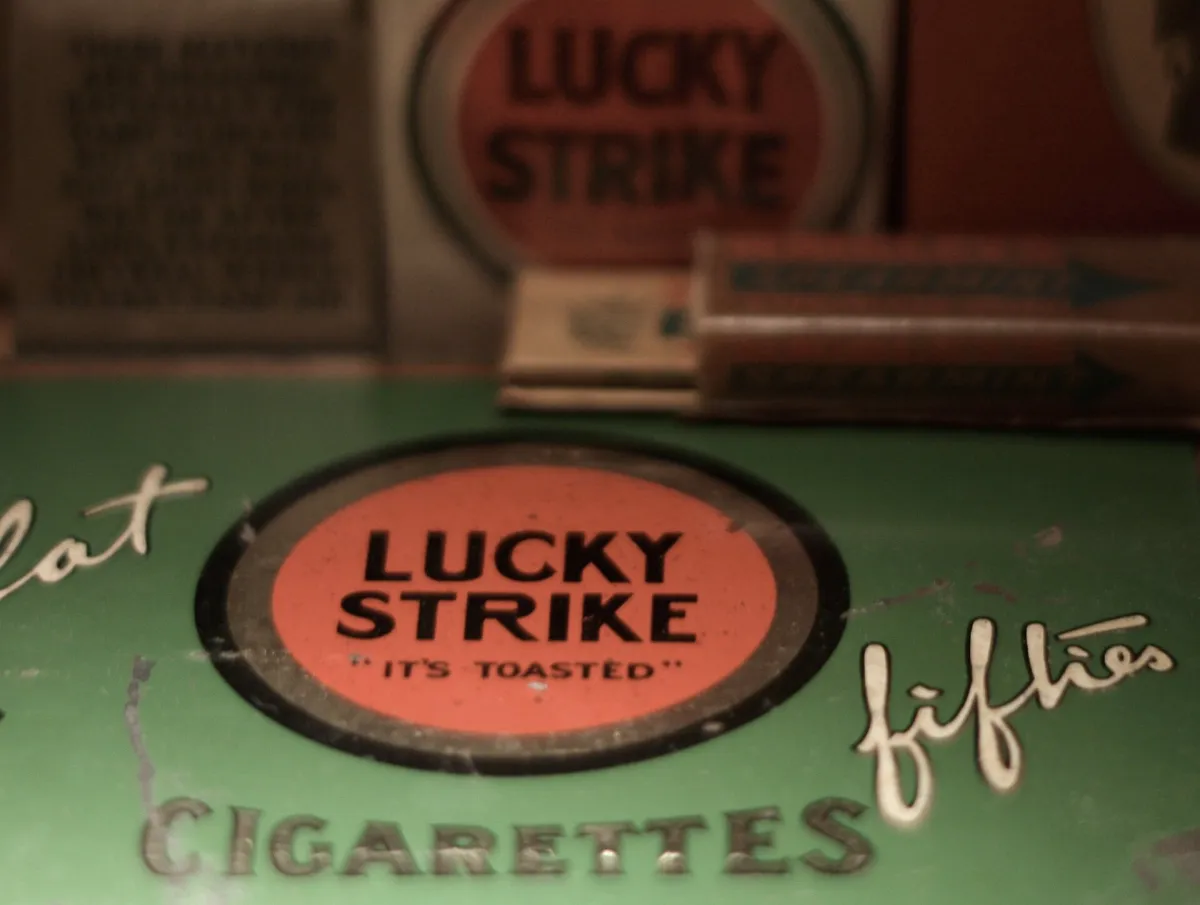
The green tin and the white pack together. Lucky Strike dropped the green in 1942 and sold the change as a wartime sacrifice. The explanation did not survive checking — see below. Wikimedia Commons — nick@, CC BY 2.0
_Baugnez_44_Historical_Center_WW2_museum_2012.jpg)
Why it was a reasonable thing to suspect
It is worth being clear that this was not a foolish belief in 1944.
Soldiers could see that the supply was deliberate and organised. They could see that the companies wanted them. They were being issued a substance that visibly changed how they felt, by an institution that was also issuing them amphetamines in some theatres and that was not in the habit of explaining itself. A man who concluded that the cigarettes had been engineered for the purpose was reasoning from what he could observe.
What he could not observe was that the engineering was real and was happening somewhere else.
The thing that actually was done
The deliberate manipulation of how addictive a cigarette is turns out to be among the best-documented corporate programmes of the twentieth century. It is simply not a wartime military one.
When the State of Minnesota's litigation and then the Master Settlement Agreement forced disclosure, roughly seventy million pages of internal tobacco industry records became public. They are held at the University of California, San Francisco, in an archive that now runs past sixteen million items and is open to anyone.
What those documents establish is that the companies studied nicotine as an addictive drug, understood the dependence they were selling, and controlled the form and the quantity of nicotine their products delivered. The best-known specific is chemistry: ammonia used in the manufacturing process converts nicotine in the smoke toward its free-base form, which is absorbed faster and hits harder at the same nominal nicotine figure. A cigarette can be made more effective at delivering its drug without the number on the packet changing.
That is the thing the theory was reaching for. It was done on purpose, it was documented internally, it was denied publicly for decades, and it was proved in court.
The green pack, which is the whole thing in miniature
There is a documented episode from exactly this period that shows the shape of what was actually going on, and it is the one on the packet.
In 1942 American Tobacco retired Lucky Strike's dark green pack for a white one, under the slogan that Lucky Strike green had gone to war. The explanation offered was material sacrifice: the copper in the green was needed for the war effort.
It was not true. The green ink used chromium; copper went into the gold trim. What the change actually did was modernise the label and make it more appealing to women, who by then were a large and growing part of the market and who market research said did not like the green. Sales rose about forty per cent.
The deception was noticed at the time. The quiz programme Information Please dropped Lucky Strike as a sponsor because listeners complained the advertising was disingenuous.
So here is a tobacco company, during the war, dressing a commercial decision in patriotic language and misstating the material facts to do it. That is real, it is documented, and it is the correct scale and kind of the thing the additive theory was reaching for. Nobody had to alter the tobacco.
Right instinct, wrong institution, wrong decade
The gap between the two is the interesting part of this entry.
The suspicion placed the manipulation in the Army, during the war, for military reasons. The documented version places it in the companies, mostly after the war, for commercial ones. The soldier who thought someone had engineered his cigarette was correct about the engineering and wrong about who, why and when — and the version he believed is unprovable while the version he did not know about is sitting in a searchable public archive.
There is also a real connection between the two, and it is not chemical. The war did more than any advertising campaign could have to establish lifelong smoking in a generation of American men, because the companies got their product into the hands of millions of them for free at the moment they were most likely to start. That was deliberate, it was commercially motivated, and it did not require anything to be added to the tobacco.
Where it stands
No evidence supports the claim that cigarettes issued to American servicemen were chemically altered for military purposes.
The broader intuition behind it — that the addictiveness of a cigarette was a designed property rather than an accident of the plant — is correct, and the proof of it fills an archive. It belongs to the tobacco companies rather than to the War Department, which is less dramatic and considerably better attested.