
Overview
The High-Frequency Active Auroral Research Program — known by its acronym HAARP — is a real ionospheric research facility located near Gakona, Alaska. Constructed in the 1990s through a collaboration between the U.S. Air Force, the U.S. Navy, and the Defense Advanced Research Projects Agency (DARPA), the installation uses a large array of high-frequency radio antennas to study the behavior of the upper atmosphere. Since 2015 the facility has been operated by the University of Alaska Fairbanks as a civilian scientific resource.
Despite its comparatively modest role in atmospheric science, HAARP became one of the most discussed alleged secret weapons in modern conspiracy culture. Proponents of the theory claim the facility is capable of steering the jet stream, manufacturing hurricanes and droughts on demand, triggering earthquakes and volcanic eruptions, and even broadcasting signals that influence human cognition. Scientists and the agencies that built HAARP uniformly reject these claims, arguing the physical energy outputs involved make such effects impossible.
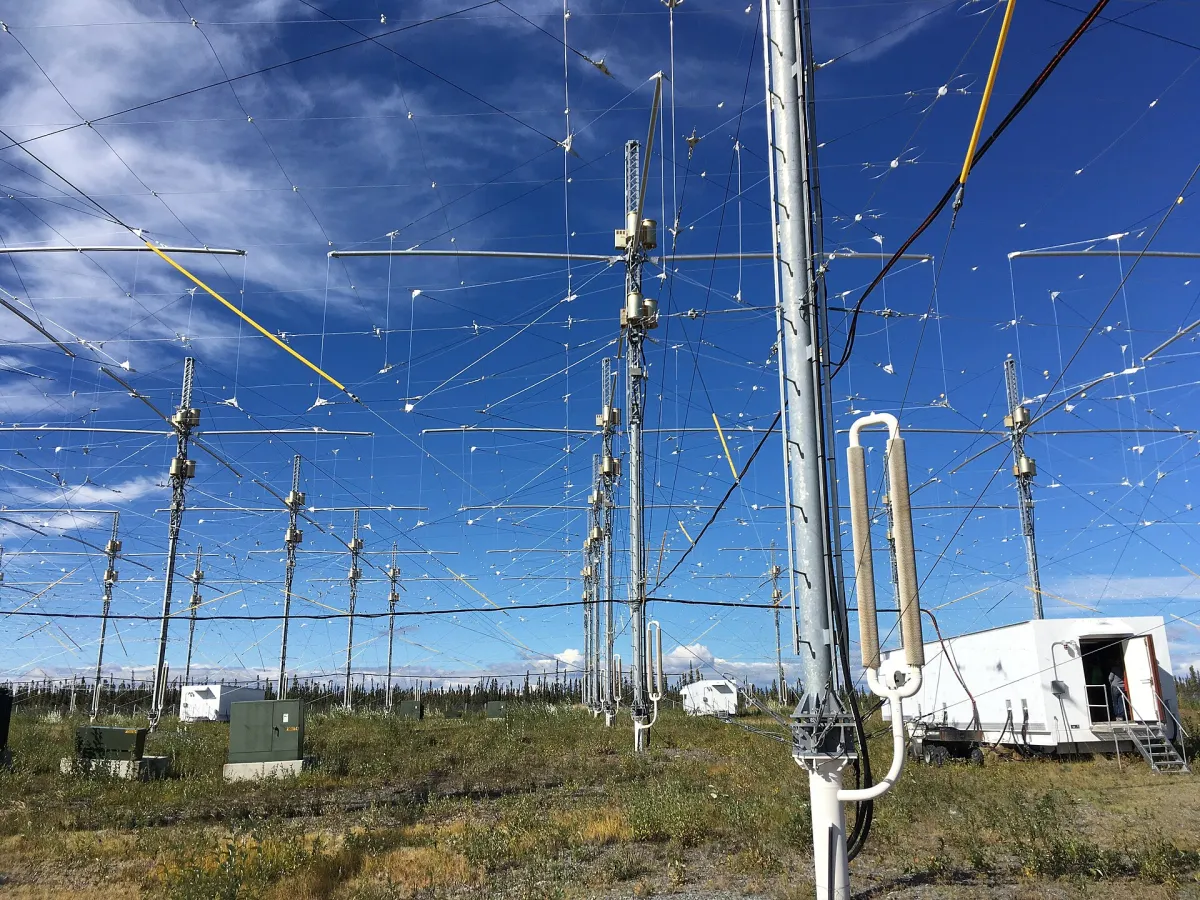
Wikimedia Commons — Secoy, A, CC BY-SA 4.0

Background
Work on HAARP began in the early 1990s and the antenna array gradually expanded over the following decade. The facility's core instrument — the Ionospheric Research Instrument (IRI) — consists of a phased array of high-frequency radio transmitters. The IRI can direct radio energy upward into the ionosphere, a region of the upper atmosphere extending roughly from 48 to 965 kilometers above Earth's surface, where solar radiation ionizes gas molecules. By heating small patches of the ionosphere, researchers can study radio wave propagation, which has practical applications for long-range communications and radar systems.
The program was unclassified from its inception, and the Air Force and Navy published technical specifications, environmental impact assessments, and research findings. Despite this openness, the facility's remote location, its association with military funding, and the sheer unfamiliarity of ionospheric physics made it fertile ground for speculation once the internet began spreading alternative narratives in the mid-1990s.
What HAARP Actually Is
The IRI at HAARP operates at a peak transmitted power of approximately 3.6 megawatts — a figure that sounds large in everyday terms but is dwarfed by the natural energy flows in the atmosphere and the ionosphere. The facility's radio energy is directed skyward and largely absorbed or scattered within a small volume of the upper atmosphere. The heating effect it produces on any given patch of ionosphere is slight and transient, detectable only with sensitive instruments.
Research conducted at HAARP and at comparable facilities worldwide — including the European Incoherent Scatter Scientific Association (EISCAT) radar in Norway and Russia's Sura ionospheric heating facility — has contributed to understanding of plasma physics, space weather effects on satellite communications, and the behavior of natural phenomena like aurora. The University of Alaska Fairbanks hosts visiting researchers and runs periodic public open-house events at the Gakona site.
The Claims
According to proponents of the HAARP weather-control theory, the facility functions as a weapon of environmental warfare. The most widely circulated version of the claim holds that HAARP can superheat sections of the ionosphere to redirect the jet stream — the high-altitude river of fast-moving air that strongly influences surface weather across North America and Eurasia. By bending the jet stream, proponents assert, HAARP's operators can cause prolonged droughts, steer hurricanes toward or away from population centers, and generate catastrophic flooding.
A related set of claims attributes major earthquakes to HAARP activity. Proponents allege that by directing energy into the Earth's crust via the ionosphere, the program can destabilize tectonic faults, triggering seismic events. Following major earthquakes — including disasters in Haiti, Japan, and Turkey — online communities have circulated claims linking unusual ionospheric readings or HAARP operational schedules to the timing of those events.
Some versions of the theory extend to mind control, asserting that HAARP's radio frequencies can be tuned to affect human brain activity across large populations. This variant sometimes overlaps with broader theories about electromagnetic weapons and neurological manipulation. Proponents have also claimed the facility is connected to chemtrail programs, satellite surveillance networks, and various alleged population-control agendas.
The theory gained notable mainstream visibility through books, documentary films, and radio programs in the 1990s and 2000s. Some commentators and political figures in various countries have cited HAARP as evidence of American geophysical warfare capabilities, though without presenting verifiable technical evidence.
Scientific Assessment
Scientists who study the atmosphere, seismology, and plasma physics consistently reject the core claims of the HAARP theory. Their central objection is one of energy scale. The total radio-frequency power output of the HAARP facility is many orders of magnitude smaller than the energy contained in a single tropical storm, let alone the broader atmospheric circulation patterns that drive regional climate. Atmospheric scientists note that the jet stream is driven by temperature differentials across enormous geographic areas, and that no ground-based transmitter operating at HAARP's power level could meaningfully redirect it.
Seismologists similarly note that earthquakes are caused by the movement of tectonic plates — a process governed by forces far exceeding anything a radio antenna array could produce or trigger. No peer-reviewed research has established a physical mechanism by which ionospheric heating could influence fault behavior deep within the crust.
The mind-control variant is rejected on similar grounds: the radio frequencies used by HAARP are not those known to interact with biological tissue in the ways the theory describes, and the signals are directed upward into the ionosphere rather than laterally across the surface.
Legacy
HAARP's transfer to the University of Alaska Fairbanks in 2015 did little to quiet the theories surrounding it. For many proponents, the handover was interpreted as a cover story or a reorganization rather than a genuine change in the facility's purpose. The program remains one of the most durable examples of how real but poorly understood government technology can anchor elaborate alternative narratives.
The HAARP theory also illustrates a recurring dynamic in conspiracy culture: a genuine, unclassified, documented program becomes the focal point for fears about covert power, environmental vulnerability, and technological overreach. Whatever the scientific reality of ionospheric research, the facility's existence has served as a canvas onto which anxieties about climate change, geopolitical conflict, and military secrecy are regularly projected.