
Overview
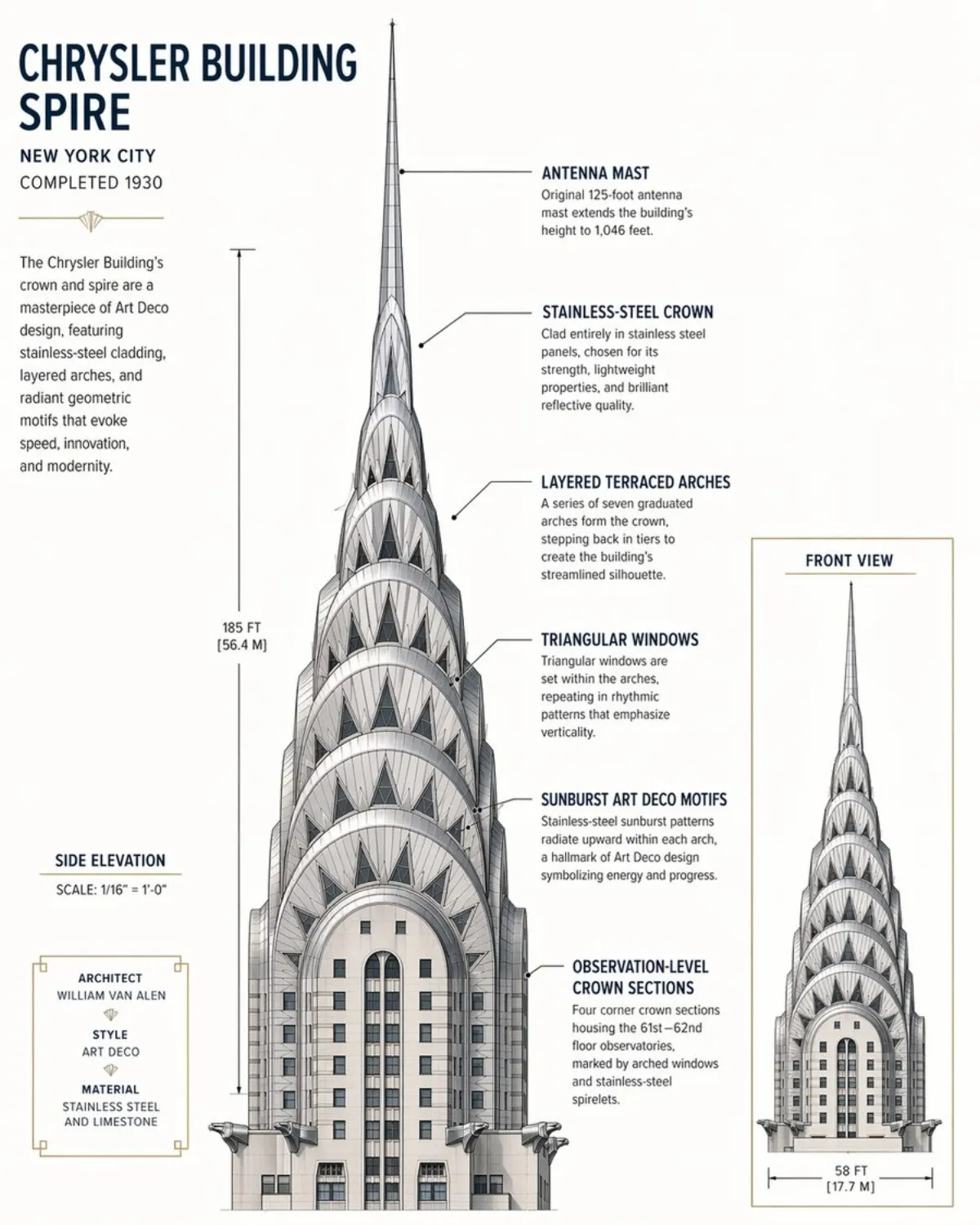
The Chrysler Building’s spire is one of the clearest cases in which architecture generated its own conspiracy theory through appearance alone. The spire was secretly assembled inside the building and then hoisted into place in 1929 to ensure that the Chrysler would surpass its rival, 40 Wall Street, in height. That secrecy created the first layer of mystery.
The second layer came from form. The spire looked like a polished metal instrument rather than a traditional roof feature. In an era obsessed with radio, lightning, electricity, and long-distance transmission, it was easy to imagine the object as functional in ways the public had not been told.
Real Secret Construction
The historical core is well documented. William Van Alen and the Chrysler team concealed the spire’s final assembly from competitors. It was raised into place rapidly, turning the building into the tallest structure in the world at the time. Contemporary publicity around its erection was minimal, which only enhanced later legend.
This hidden assembly became the enabling fact behind the theory. If the spire could be built in secret, perhaps its purpose was secret too.
Death Ray and Jamming Variants
The most extreme version described the spire as a death ray—an energy device capable of projecting destructive force across distance. A more technologically modest variant described it as a radio jammer or atmospheric interference machine, meant either to disrupt signals or to dominate broadcast space.
These variants reflected the same cultural conditions: widespread fascination with invisible energy and a limited public understanding of what very tall metal structures might or might not do. The skyscraper was a new kind of object, and the public often understood it through the language of wonder and weaponry.
Why the Building Attracted Techno-Mystery
The Chrysler Building arrived at the intersection of Art Deco aesthetics and machine-age imagination. It was associated with speed, automobiles, steel, broadcasting, and modernity. Its crown and needle looked like the extension of a machine upward into the sky.
Unlike older towers, it did not evoke church spires or civic domes. It evoked instrumentality. That made it unusually susceptible to theories about hidden technical purpose.
Broadcasting Reality and Rumor Growth
Later use of upper Chrysler spaces for radio and television equipment fed these rumors further. Once broadcasting entered the building’s upper levels, the public could retroactively reinterpret the whole top as a communications apparatus. What had been an ornamental and competitive height element could now be recoded as part of a signal system.
This did not prove the more dramatic theories, but it strengthened them by providing a real communications afterlife for the building’s crown and upper reaches.
Urban Weapon Theory
The death-ray version of the theory also fit broader interwar anxieties about future warfare. Newspapers, science fiction, and popular speculation all entertained the possibility that cities would soon host new forms of directed-energy or remote-control weaponry. A hidden machine at the top of a skyscraper therefore belonged to a wider imaginative environment.
The Chrysler spire became a local, visual, urban version of those expectations.
Historical Significance
The Chrysler Building Spire theory is significant because it shows how secrecy in construction, striking design, and later technical use can combine to generate durable legends of hidden purpose. The object did not need to malfunction or explode. It simply needed to look like a machine and arrive under a veil.
As a conspiracy-history entry, it belongs to the family of techno-architecture theories: claims that iconic buildings conceal operational devices beneath their public decorative explanation.