
Overview
The Apollo 20 hoax is an internet legend that emerged in 2007, centered on the claim that a secret joint American-Soviet crewed mission was launched to the Moon in 1976 — three years after the official Apollo program ended with Apollo 17 in December 1972. According to the story, the mission's purpose was not scientific exploration but covert recovery of an extraterrestrial spacecraft discovered on the lunar far side, along with a preserved alien occupant found inside it. The tale spread rapidly through early video-sharing platforms and conspiracy forums before being exposed as an elaborate fabrication created by a French filmmaker. Despite that exposure, the Apollo 20 narrative continues to circulate and retains a devoted following in UFO enthusiast communities.
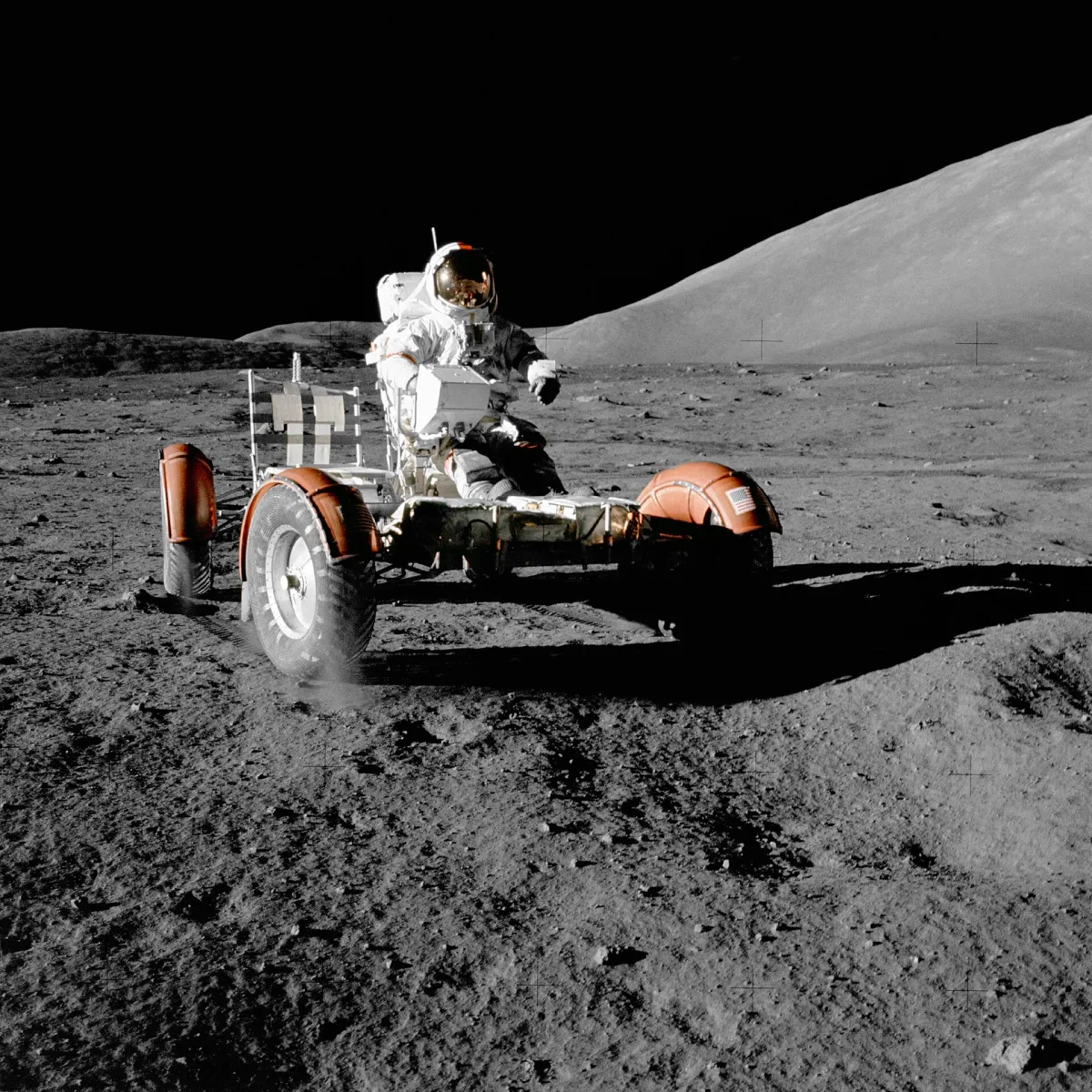
Wikimedia Commons — NASA / Harrison H. Schmitt, Public domain

Background: The Real Apollo Program
NASA's Apollo program successfully landed astronauts on the Moon six times between 1969 and 1972. Three additional missions — Apollos 18, 19, and 20 — were planned but cancelled in 1970, primarily due to congressional budget cuts and a reallocation of resources toward the newly prioritized Space Shuttle program. The cancellations were publicly announced and thoroughly documented in congressional records and NASA administrative files. Apollo 18 hardware was later repurposed for the Apollo-Soyuz Test Project in 1975, a genuine collaborative mission with the Soviet Union that involved docking in orbit but no Moon landing.
This real history of cancelled missions became fertile ground for speculation. The fact that three numbered Apollo missions never flew left an opening that the Apollo 20 legend would eventually fill, grafting an implausible secret mission onto what was, in reality, a mundane story of budget constraints and shifting national priorities.
The Claims
The Apollo 20 story coalesced around a series of videos uploaded to YouTube in 2007, purportedly showing footage from a clandestine mission. According to the narrative put forward in those videos and accompanying online posts, Apollo 20 was launched from Vandenberg Air Force Base in California — a detail proponents sometimes point to as significant, since Vandenberg hosted military satellite launches — and carried a joint American-Soviet crew. The mission's target, as the legend holds, was a massive cigar-shaped spacecraft of clearly non-human origin that had been spotted in photographs taken during the Apollo 15 mission in 1971. Proponents claim that the object, sometimes called the "Mona Lisa" or referred to by similar names in various retellings, was visible in official NASA imagery and had been the subject of secret government analysis for years before the supposed retrieval mission was approved.
The most widely circulated element of the legend involves the alleged discovery inside the derelict alien craft of a preserved humanoid figure, described as female in appearance, in a state of suspended animation or mummification. Videos purporting to show this figure were presented as genuine mission footage smuggled out by a whistleblower. Alongside the figure, proponents claim the crew recovered alien technology that was then transferred to classified facilities for study. The legend also asserts that the Soviet government's participation was kept secret from the public of both nations, supposedly part of a broader framework of covert space cooperation that existed beneath the surface of the openly adversarial Space Race.
Origins and Exposure
The videos were uploaded under a username associated with a person who identified himself as William Rutledge, claiming to be a retired American astronaut who had participated in the mission and was coming forward decades later. He described the mission in detail across numerous forum posts and video uploads, lending the story a veneer of firsthand authority.
Investigative work by journalists, amateur researchers, and visual effects professionals fairly quickly established that the footage was fabricated. The individual behind the uploads was identified as Thierry Speth, a French artist and filmmaker. Speth subsequently acknowledged creating the material, describing the project as a work of artistic fiction and a deliberate experiment in viral storytelling rather than a sincere attempt to deceive anyone about historical events. The footage was produced using a combination of computer-generated imagery and physical props, with some elements composited onto genuine NASA Apollo photography to increase its apparent authenticity. Speth's own descriptions of the project over time have varied in tone, sometimes emphasizing the artistic dimension and at other times remaining evasive, which has inadvertently fueled continued speculation in some corners of the internet.
Evidence and Skepticism
No credible evidence supports any aspect of the Apollo 20 mission as described in the legend. NASA's budget allocations, launch manifests, and personnel records for the mid-1970s are extensively documented and show no trace of a crewed lunar mission in 1976. The Soviet space program's records, many of which have become accessible since the end of the Cold War, similarly contain nothing corroborating a joint Moon landing during this period. Vandenberg Air Force Base, while used for military orbital launches, has never been configured with infrastructure suitable for launching a crewed lunar mission, a fact noted by aerospace analysts who examined the claim.
The Apollo 15 photographs that proponents cite as showing the alien spacecraft are genuine NASA images. However, the object identified in them is consistent with a natural geological formation — a ridge, crater rim, or rockfall feature — and has been examined by independent image analysts who found no basis for the extraterrestrial interpretation. No evidence supports the existence of a "Mona Lisa" figure or any recovered alien technology.
Legacy
Despite its thoroughly documented origins as a creative fabrication, the Apollo 20 story has proven remarkably durable. It circulates widely on social media and UFO-focused platforms, often stripped of any account of how it was made. The legend appeals to several persistent themes in conspiratorial thinking: the idea that governments routinely conduct secret space operations hidden from the public, that evidence of extraterrestrial contact has been recovered and suppressed, and that photographic evidence of alien structures exists in plain sight within official archives.
The Apollo 20 hoax is frequently cited in discussions of how internet-era misinformation spreads and how creative fiction can be mistaken for historical disclosure. It also illustrates the way genuine historical ambiguity — in this case, the real cancellation of Apollo missions 18 through 20 — can provide a scaffolding onto which elaborate invented narratives are constructed. Researchers who study conspiracy culture point to it as an example of a "hoax within a hoax," a fabrication that was acknowledged by its creator yet continues to be treated as suppressed truth by a subset of believers.