
Overview
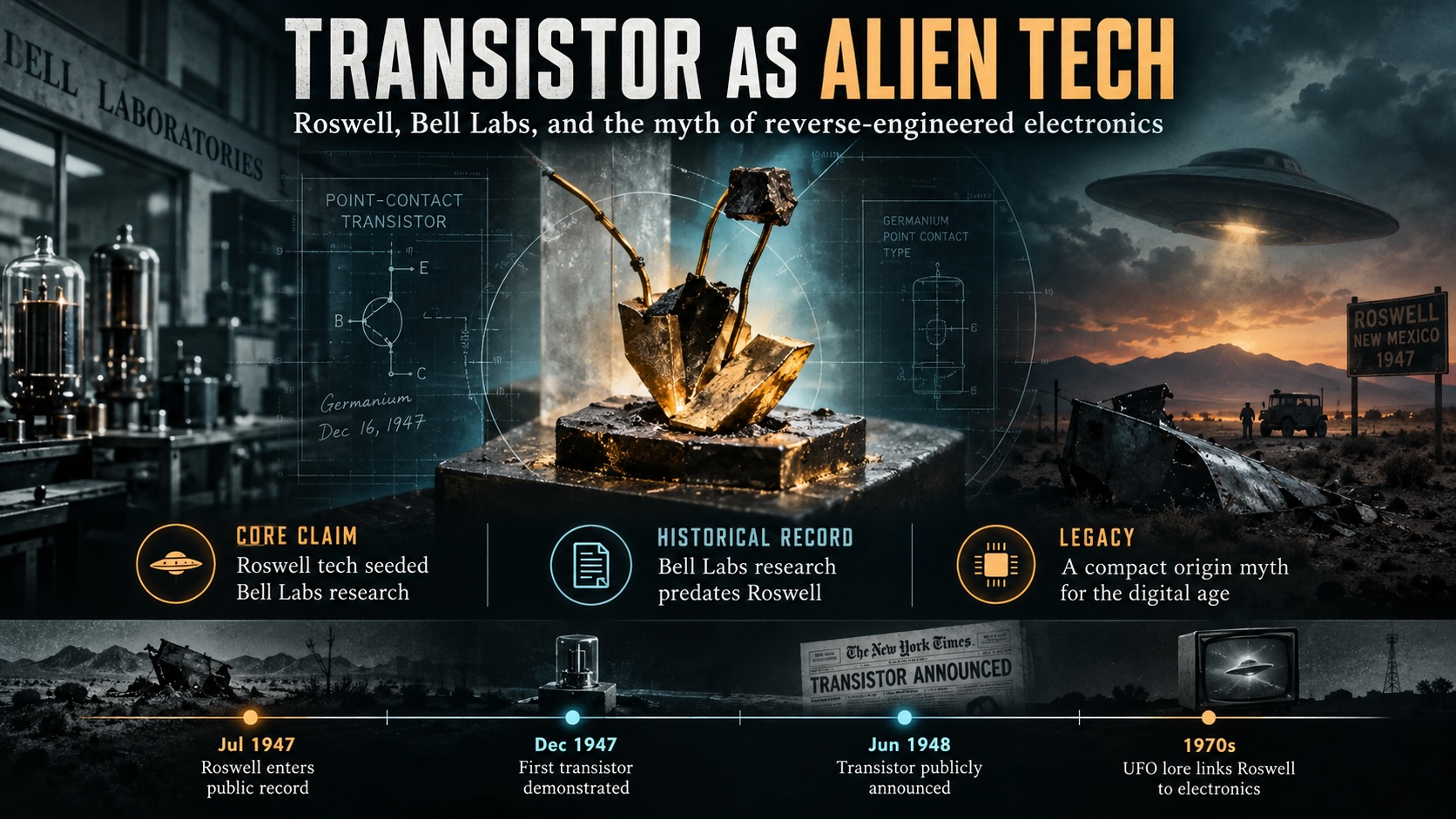
The “Transistor as Alien Tech” theory places the birth of modern electronics inside the mythology of crash retrieval and reverse engineering. Rather than treating the transistor as a landmark of twentieth-century industrial research, it treats it as the first civilian release of recovered off-world science.
Historical Context
The timing invites speculation. The Roswell incident occurred in July 1947, and the first transistor was demonstrated at Bell Labs in December 1947. For conspiracy culture, the closeness of those dates seemed to demand explanation.
The historical record at Bell Labs, however, describes a research program already underway before Roswell. John Bardeen, Walter Brattain, and William Shockley were working on semiconductor physics and solid-state amplification problems as part of a broader attempt to replace vacuum tubes. Computer History Museum histories emphasize that the first successful point-contact transistor emerged from this existing Bell Labs effort and was publicly announced in 1948.
The alien-tech theory emerged later, especially as Roswell became central to postwar UFO mythology. In that environment, major post-1947 technological advances—including transistors, integrated circuits, fiber optics, and stealth—were often reimagined as derivative of recovered craft.
Core Claim
Roswell debris or concepts were handed to Bell Labs
Believers argue that materials or design principles from the Roswell recovery were quietly distributed to elite research institutions.
The transistor was too revolutionary to be ordinary
The leap from hot, bulky vacuum tubes to compact semiconductor switching is treated as a discontinuity beyond normal human progress.
Bell Labs served as the civilian release mechanism
In the theory, Bell Labs did not invent the transistor so much as translate and mainstream something already obtained elsewhere.
Why the Theory Spread
The dates were symbolically perfect
Roswell and the transistor both belong to 1947, making chronological association unusually tempting.
Bell Labs already had an aura of hidden genius
The institution’s prestige and industrial secrecy made it easy to cast as a place where extraordinary technologies could be quietly introduced.
Roswell mythology colonized postwar invention history
Once Roswell became a central explanatory myth for advanced technology, the transistor fit naturally into that framework.
Documentary Record
The documentary record strongly supports Bell Labs’ internal research path to the point-contact transistor and the December 1947 demonstration by Bardeen and Brattain. Computer History Museum and Bell Labs histories preserve a detailed research chronology that predates the Roswell incident.
The public record does not support the claim that alien technology recovered at Roswell was transferred to Bell Labs or used in the transistor’s invention. That claim belongs to later UFO-technological mythology rather than to the documented history of semiconductor research.
Historical Meaning
This theory matters because it is one of the clearest examples of UFO culture absorbing mainstream technological history. Instead of asking whether alien craft were recovered, it asks whether modern civilization itself is built on that recovery.
Legacy
The transistor theory remains influential because it offers a compact origin myth for the entire digital age. If the transistor is alien, then every later computer, chip, and network becomes part of the same hidden lineage.