
Overview
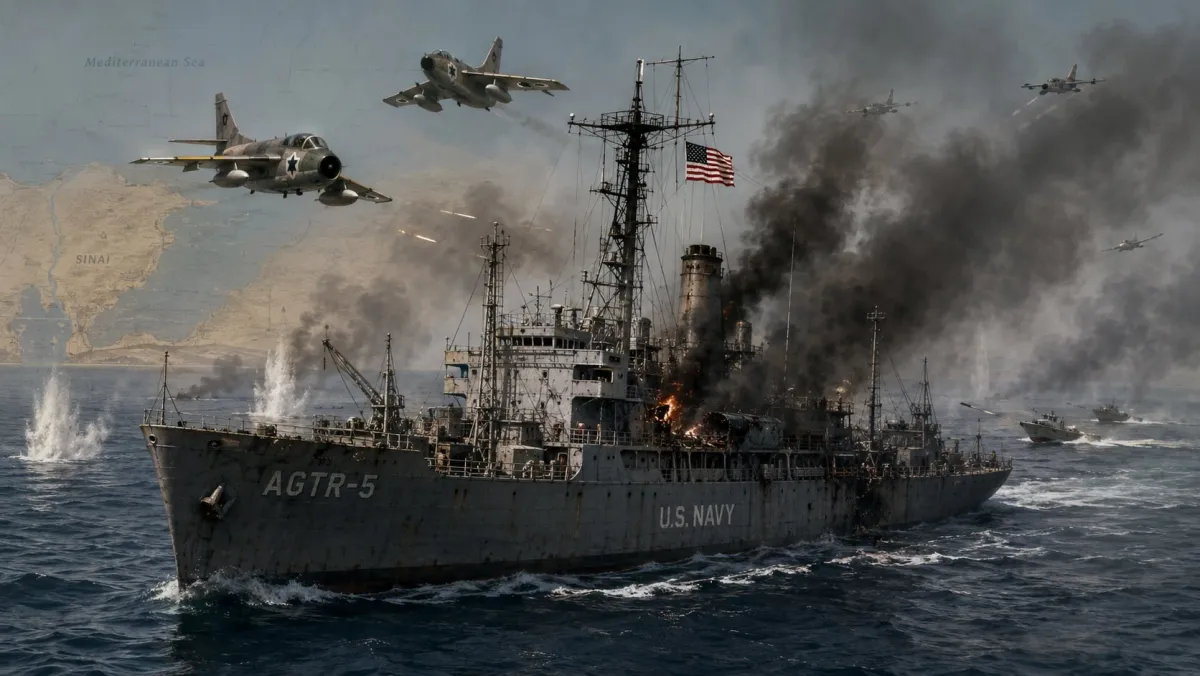
The USS Liberty incident refers to a sustained military attack on the American signals intelligence vessel USS Liberty (AGTR-5) by Israeli air and naval forces on June 8, 1967, during the Six-Day War. The attack left 34 American sailors dead and approximately 171 wounded, making it one of the deadliest attacks on a U.S. Navy vessel during peacetime. The Israeli government and the official U.S. government position have maintained that the attack resulted from a tragic case of mistaken identity, with Israeli forces wrongly believing the ship to be an Egyptian vessel. Survivors, their advocates, and a number of current and former officials have long disputed this explanation, arguing that the attack was deliberate. The controversy has persisted for decades, fueling ongoing historical, legal, and political debate.
Background
The USS Liberty was a converted cargo ship pressed into service as a signals intelligence (SIGINT) collection vessel. In early June 1967, as war broke out between Israel and neighboring Arab states, the ship was ordered to the eastern Mediterranean to monitor communications in the region. The vessel was operating in international waters off the northern Sinai coast, approximately 25 nautical miles from the Egyptian shoreline, when it was attacked.
At the time, the Six-Day War was in full swing. Israeli forces were engaged in rapid, decisive combat on multiple fronts against Egypt, Jordan, and Syria. The Liberty flew a large American flag and its hull markings clearly identified it as a U.S. Navy ship. It was a slow, lightly armed vessel with no offensive capability. American and Israeli forces were ostensibly allies, with the United States maintaining a policy of informal support for Israel during the conflict.
The Attack
Shortly after 2:00 PM local time on June 8, 1967, Israeli aircraft — initially unmarked jets, later identified as Mirage III fighters — began attacking the Liberty. The aircraft made multiple passes, strafing the ship with cannon fire and rockets. Torpedo boats subsequently closed in and fired several torpedoes; one struck the ship's port side, tearing open a large hole and killing a number of sailors in the spaces below decks. During the assault, crew members reported that Israeli forces also shot at life rafts deployed in the water.
The Liberty's crew attempted to signal distress and identify themselves as a U.S. vessel during the attack. American aircraft were launched from a nearby carrier to render assistance but were recalled before reaching the scene. The attack lasted approximately 75 minutes. The Liberty remained afloat, badly damaged, and was eventually escorted to Malta for emergency repairs. In total, 34 crew members were killed and approximately 171 were wounded, many seriously.
Official Investigations
The United States and Israel each conducted investigations in the weeks and months following the attack. The U.S. Navy's Court of Inquiry, convened rapidly and under significant time constraints, concluded that the attack had been a case of mistaken identity. Israeli investigations reached similar conclusions, asserting that reconnaissance aircraft and torpedo boat commanders had misidentified the Liberty as an Egyptian horse transport vessel. Israel subsequently apologized and paid compensation to the families of the dead and wounded, as well as a settlement to the U.S. government for damage to the ship.
Critics of these official findings have challenged both the process and the conclusions. The U.S. Court of Inquiry was completed in less than a week, a timeline that several legal and military observers have described as unusually brief for an incident of this magnitude. The classified portions of the investigation remained sealed for years. Congressional calls for a more thorough inquiry were not acted upon for decades. The National Security Agency, whose mission overlapped significantly with the Liberty's intelligence-gathering role, kept relevant records classified for many years.
The "Deliberate Attack" Debate
The claim that the Israeli attack was intentional — rather than a tragic error — has been advanced by a significant number of Liberty survivors, several retired U.S. military and intelligence officers, and some former government officials. Those who dispute the mistaken identity explanation point to a range of factors: the ship's large and clearly displayed American flag, its distinctive silhouette unlike any Egyptian vessel, the duration and close-range nature of the assault, the targeting of life rafts, and what survivors describe as repeated low-altitude overflights by Israeli aircraft in the hours before the attack that would have allowed clear identification.
Advocates of this position have argued that Israel had reason to want its communications monitored as little as possible during a period of rapid battlefield operations, particularly regarding events near the town of El Arish where allegations of prisoner killings were later raised. Some former officials, including a former Chairman of the Joint Chiefs of Staff, have been quoted in various accounts expressing doubt about the accidental explanation, though the precise language and context of such statements has itself been a matter of dispute.
Defenders of the official account — including the Israeli government and some American analysts — counter that military misidentification is not unusual in the fog of combat, that procedural failures and poor communication contributed to the tragedy, and that no credible documentary evidence of a deliberate order has emerged from Israeli archives. They note that Israel had little strategic motive to attack a U.S. ship and significant reasons to avoid such an act.
The debate has been complicated by the long-term classification of relevant documents on both the American and Israeli sides, and by the inherently contested nature of witness testimony gathered years or decades after the event.
Legacy
The USS Liberty incident occupies an unusual and contentious place in American military and diplomatic history. Survivors organized as the USS Liberty Veterans Association and spent decades pressing for a fuller congressional investigation, which was never granted. The ship itself was eventually decommissioned and sold for scrap. A memorial to those killed stands at Arlington National Cemetery.
The incident has become a touchstone in broader discussions about the U.S.-Israel relationship, the limits of military accountability, and the handling of sensitive diplomatic events. It is frequently cited in debates about government transparency and the treatment of veteran communities whose accounts conflict with official narratives.
For conspiracy researchers and historians alike, the Liberty case illustrates how a contested historical event can remain unresolved for generations when official inquiries are perceived as incomplete and classified records are withheld from public review. Whether the attack was a catastrophic misidentification or something more sinister remains, for many, an open question — one that the available public record has not settled to the satisfaction of those most directly affected.