
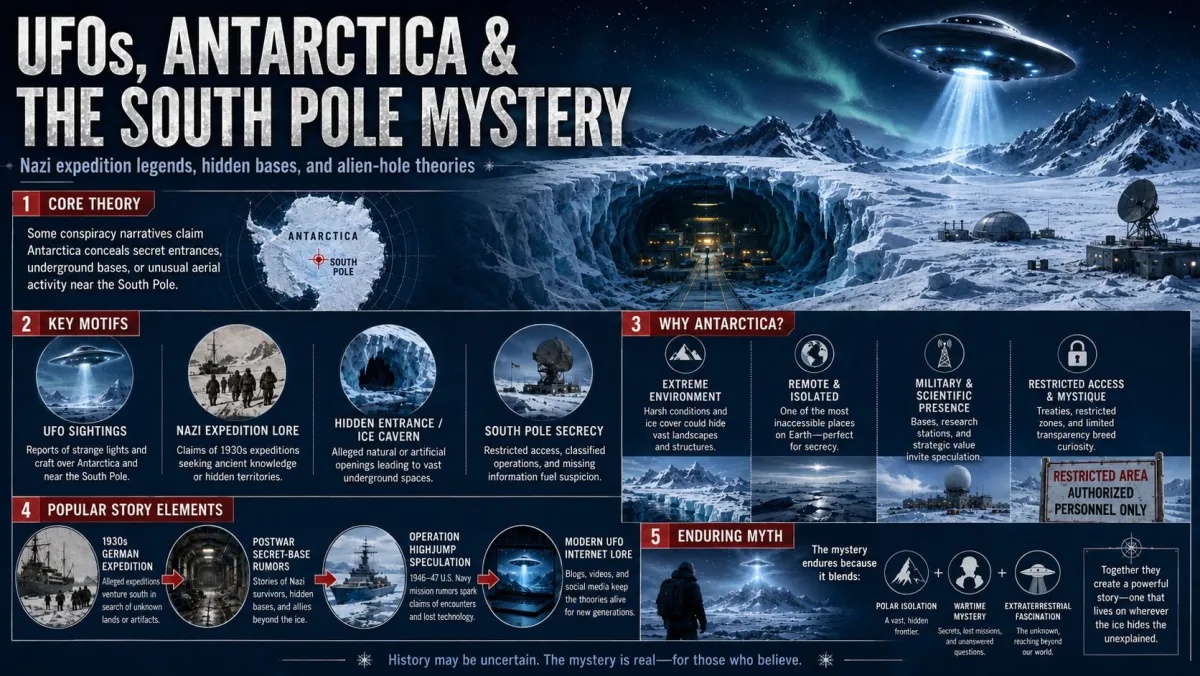
What the expedition was for
The German Antarctic expedition sailed from Hamburg on 17 December 1938 aboard a vessel named Schwabenland and was home by 12 April 1939. It went because of margarine.
That is not a joke at its expense. Whaling in the 1930s supplied oil, lubricants, glycerine for the nitroglycerine in explosives, and edible fats, and Germany's stake in it was large: a fleet of fifty whale-catchers and seven factory ships, which took 492,532 barrels of oil in the 1938–39 season alone. The fleet worked off a coast the Norwegians had discovered, and the German government wanted to know whether it could claim territory there or site a shore station of its own. The expedition was reconnaissance for a whaling base.
What it achieved was real and considerable. Flying in good weather between 5°W and 15°E, its aircraft mapped some 250,000 square kilometres by oblique photography and found a mountain range more than 800 kilometres long and 3,000 metres high, lying about 200 kilometres inland, which the Norwegians had missed. The Germans named the area Neuschwabenland, planted flags at a few points on the coast, and dropped swastika flags from the air over the interior as the basis of a claim.
The claim was never made. Norway had formally claimed the region on 14 January 1939, while the expedition was still in the south, and Germany appears to have let the matter drop; shortly after Schwabenland returned, planning turned instead toward an unclaimed stretch of the Pacific sector. Berlin announced the expedition's results publicly on 9 March 1939.
Two follow-up expeditions were planned, for 1939–40 and 1940–41, and either might have built something. Neither sailed, because the war began. Colin Summerhayes and Peter Beeching, searching for the 2007 study that remains the standard account, could find no German document indicating any activity in Dronning Maud Land after Schwabenland at any point during the Second World War.
The first Germans to stand in Dronning Maud Land did so after 1959, as guests of a Russian expedition to the Schirmacher Oasis.
Two submarines in Argentina
The refuge story does not begin in Antarctica. It begins at a naval base in Argentina.
Early on 10 July 1945, two months after the German surrender and ten weeks after Hitler's death, the U-boat U-530 put into Mar del Plata. Its captain, Leutnant Otto Wermuth, seems to have expected a welcome. His arrival instead produced a frenzy of speculation that the boat had carried Hitler, Eva Braun and Martin Bormann out of Germany and landed them in Patagonia — or at a "New Berchtesgaden" in Antarctica.
On 16 July, six days later, a Hungarian exile in Argentina named Ladislas Szabo published a detailed account of Hitler's flight and his hiding place in Dronning Maud Land in the Buenos Aires paper La Critica. It went round the world inside a week: the Toronto Daily Star ran it on 18 July 1945 under the headline "Hitler's on Ice in Antarctic." When U-977 arrived at Mar del Plata on 17 August under Oberleutnant Heinz Schaeffer, the story had its second boat.
Both crews became prisoners of war and were interrogated by the Argentine, United States and Royal Navies, with the interrogators specifically pursuing whether senior Nazis had escaped by submarine. They concluded that the boats' late arrival was innocuous, and the men were released. The 2007 study's finding on the central physical question is blunt: neither submarine could have reached Antarctica.
So the Antarctic refuge was in print within a week of the first U-boat docking, written by a journalist in Buenos Aires, before anyone had looked at anything.
Operation Highjump, and what it was for
Operation Highjump is the part of the story that looks most like evidence, because its scale is genuinely startling.
It was the largest expedition ever sent to Antarctica: just over 4,700 men, 33 aircraft and 13 ships, including the icebreaker Northwind, the aircraft carrier USS Philippine Sea and the submarine USS Sennet. Admiral Chester Nimitz authorised it on 26 August 1946. Rear-Admiral Richard H. Cruzen commanded it, with the retired Rear-Admiral Richard Byrd as Officer-in-Charge of the Project. It was classified confidential.
Its stated objectives, in the Navy's own 1947 report, begin with training personnel and testing equipment in frigid conditions, and continue with consolidating and extending American sovereignty over as much of the continent as was practicable. The study's conclusion about the purpose behind that is specific and, once stated, fairly obvious: Highjump was preparation for a possible war with the Soviet Union in the Arctic. Antarctica was the only place to practise.
Three details close off the battle reading:
Byrd's own flying was confined to the Ross Sea region and the South Pole, roughly 2,000 kilometres from Dronning Maud Land. No American forces landed anywhere near Dronning Maud Land. And the single aircraft lost during the whole operation came down at 71°22′S, 99°20′W — on the opposite side of the continent from the alleged base.
The admiral's warning
The strongest-sounding piece of evidence in the whole theory is a line attributed to Byrd himself. In the version that circulates, he warned that "in case of a new war the continental United States would be attacked by flying objects which could fly from pole to pole at incredible speeds."
The source is a real interview. Lee Van Atta, a reporter who had been on Highjump, filed it for International News Service, and it ran in El Mercurio of Santiago on 5 March 1947. The Spanish text translates as this:
Admiral Richard E. Byrd warned today that the United States should adopt measures of protection against the possibility of an invasion of the country by hostile planes coming from the polar regions. The Admiral explained that he was not trying to scare anyone, but the cruel reality is that in case of a new war, the United States could be attacked by planes flying over one or both poles… I have to warn my compatriots that the time has ended when we were able to take refuge in our isolation and rely on the certainty that the distances, the oceans, and the poles were a guarantee of safety.
Planes. Byrd was making the standard strategic argument of 1947 — that the polar great-circle routes had abolished America's distance from everybody else, which is the same anxiety that produced the DEW Line a decade later. The quotation about flying objects moving pole to pole at incredible speeds first appears in a 1975 book by Mattern and Friedrich, and the 2007 study calls it at best a bad translation and at worst a deliberate one.
The same 1975 book faked a photograph of a flying boat landing in the Schirmacher Oasis — the one place in Dronning Maud Land Germans would eventually reach, three decades later, with the Russians.
And there is a final turn. One later author, Joseph Farrell, reprinted the original Spanish alongside the English mistranslation in his own book. The correction has been sitting next to the error, on the same page, for readers who compared them.
Atom bombs and the SAS
Two further pieces get folded in.
In 1958 the United States did detonate three nuclear weapons in the general region, in a classified operation called Argus. They went off over the ocean, more than 2,000 kilometres north of Dronning Maud Land, at high altitude — the experiment was about trapped radiation belts, not about ice.
Britain did run a secret Antarctic operation during the war: Tabarin, from 1943, which established bases on the Antarctic Peninsula and the islands west of it. Men with Special Air Service backgrounds were in the region. British wartime interest, however, did not extend across the Weddell Sea to Dronning Maud Land, a thousand kilometres east, and the study found that the SAS men present at the time were there in civilian jobs. The later claim that the SAS assaulted a German base around Christmas 1945 has nothing behind it.
Why it holds together anyway
Every anchor is real, which is what gives the theory its unusual durability. A secret German expedition did go to Dronning Maud Land intending, among other things, to establish a base. Britain did mount a classified Antarctic operation. Two U-boats did turn up in Argentina after the surrender. The United States did send a fleet and classify the planning. Three nuclear weapons were secretly detonated in the region. Each of those is a fact, and each was obscure for years.
The theory's method is to treat the gaps between them as a single concealed thing. The 2007 study is candid about why that is hard to refute outright, and the candour is worth quoting rather than paraphrasing: absence of evidence is not evidence of absence, and perhaps there were cover-ups, and perhaps they succeeded. What the authors could do instead was check each link — the submarines' range, the location of Byrd's flights, the coordinates of the one lost aircraft, the altitude and position of the Argus shots, the day jobs of the SAS men in the Peninsula, and the Spanish in the newspaper.
What the record supports
Germany surveyed part of Dronning Maud Land from the air in early 1939 looking for a whaling station, named it, claimed nothing, and never returned during the war. Two submarines surrendered in Argentina in 1945 and had not been near the ice. The United States ran a very large cold-weather military exercise in 1946–47 on the other side of the continent, and its commander warned the press about bombers.
No base has been located in sixty years of continuous scientific occupation of Antarctica by a dozen countries, including on the ground in Neuschwabenland. No document in the German archives describes one. The photograph was made in 1975, and the admiral was talking about aeroplanes.