
Overview
The Flat Earth Antarctic Wall theory fused old cosmological models with modern geopolitical imagination. Its basic map described the Earth as a plane ringed by ice. Its modern conspiratorial form added enforcement: the edge was said to be blocked, hidden, or guarded by powerful institutions.
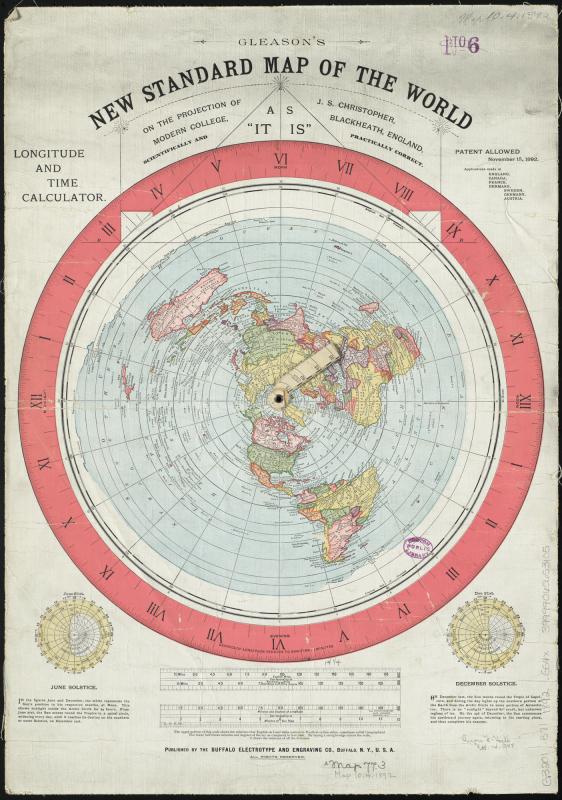
Wikimedia Commons — Norman B. Leventhal Map Center at the BPL, Public domain
.jpg)
Historical Context
The belief that the world exists as a disk bounded by ice was not invented in the twentieth century. Nineteenth-century flat-earth revivalists, especially those descending from Samuel Birley Rowbotham, described a circular Earth with the North Pole at the center and a wall of ice around the outer edge.
In the United States, Wilbur Glenn Voliva helped keep these ideas visible in the early twentieth century through preaching and broadcasting in Zion, Illinois. By the 1930s, flat-earth belief had a recognizably modern public face even if it remained marginal.
Core Claim
Antarctica is the perimeter, not the bottom
Believers say Antarctic ice is not one continent among others but the outer wall holding the oceans in place.
Access is controlled
The theory claims explorers do not travel freely to the true edge and that official expeditions operate under restrictions.
Naval force proves concealment
Later versions argue that military or scientific operations in the polar south show that states are guarding the boundary rather than studying a continent.
Historical Development
Religious flat-earth revival
Voliva-era preaching gave the theory a platform, linking cosmology to scriptural authority and anti-modern polemic.
Cartographic persistence
Older disk-and-ice-wall diagrams remained available and reusable long after mainstream science rejected them.
Postwar Antarctic operations
Operation Highjump and other twentieth-century Antarctic missions provided large, visible state activity that could be reinterpreted as perimeter enforcement.
Historical Assessment
The documentary record supports the existence of modern flat-earth revivalism and of real American military operations in Antarctica. The claim that U.S. Navy warships guarded the edge of the world is the conspiratorial overlay placed on top of those facts.
Legacy
The Antarctic wall narrative became one of the most durable modern flat-earth motifs because it combined a simple visual model with a convenient answer to the question of why ordinary people cannot inspect the alleged edge themselves: they are being prevented from doing so.