
Overview
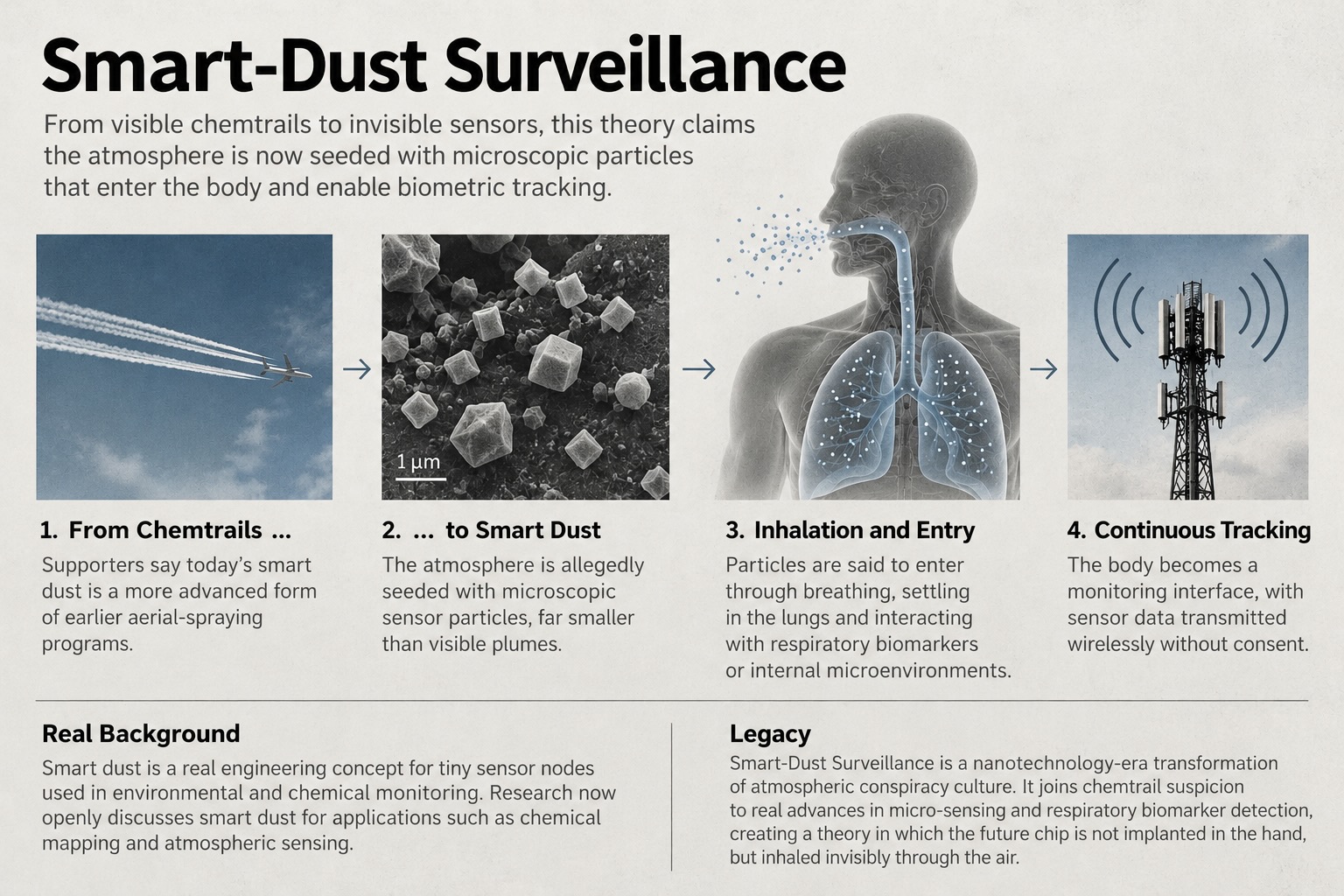
This theory holds that the age of visible chemtrails has given way to something quieter. Rather than large chemical plumes, its proponents say the atmosphere is being seeded with microscopic sensor particles small enough to be breathed in, turning the lungs into a monitoring interface and removing any need for an implantable chip.
From Chemtrails to Smart Dust
The theory updates older aerial-spraying narratives rather than replacing them. Supporters argue that the earlier language of chemtrails was too crude for a surveillance era built on miniaturization. Smart dust offers a vocabulary that fits better: wireless sensing, devices below the threshold of sight, tracking that leaves nothing behind to find.
That framing is what gives the theory its momentum. Each new result in miniaturised sensing arrives already looking like confirmation, because the theory was written to accommodate whatever came next.
What Smart Dust Actually Is
Smart dust is not a rumour. It is a research program with a paper trail, and most of that trail runs through one laboratory.
The term was coined by Kristofer Pister, an electrical engineering professor at the University of California, Berkeley. Working with Joseph Kahn and Bernhard Boser, Pister submitted a proposal under DARPA solicitation BAA 97-43 in 1997, listing himself as point of contact at 497 Cory Hall and the total funds sought as $2,950,000. DARPA’s Microsystems Technology Office took the work up under its MEMS program, the project held its kickoff in June 1998, and it finished in 2001.
The proposal defines the subject in a single line: “Smart Dust: millimeter scale sensing and communication platforms.” Each system was to consist of one or more data receivers and hundreds to thousands of sensor nodes. A single node is called a dust mote, and the document specifies what goes into one.
Power would come from a solar cell array, a thick film battery, or a commercial hearing aid battery. The sensors would be MEMS devices chosen from a named set: vibration, temperature, barometric pressure, sound, light, magnetic field. Circuits would handle the analog interface, analog-to-digital conversion, memory and control. Size was expected to range from one cubic millimeter for a mote with solar cells and a thick film battery, down to a hundred times thinner for one running on solar power alone, and up to roughly a sugar cube where commercially available batteries were used. Cost was projected at “roughly $0.10 (ten cents) per node” and upward, depending mostly on the power supply.
What a built node actually looks like is easier to show than to describe. In 2017 a team at KAUST led by Muhammad Fahad Farooqui published a fully integrated wireless sensor node in Advanced Materials Technologies. Its sensors and antenna are inkjet-printed onto the walls of a 3D-printed cubic package, and a 3D-printed circuit board inside carries the microelectronics. It reads temperature, humidity and hydrogen sulfide, the combination that matters for forest fires and industrial leaks, and the finished cube measures 21 millimeters on each side.
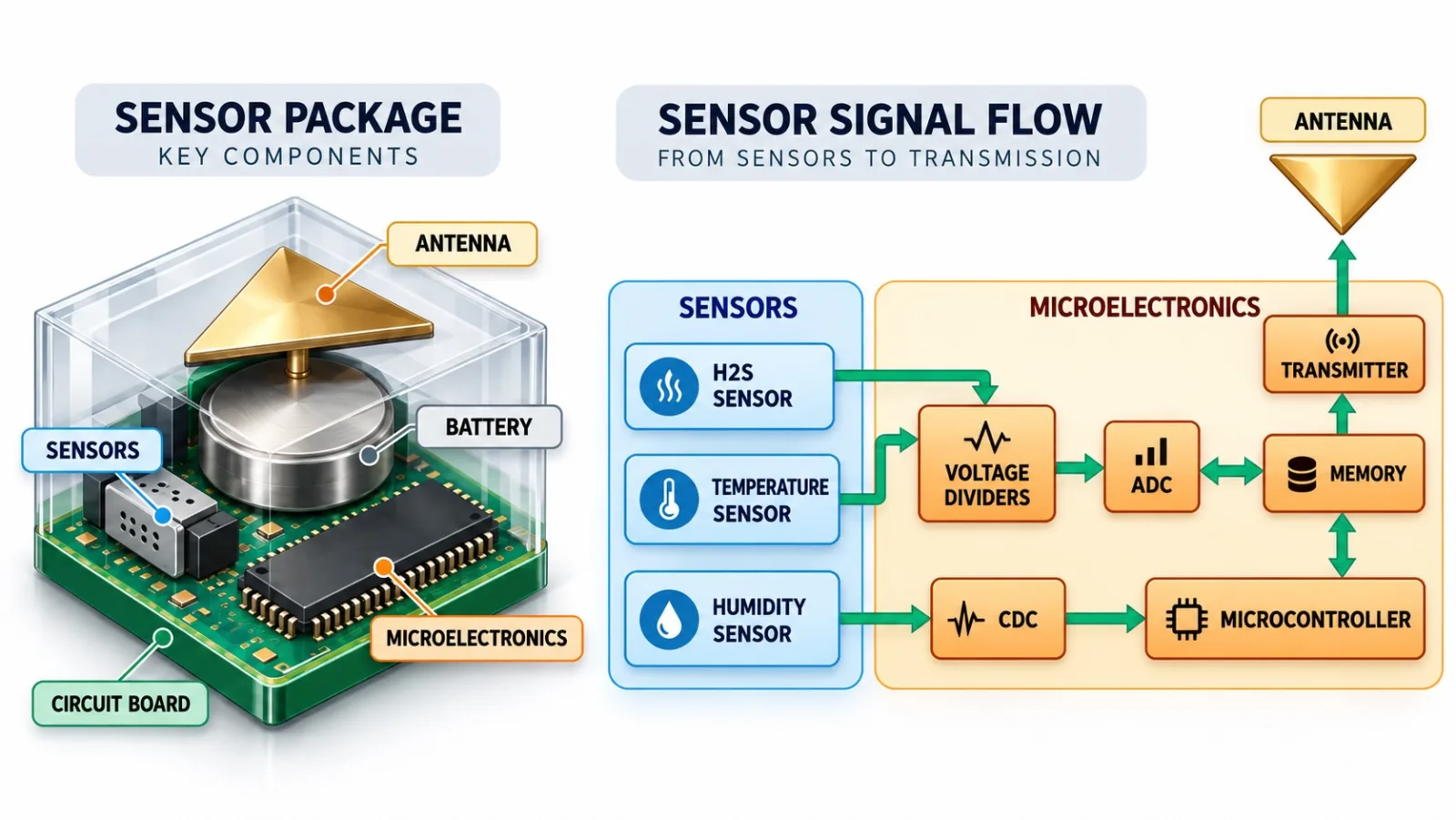
Diagram of the node reported in Farooqui et al., Advanced Materials Technologies, 2017. It consists of a 3D-printed functional cube package containing several inkjet-printed sensors and the antenna; the circuit board is also 3D-printed and holds the microelectronics enclosed in the package.
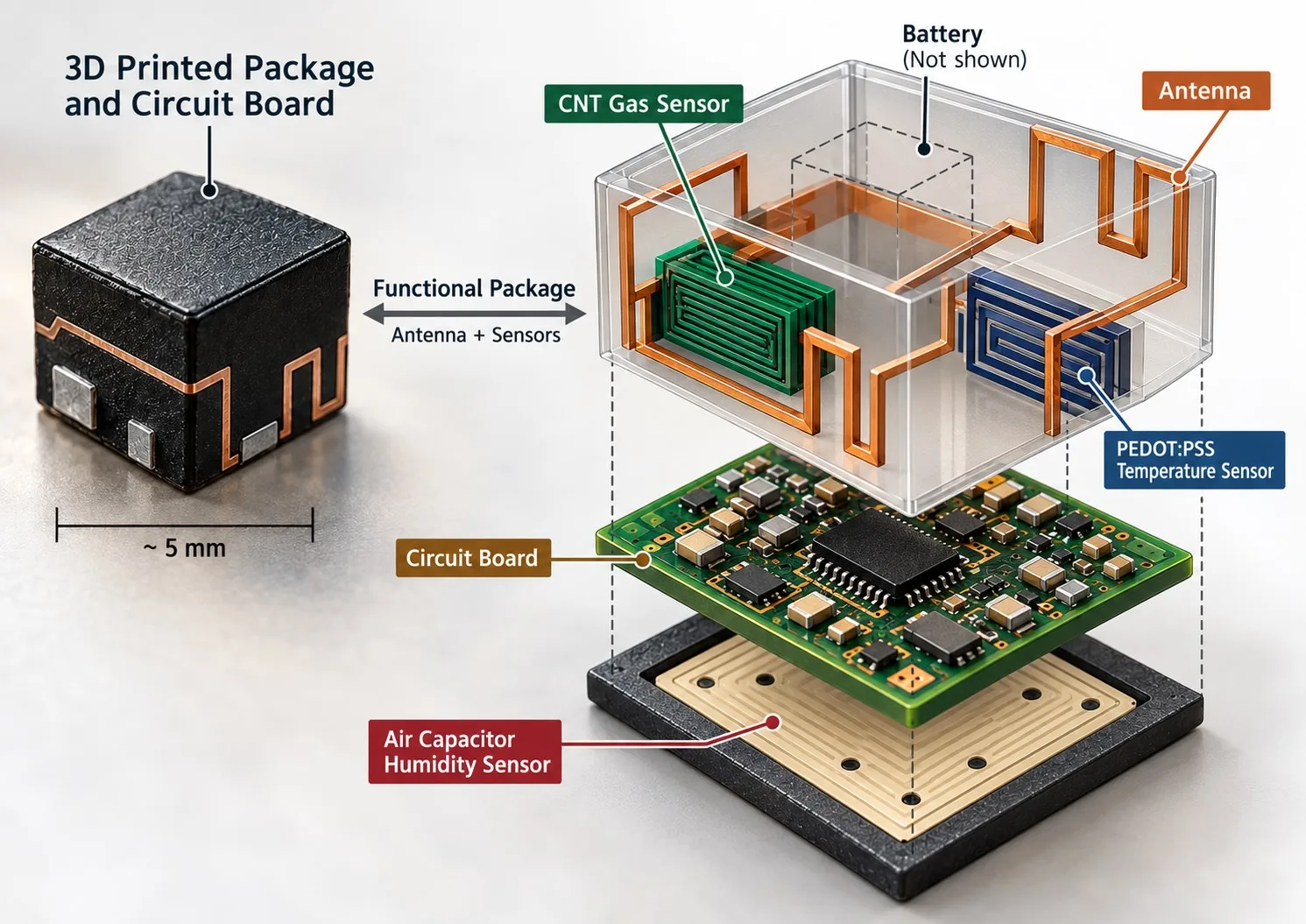
3D-printed, fully integrated wireless sensor devices
Kahn, Katz and Pister set out the research agenda publicly in “Next Century Challenges: Mobile Networking for ‘Smart Dust’”, presented at MobiCom in August 1999. The paper is candid that the hardware was running well ahead of everything around it. The networking and application layers needed to turn a cloud of motes into a working system did not yet exist.
How the Documented Devices Get Power and Send Data
Two constraints shape every device built at this scale, and the proposal is specific enough about both to be checked against the theory.
The first is communication, and it is the detail most often left out. Smart dust was never designed to broadcast. The BAA 97-43 proposal lists the mote’s communication hardware as a corner cube reflector, which is a modulated retroreflector, and a hybrid infrared laser diode for transmitting with a photodiode for receiving. The matching data receiver is described as a conventional optical system collecting signals from hundreds or thousands of sensors at once through a custom CMOS imaging chip. A retroreflector does not transmit on its own. It answers a beam that is already pointed at it, which means an unobstructed optical path between each mote and the reader. A mote that cannot see its interrogator has no way to report.
The second is power. Energy storage has not shrunk at the rate the electronics have, so submillimeter devices generally take their power from outside themselves: light, vibration, heat, or radio waves.
Neural dust shows both constraints in a later and smaller device. In August 2016 a Berkeley team including Dongjin Seo, Ryan Neely, Konlin Shen, Utkarsh Singhal, Elad Alon, Jan Rabaey, Jose Carmena and Michel Maharbiz published results in Neuron describing motes implanted in the muscles and peripheral nerves of rats. The first generation measured 3 millimeters by 1 millimeter by 0.8 millimeters. The team later reached a 1 millimeter cube and set a longer-term target of 50 microns per side. Ultrasound did double duty: a piezoelectric crystal converted incoming pulses into electricity, and changes in the returning echo carried the recorded nerve voltage back out. The motes were pinged every 100 microseconds. Berkeley credits the funding to DARPA.
Those sensors were placed surgically, and they report to a transducer held against the body.
The Programs the Theory Names
Two DARPA programs recur in smart-dust discussion, and the agency documents both.
SHIELD, or Supply Chain Hardware Integrity for Electronics Defense, aimed to produce a “dielet” measuring 100 micrometres on a side, small enough to sit inside the packaging of an integrated circuit. It combined an encryption engine, passive sensors that register any attempt to image, de-solder or de-lid the chip, and near-field power and communication. Its stated purpose was authentication: proving a chip is what it claims to be, and making counterfeiting too slow and costly to be worth attempting. DARPA lists the program as complete.
ElectRx, short for Electrical Prescriptions, ran out of DARPA’s Biological Technologies Office. It sought closed-loop interfaces to the peripheral nervous system as an alternative to drugs for pain, inflammation and post-traumatic stress, and it is the program most often named as the parent of neural dust. DARPA lists it as complete as well.
Neither program description mentions atmospheric dispersal. Both concern devices placed deliberately: one inside a chip package, one inside a body.
Lungs as the Tracking Interface
The theory’s most distinctive move is to treat breathing as the delivery mechanism. Implantation is the step that has always made chip narratives hard to sustain, because it requires consent, a procedure, or an improbably large conspiracy of clinicians. Inhalation removes all three. On this account the sensors simply arrive, drawn in with ordinary air, and settle where no one would think to look.
From there the claim extends to what the sensors supposedly do once inside: interact with respiratory biomarkers, read exhaled chemistry, or report from the internal microenvironment of the lung. The body is cast as both host and transmitter.
Biometric Tracking Without Consent
Recent work on exhaled-breath biomarkers, wearable respiration monitoring and touch-free pulmonary sensing has widened the vocabulary this theory can draw on. Diagnostic research tends to describe what it would like to be able to measure, and that language transfers easily. What medicine frames as a promise, the theory reads as a capability already in service.
The same is true of the engineering literature. A paper proposing sensors that could one day be dispersed over a forest to detect fires early is describing an aspiration and a funding case. Read through the theory, it becomes a deployment notice.
Where the Record Stands
Smart-Dust Surveillance is an inheritance of atmospheric conspiracy culture, rewritten for an era that finds miniaturization more plausible than large visible plumes. It joins chemtrail suspicion to a genuine and well-documented line of research, which is the source of both its durability and its reach.
The devices in that documented record are millimeter-scale rather than dust-scale. They are positioned by hand or implanted surgically, and they depend on an external reader at close range, whether an optical line of sight or an ultrasound transducer against the skin. No evidence has been produced that sensors of this kind have been dispersed in the atmosphere, inhaled, or recovered from a human lung.