
Overview
The claim is that the Pinkerton National Detective Agency was not really a detective agency but the private enforcement arm of American industrial capital — an intelligence service and a standing army available for hire, operating across state lines with none of the accountability of a police force.
What separates this from most entries in conspiracy history is that the central allegation was investigated twice by the United States Senate, both times found to be substantially true, and legislated against. The statute Congress passed in response is still in force.
The argument is therefore not about whether it happened. It is about what to call it.
The founding story is itself a disputed conspiracy
Pinkerton's reputation was made in February 1861, before any of the labour history, by a claim about a plot.
Allan Pinkerton, then providing security for a railroad, reported that secessionists in Baltimore intended to kill Abraham Lincoln as he passed through the city on the way to his inauguration. Lincoln was persuaded to change his route and travel through at night. Pinkerton's account of having saved the president-elect became the foundation of the agency's national standing.
Historians have argued about the Baltimore Plot ever since. Some accept that a genuine threat existed; others hold that Pinkerton inflated fragmentary talk into a conspiracy, and note that he had a direct commercial interest in the story being believed and repeated it energetically for the rest of his life. No conspirator was ever charged.
The agency that would spend a century being accused of manufacturing threats began by being accused of manufacturing one.
The Civil War intelligence failure
Pinkerton ran intelligence for General George McClellan during the first years of the war, and the results are documented and bad.
His estimates of Confederate strength were consistently and enormously too high — at times more than double the actual force. McClellan, temperamentally cautious to begin with, acted on those numbers and declined to press advantages he in fact held. The overestimates were a real contribution to a real strategic failure.
This matters to the theory because it complicates the picture of a ruthlessly effective machine. The agency's intelligence work was for hire and it tended to produce what the client's assumptions pointed toward, which is a different and more ordinary vice than the one usually alleged.
The Molly Maguires
In the 1870s the agency was engaged by Franklin Gowen, president of the Philadelphia and Reading Railroad and a major coal operator, to deal with unrest in the Pennsylvania anthracite fields.
The Pinkerton operative James McParlan spent more than two years undercover inside Irish mining communities in Schuylkill County. His testimony was the basis of a series of trials between 1875 and 1878 that ended in twenty executions.
The proceedings had features that would not survive review today. Gowen, the man who had hired the detective, acted as a prosecutor. The coal and railroad interests supplied the investigation, the private police who made arrests, and much of the courtroom apparatus. The convictions rested substantially on one paid infiltrator whose account could not be independently checked.
In January 1979 Governor Milton Shapp granted John Kehoe — hanged on 18 December 1878 as the alleged leader — a posthumous pardon, the first in Pennsylvania's history. Shapp described the executed men as martyrs, and the charges as aimed at the suppression of organised labour.
That is a state government, a century later, formally repudiating a set of executions obtained through Pinkerton work. Whether an actual violent society existed in the coalfields is still argued by historians. What is not argued is that the process which hanged twenty men was controlled by the companies they were in dispute with.
Homestead
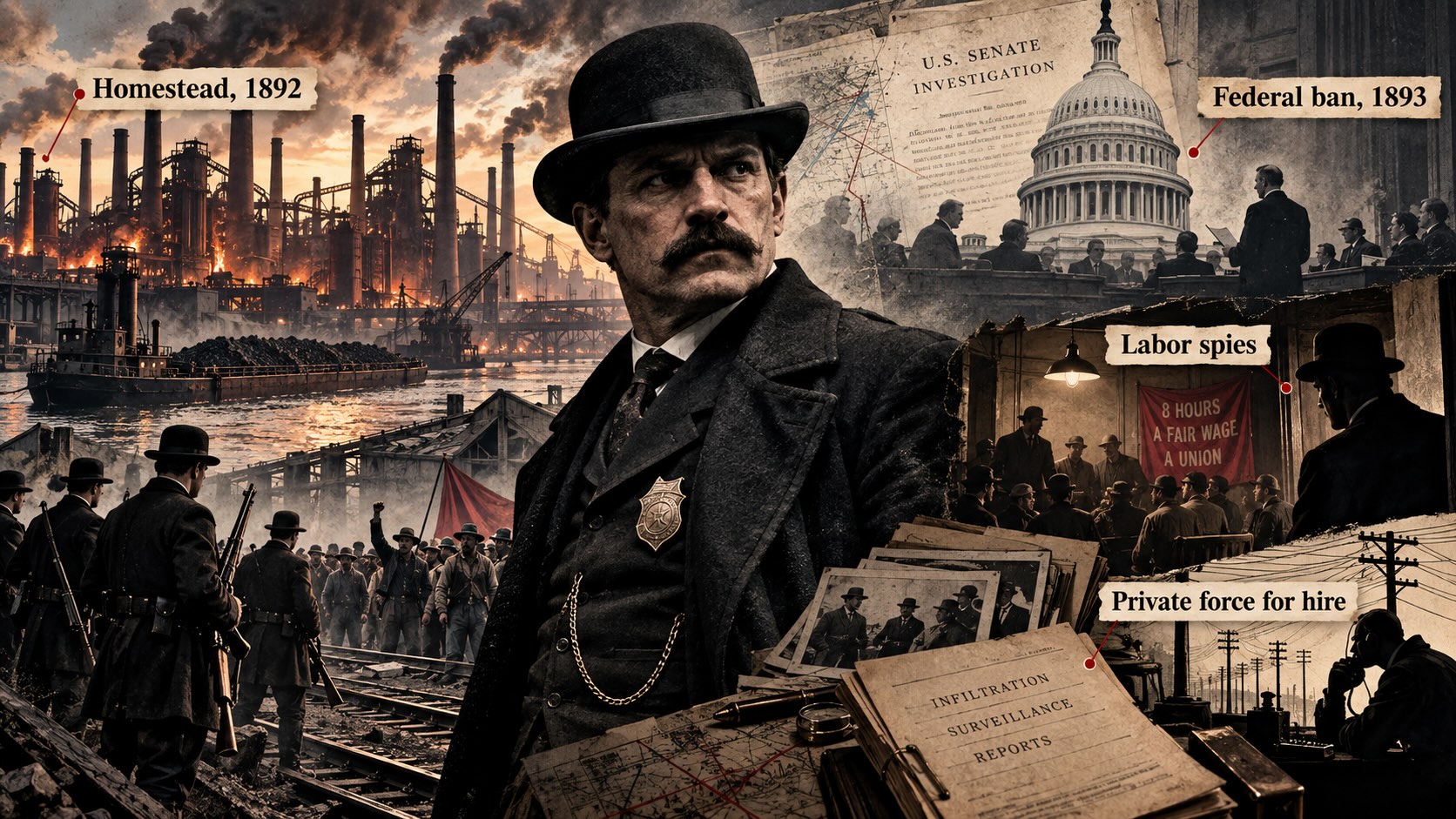
The defining event is the one everyone knows. In July 1892 Henry Clay Frick locked out the workforce at Carnegie's Homestead steel plant and brought roughly three hundred Pinkerton agents up the Monongahela on barges before dawn on 6 July to secure the works for replacement labour.
The strikers were waiting. The fighting lasted through the day, the Pinkertons eventually surrendered and were made to run a gauntlet through the town, and the total dead across the confrontation and the siege came to sixteen, with more than twenty wounded.
The national reaction was the important part. A private company had landed an armed force on American soil to take a position from American workers, and it had lost. Congressional investigations followed within weeks.
What Congress did
The response was direct. A rider attached to the Sundry Civil Appropriation Act of 5 August 1892 was made permanent by an act of 16 January 1893: no employee of the Pinkerton National Detective Agency, or any similar organisation, could be employed by the federal government or the government of the District of Columbia.
That provision survives. It is codified at 5 U.S.C. § 3108 and is carried into the Federal Acquisition Regulation at section 37.109, which government contracting officers still work with. The Government Accountability Office has interpreted it repeatedly, including in a 2006 decision arising from private security contracting, and has observed that the act has outlived the circumstances that produced it.
A single private company provoked Congress into a permanent statutory ban that has now outlasted the company's relevance by more than a century, and which the government's own auditors describe as an anachronism it has not got round to repealing.
The Senate's second look
The strongest evidence for the surveillance version of the theory is not from the nineteenth century at all.
Between 1936 and 1937 a Senate subcommittee chaired by Robert La Follette Jr. investigated violations of labour rights, and its findings on industrial espionage were extraordinary. Its census of labour spies identified thousands of operatives active in the mid-1930s. Pinkerton, the largest supplier, was found to have agents in practically every union in the country — placed inside organisations, elected to office within them in some cases, reporting on members to the employers those members were bargaining against.
La Follette's conclusion was that espionage of this kind was a common and almost universal practice in American industry, and that it was the most effective method management had for preventing unions forming and wrecking them when they did.
That is the shadow-intelligence-service claim, established under oath, by a committee of the Senate, in nine volumes of testimony.
Where the theory overreaches
The documented record supports a great deal. It does not quite support the framing.
A shadow government implies direction — that the agency set policy rather than sold a service. What the evidence shows is a contractor. Pinkerton went where it was paid to go, produced the findings its clients were disposed to receive, and its intelligence work was mediocre when the client wanted a particular answer, as the Civil War estimates show.
The more accurate and in some ways more troubling description is not a parallel state but an absent one: a period in which the public authority that was supposed to hold a monopoly on force declined to exercise it in industrial disputes, and a market filled the gap. The governors who sent militia after the Pinkertons had already fought were not being manipulated by a hidden power. They were arriving late to a function they had left open to tender.
Afterwards
The agency long outlived the era that made it notorious, moved into corporate security and risk consulting, and was bought by the Swedish firm Securitas in 1999. It still exists.
So does the 1893 statute, which is the strangest survival in the story: a law naming one private company, passed in anger, still cited in federal procurement rules a hundred and thirty years after the barges.