
Overview
The “Astor” Fur Monopoly theory centers on the belief that John Jacob Astor’s rise in the North American fur trade was not simply the story of a ruthless entrepreneur, but part of a deeper Anglo-American arrangement over territory, commerce, and political control.
In this theory, Astor appears not only as a businessman but as an intermediary figure between American expansion and British imperial interests. His private dealings with Canadian and British-connected fur operators, his efforts to dominate the Great Lakes and Columbia River trade, and the later diplomatic fights over Oregon are read together as evidence that commercial monopolies and frontier diplomacy were working toward the same end.
The strongest version of the theory says Astor had “private treaties” with the British to divide the continent, leaving one sphere to the United States and another to Britain. A more restrained version says Astor’s business strategy aligned so closely with Anglo-American territorial bargaining that the distinction between private commerce and statecraft became difficult to separate.
Historical Background
Astor’s fortune emerged in a period when commerce, diplomacy, and territorial ambition often overlapped. The North American fur trade was not merely an economic contest. It shaped routes, alliances, settlement patterns, and state claims.
Jay’s Treaty opened new commercial possibilities across the British-American borderlands, and Astor used that opening aggressively. By the late 1790s and early 1800s he had established strong connections in Montreal and inserted himself into the trade networks that linked the United States, British North America, and Atlantic markets.
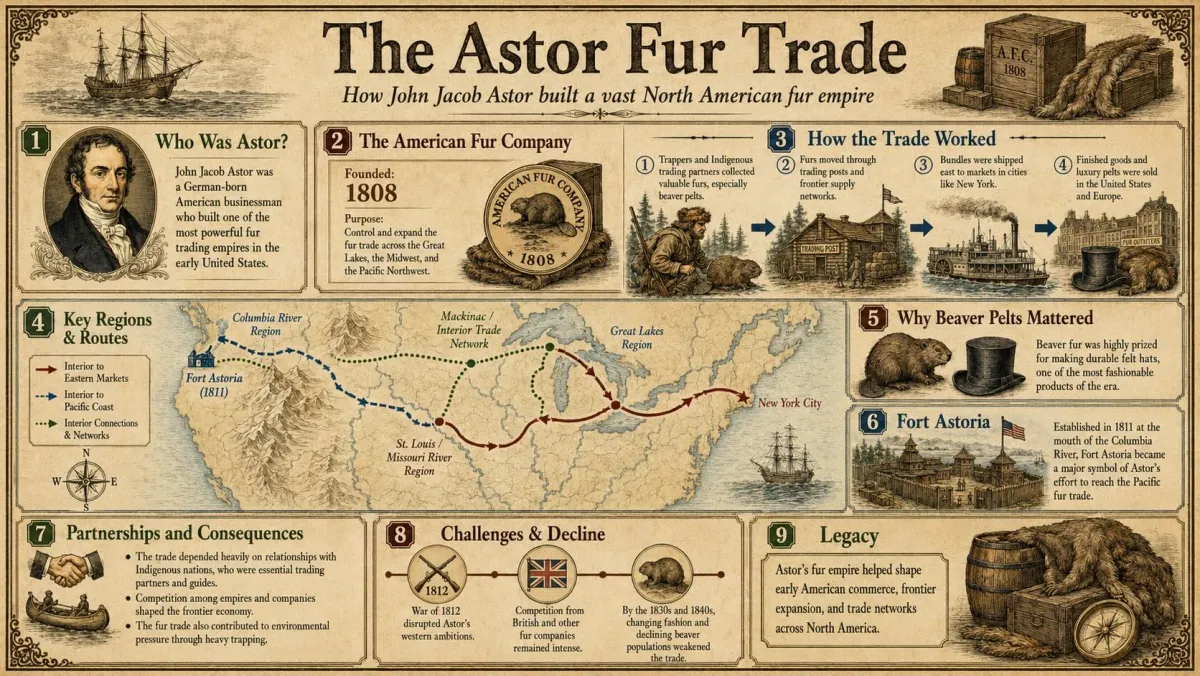
In 1808 he founded the American Fur Company. He also pursued a Pacific strategy through the Pacific Fur Company, aiming to create a chain of posts stretching to the Columbia River and then outward to China trade. That plan made Astor more than a merchant in the eyes of supporters and critics alike. His venture touched the most contested geography in North America.
Why Conspiracy Writers Focus on “Private Treaties”
The phrase “private treaties” usually refers not to one publicly known state treaty signed in Astor’s name, but to the web of private agreements, joint-venture proposals, personnel recruitment, and cross-border business arrangements he used in dealing with British-Canadian competitors.
One reason the theory took hold is that Astor did in fact seek cooperation with the North West Company rather than operating only as a straightforward nationalist rival. In 1809 he tried to neutralize that company through a joint venture west of the Rockies. He then recruited veteran Nor’Westers and in 1810 signed a provisional agreement with former North West Company men to help staff and organize the Pacific Fur Company.
To believers, these arrangements look less like ordinary commerce and more like backstage diplomacy. They argue that Astor’s empire was constructed through understandings that paralleled official border politics and may have anticipated them.
Astoria as the Key Event
Fort Astoria is central to the theory because it sits at the intersection of private capital and sovereignty. Astor’s Pacific Fur Company established Astoria in 1811 at the mouth of the Columbia River, creating the first American settlement in the Oregon Country.
In standard history, Astoria is evidence that Astor was helping strengthen the U.S. position against British rivals. In conspiratorial interpretation, the same outpost can be read differently. Astoria becomes a bargaining chip: a private commercial beachhead planted in contested territory that could later be traded, abandoned, or used to anchor wider negotiations over a divided Northwest.
When war broke out between the United States and Britain, Astor’s agents sold Astoria to the Canadian-based North West Company in 1813, after which the post was renamed Fort George. This event is one of the chief reasons the theory survives. To supporters, the sale looks less like a wartime emergency and more like proof that the lines between Astor’s interests and British interests were never as separate as the public story suggested.
The Oregon Question and the “Split in Half” Idea
The claim that Astor had a role in “splitting the U.S. in half” is usually tied to later Oregon diplomacy rather than to the existing eastern states of the Union.
The Convention of 1818 set the U.S.-British boundary at the forty-ninth parallel from the Lake of the Woods to the Rockies and left the country west of the Rockies open to both powers for ten years without prejudice to either side’s claims. Later negotiations included British proposals that would have drawn the line down the Columbia River, dividing the disputed Oregon Country between the two powers.
This matters because conspiracy writers often take those real partition proposals and project them backward onto Astor’s earlier business moves. In that reading, Astor’s commerce, the loss of Astoria, and the later British push for a Columbia boundary become parts of one hidden plan. Historically, however, the documented diplomatic negotiations were between governments over Oregon Country, not a personal Astor-British treaty to partition the entire United States.
Main Claims Within the Theory
Commercial monopoly as geopolitical instrument
This version holds that Astor’s monopoly was never just about beaver pelts. It was a mechanism for controlling transport corridors, trade routes, and political leverage in contested territory.
Hidden Anglo-American coordination
Another version argues that American and British elites were less opposed than they appeared in public, and that Astor served as a private broker whose deals helped stabilize an eventual continental compromise.
Managed loss of Astoria
A stronger interpretation sees the 1813 sale of Astoria not as an emergency decision but as a deliberate transfer that fit an already understood territorial arrangement.
Oregon partition as proof of earlier planning
In this version, later British proposals to divide Oregon along the Columbia River are treated as confirmation that the territorial split had been envisioned from the beginning.
What Is Documented
Several foundational parts of the story are well documented.
Astor benefited from the post-Jay Treaty trading environment. He founded the American Fur Company in 1808. He sought cooperation with the North West Company and signed agreements with experienced former Nor’Westers to build his Pacific venture. Fort Astoria was established in 1811 and sold to the North West Company in 1813 during the War of 1812. The Convention of 1818 created joint occupation in Oregon Country, and later British proposals did seek a partition line tied to the Columbia River.
These facts are enough to explain why the theory exists. They show a real overlap between private monopoly-building and formal territorial politics.
What Is Not Documented
What remains unverified is the specific allegation that Astor signed or possessed a secret personal treaty with Britain to split the United States in half.
The available diplomatic record documents negotiations between states over Oregon Country and private agreements between Astor and fur-trade actors. Those are real. The leap from those facts to a hidden continental partition agreement is the central speculative step in the theory.
Significance
The “Astor” Fur Monopoly theory remains notable because it captures an important truth about the early republic even where its strongest claim remains unproven: frontier capitalism and imperial diplomacy were deeply entangled.
Astor’s career shows how private capital could shape exploration, settlement, trade, and territorial claims. That makes him an ideal figure for conspiracy narratives. He stood at the point where commerce could look like statecraft and where monopoly could look like empire.
For that reason, the theory endures not because a single secret treaty has been produced, but because the historical record already shows a world in which businessmen, diplomats, and empires routinely moved through the same channels.