
Overview
One of the more durable 9/11 claims holds that the Pentagon rehearsed, in advance, the event that later happened to it: a passenger aircraft striking the building, with the emergency response planned out before the fact. In its shortest form it is usually stated as a single exercise, given the military abbreviation MASCAL and treated as a codename.
The exercises are real. They are not obscure, and they were not uncovered by researchers working against the government's account — they are described in the Defense Department's own published history of the attack, Pentagon 9/11, written by the Office of the Secretary of Defense Historical Office. What that history records is more specific than the popular version, and in one respect more uncomfortable.
What MASCAL refers to
MASCAL is ordinary military shorthand for mass casualty. It is not a project name or a codename; it describes a category of plan that hospitals, clinics and installations are expected to hold and to practise. The Pentagon's two in-house clinics kept one. On the morning of 11 September, as the wounded began arriving, "the clinic activated its mass casualty plan" — a standing procedure being run, not an operation being launched.
That distinction matters to how the story reads. A standing emergency procedure restated as a codename acquires an air of design it never had.
The exercises in the record
Pentagon 9/11 documents several rehearsals at the building in the years before the attack, run by two different organisations for two different purposes.
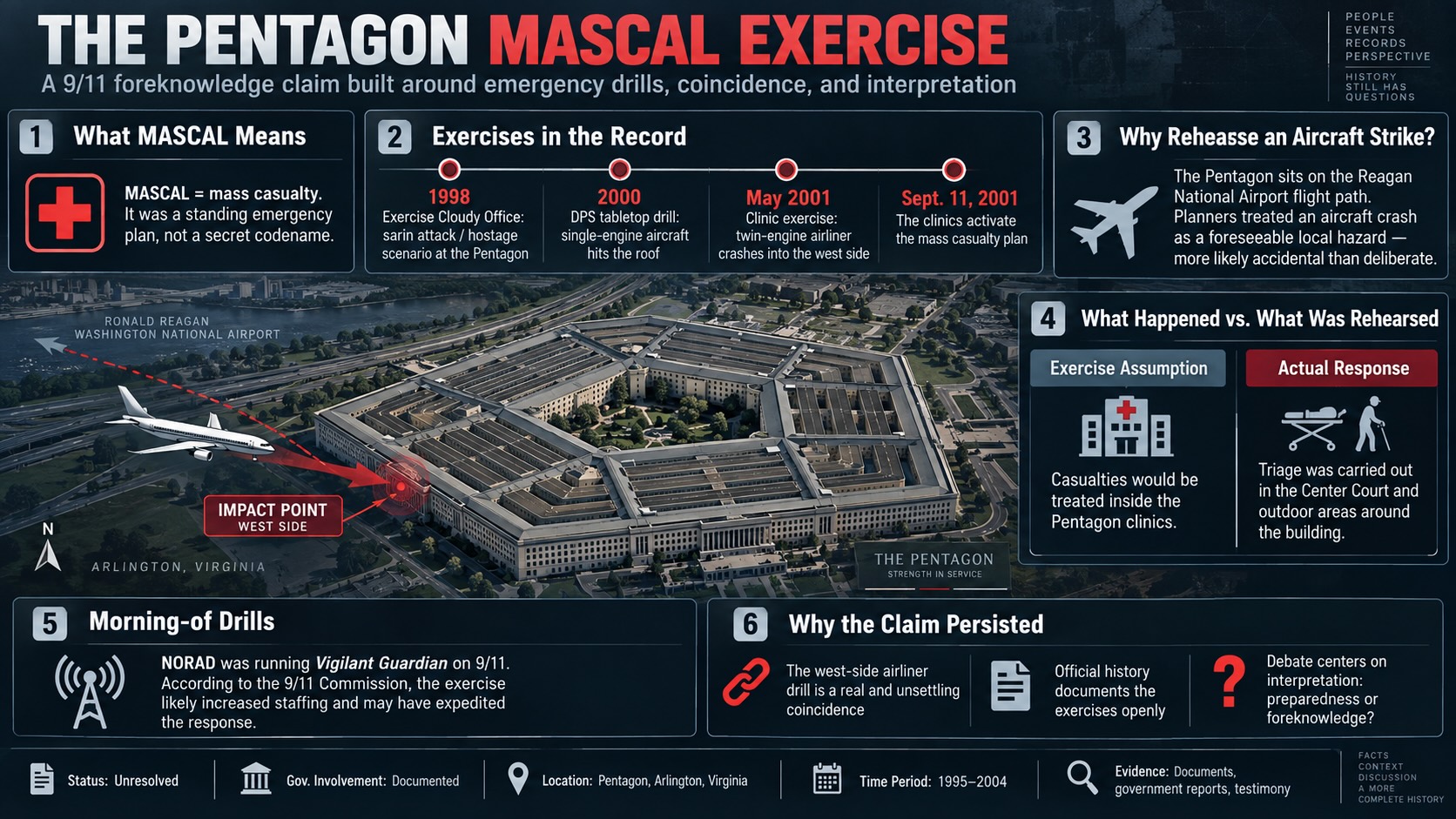
The first was a counterterrorism exercise. The 1995 sarin attack on the Tokyo subway had prompted the Defense Protective Service, the Pentagon's own police force, to begin planning for a chemical or biological attack on the building. "For Exercise Cloudy Office in 1998 DPS employed a scenario in which sarin was released after terrorists breached security, reached the office of the secretary of defense, and took hostages. The exercise, participated in by 500 people from local, state, and federal agencies, 'killed' 26 people and 'contaminated' 100 at the Pentagon."
The second involved an aircraft. "Because the Pentagon lay in the flight path of Reagan National Airport, the 16th busiest in the country, DPS also considered the possibility of the crash of an airplane into the building, an event it thought more likely to be accidental than deliberate. In 2000 DPS held a tabletop exercise with a scenario of a single-engine aircraft hitting the roof and bursting into flames."
The third is the one the claim rests on. The Pentagon's medical clinics ran their own rehearsals, separate from the police exercises. "The scenario changed for each drill; presciently, training carried out the previous May supposed casualties resulting from an accidental crash of a twin-engine airliner into the west side of the building."
That is the Defense Department's own history, using its own adverb, about its own building. The May 2001 exercise supposed an airliner hitting the west face — the face that was struck four months later.
Why the building rehearsed an aircraft at all
The same paragraph that records the coincidence also explains it, and the explanation is domestic rather than strategic. The premise "was adopted at the suggestion of Colonel John Baxter, commander of the Air Force Clinic, who, like everybody else in the building, was reminded often that the Pentagon was on the Reagan National Airport's flight path." The proposal was approved by the Air Force Surgeon General, Lieutenant General Paul Carlton, Jr.
The Pentagon sits roughly a mile from the end of a runway at one of the busiest airports in the country. Aircraft pass low over it continuously. Planners at the building treated an aircraft coming down on it as the obvious local hazard — the one a passer-by would name — and the record is explicit that they expected an accident rather than an attack.
The wider region was also unusually well drilled for reasons that had nothing to do with aviation. "Because of the importance of the National Capital Region its hospitals and clinics were unusually well prepared to handle mass casualties. They routinely conducted drills to practice for chemical or biological attacks."
What the rehearsal actually prepared for
The exercises are often described as though the building had a plan for the day and executed it. The history's account of how the rehearsal met the event is less tidy.
The May 2001 scenario assumed the casualties would come to the clinics: "The exercise assumed that the two Pentagon clinics would treat patients inside their facilities." What happened was the reverse. "Instead, circumstances on 11 September compelled the medics to perform triage in the Center Court and in the parking lots, grassy areas, and roads surrounding the Pentagon." The clinics themselves were evacuated.
What the rehearsals did leave behind was familiarity rather than a script. Army Captain Jennifer Glidewell, chief nurse of the Acute Care Section, pushed back into the building against the crowds leaving it; "since she was familiar with mass casualty exercise procedures," she worked in the Center Court until the evacuation order at about 10:15 a.m. forced the medical staff out. At the Rader Army Health Clinic at Fort Myer, officials announced "a 'Code Yellow' for a mass casualty situation," evacuated, and then stood by to receive casualties.
The 1998 chemical exercise has a plainer epilogue. "By 2001, however, DPS had made little progress in acquiring chemical and biological detection equipment, a key component of its counterterrorism planning." An exercise had identified a gap; three years later the gap was still there.
Where this meets the missile theory
The exercise claim is usually carried alongside The Pentagon Missile Theory, and the two are frequently cited in the same breath. Structurally they pull against each other.
The missile theory's central assertion is that no airliner struck the Pentagon — that the damage was caused by a missile, a drone or a smaller substituted aircraft. The exercise claim's force depends on the opposite: that the building rehearsed an airliner striking its west side and then an airliner struck its west side. Read as foreknowledge, the rehearsal is evidence that the thing rehearsed is the thing that happened, which is precisely what the missile theory denies.
They travel together anyway, because both rest on the same underlying premise rather than the same factual claim: that the institution which owned the site also controlled the account of what happened there. Once that premise is in place, a rehearsal and a disputed impact can sit side by side without either having to agree with the other. The same pattern appears in The Martial Law Drills, where the existence of a contingency plan is read as intent to use it, and in The Missing 2.3 Trillion, where a budgeting failure and an impact point are joined by the same reasoning.
The exercises running that morning
A related claim concerns exercises under way on 11 September itself, and this one is confirmed by the 9/11 Commission. "On 9/11, NORAD was scheduled to conduct a military exercise, Vigilant Guardian, which postulated a bomber attack from the former Soviet Union."
Coordination between the civil and military sides over exercises was routine rather than exceptional. The Commission's staff recorded that "most FAA centers had a civilian employee to coordinate with NORAD, for situations like training exercises."
The confusion the exercise caused that morning is preserved in the transcripts. At 8:37:52, in the first notification the military received at any level that a hijacking was under way, Boston Center's traffic management unit reached the Northeast Air Defense Sector:
FAA: Hi. Boston Center TMU, we have a problem here. We have a hijacked aircraft headed towards New York, and we need you guys to, we need someone to scramble some F-16s or something up there, help us out.
NEADS: Is this real-world or exercise?
FAA: No, this is not an exercise, not a test.
That single question is the most quoted line in the whole claim. It was also put directly to the officer responsible, in public, by a commissioner who framed the problem in the same terms the claim does. At the Commission's twelfth public hearing in June 2004, Commissioner Tim Roemer read the exchange aloud and asked General Ralph Eberhart: "you were postured for an exercise against the former Soviet Union. Did that help or hurt?"
Eberhart answered that it helped. "My belief is that it helped because of the manning, because of the focus, because the crews — they have to be airborne in 15 minutes. And that morning, because of the exercise, they were airborne in six or eight minutes." Of the radio exchange itself he said, "The situation that you're referring to, I think, at most cost us 30 seconds — 30 seconds." Asked whether the confusion recurred later in the morning, he replied: "No, it became painfully clear, Commissioner, that this was not an exercise."
The Commission's written finding matched the testimony — that "the response was, if anything, expedited by the increased number of staff at the sectors and at NORAD because of the scheduled exercise."
What the claim has to account for
An institution that rehearses a hazard and then suffers it will always look, afterwards, as though it knew. That is not a trivial intuition, and the May 2001 scenario naming the west side of the building is a genuine and unsettling coincidence — the Defense Department's own historians thought so, and said so in print.
What a foreknowledge reading inherits is the rest of the same record. The aircraft scenarios were written as accidents, by people who worked under an approach path and said so. The 2000 exercise supposed a single-engine aircraft on the roof; the May 2001 exercise supposed a twin-engine airliner and assumed the wounded would be treated indoors, which is not what the day required. The chemical exercise's documented legacy is equipment that had still not been bought. And the exercise most often cited as suspicious on the morning itself was a Cold War bomber scenario that the Commission concluded put more people on duty than would otherwise have been there.
Legacy
The Pentagon exercises occupy a particular place in 9/11 claims because nothing about them has to be uncovered. They are in the official history, described at length, with the coincidence flagged by the authors rather than buried by them. The argument is not about whether the rehearsals happened but about what a rehearsal means — whether planning for a foreseeable hazard is evidence of preparation for it, or evidence only that the hazard was foreseeable.