
Overview
At 9:02 on the morning of 19 April 1995, a rented Ryder truck packed with roughly two tonnes of ammonium nitrate and nitromethane detonated outside the Alfred P. Murrah Federal Building in Oklahoma City. The north face of the building came off. One hundred and sixty-eight people were killed, nineteen of them children in the second-floor day care centre, and more than six hundred were injured. It remains the deadliest act of domestic terrorism in American history.
Timothy McVeigh was arrested within ninety minutes of the blast, on an unrelated traffic stop. He was convicted in 1997 and executed on 11 June 2001. Terry Nichols was convicted federally and in Oklahoma state court and is serving life without parole. Michael Fortier, who knew of the plan and said nothing, testified for the prosecution and served twelve years.
That much is settled, and the conspiracy literature around this case mostly does not dispute it. The argument is not whether McVeigh did it. It is whether he did it alone — whether others were present who were never charged, and whether parts of the federal government knew something beforehand.
Those are narrower questions than the ones usually attached to an atrocity, and they are narrower in a way that makes them harder to dismiss, because the official record contains real loose ends.
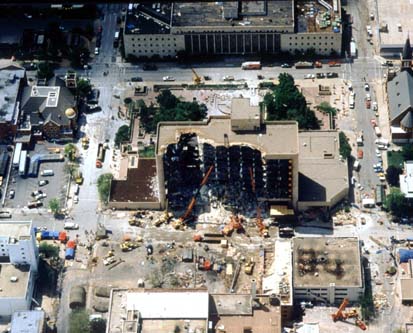
Wikimedia Commons — Leonard Brakebill, Oklahoma Air National Guard, Public domain

John Doe No. 2
The most durable of them began with the government itself.
In the days after the bombing the FBI released two sketches. The first became McVeigh. The second — a heavier man, dark hair, baseball cap, tattoo on the left arm — was labelled John Doe No. 2, and for a period the Bureau's own public position was that a second man had been with McVeigh when the truck was collected.
The sketch came from Tom Kessinger, a mechanic at Elliott's Body Shop in Junction City, Kansas, where the Ryder truck was rented. He described two men.
In June 1995 federal investigators concluded that Kessinger had merged two separate visits. The second man was Todd Bunting, an Army private from nearby Fort Riley, who had been in the shop on 18 April — the day after McVeigh collected the truck — with a friend, wearing a cap and carrying a tattoo matching the description. Kessinger came to accept he had been confused, and was prepared to testify to that.
It is a mundane and well-documented explanation of a genuine witness error, and it is also the thing that gave the case its most enduring symbol. A government that spends weeks hunting a man, then announces he was never there, is asking for a degree of trust it had not earned. The sketch outlived the retraction.
Elohim City
The second strand is more substantial, because it rests on contemporaneous government paperwork rather than on recollection.
Elohim City was a white separatist settlement in eastern Oklahoma, near the Arkansas line. From August 1994 the Tulsa office of the Bureau of Alcohol, Tobacco and Firearms ran a paid confidential informant inside it: Carol Howe, who visited nearly weekly and filed more than seventy intelligence reports to her handler between mid-1994 and March 1995.
What those reports contain is the heart of the matter. Howe reported that Andreas Strassmeir — a German national living at the compound, and the son of a senior German political figure — spoke about bombing federal buildings and taking direct action against the United States government. She reported that a target list had been narrowed to three buildings, one in Oklahoma City and two in Tulsa. Reporting from that period describes the Murrah building being cased in late 1994 or early 1995.
Phone records established that McVeigh called Elohim City on 5 April 1995, two weeks before the bombing. Howe later testified that she had seen McVeigh at the compound in July 1994.
For roughly a year after the bombing, the FBI did not interview Strassmeir, did not go to Elohim City to question him, and did not put him before a grand jury. He subsequently left the United States. He has consistently denied involvement.
This is where the case stops being a matter of interpretation. An informant was reporting to a federal agency that people at a specific location were discussing bombing federal buildings, including one in Oklahoma City, in the months before a federal building in Oklahoma City was bombed. What that means is contested. That it happened is in the record.
Prior knowledge
From those reports grows the strongest claim in the literature: that some part of the government knew, or had enough to know.
The versions differ in severity. The weakest holds only that the intelligence existed and was not acted on — a failure of analysis rather than intent, of a kind the same decade produced repeatedly. The strongest holds that an operation was being run against the plotters, that it was not stopped in time, and that the subsequent investigation was shaped to avoid exposing it.
A persistent variant claims that ATF staff were warned not to come to work that morning. The Oklahoma County grand jury examined it directly and found no evidence for it; ATF personnel were in the building, and agents were among the injured.
What the grand jury did
Oklahoma County convened a county grand jury in 1997 specifically to examine the conspiracy claims, after sustained public and legislative pressure. It sat for eighteen months at a cost of around half a million dollars, and reported at the end of December 1998 in a twenty-one page document.
It found no additional perpetrators beyond McVeigh and Nichols. It found no evidence that the federal government had advance knowledge. It found no evidence that Elohim City residents were involved in the bombing. It found no evidence of a second device. It returned a single sealed indictment, which reporting at the time indicated concerned possible interference with the jury rather than the bombing.
It is the most direct examination the alternative accounts have received, and it is also the piece of the record proponents are least satisfied by — a county body, with county resources, examining the conduct of federal agencies that were not obliged to open their files to it.
The tapes
The last strand is narrower and, in evidentiary terms, the most concrete: the question of what the security cameras recorded.
Jesse Trentadue, a Salt Lake City attorney whose brother died in federal custody in 1995 in circumstances he has never accepted, pursued the FBI through Freedom of Information Act litigation from 2008 seeking footage from cameras covering the Murrah building and its surroundings. His basis was documentary — a Secret Service record written after the bombing describing security footage that showed suspects leaving the truck minutes before detonation.
The matter went to trial in Utah in 2014. A federal judge, unsatisfied with earlier explanations, had ordered the Bureau to account for why it could not locate tapes referenced in its own evidence logs. Witnesses testified that cameras had been monitoring the area, and that further recordings might exist; the Bureau's position was that no camera captured the blast and that its searches had been adequate. In June 2015 the court granted summary judgment to the FBI, finding the search reasonable.
No footage of the truck's arrival has ever been released.
The newest strand
Since the thirtieth anniversary a further claim has circulated, largely on short-form video: that McVeigh was not executed at all, and that a man photographed in a federal law-enforcement role in later years is the same person.
The entire case for it is facial resemblance between photographs. There is no documentary element — no record, no testimony, no discrepancy in the execution account, which was witnessed by media representatives and by survivors and victims' relatives. Resemblance between two faces is not evidence of identity, and unfamiliar face matching is unreliable enough that it defeats trained examiners under test conditions.
It is worth noting chiefly as a contrast. The Elohim City material is a documented intelligence failure with named informants, filed reports and dates. This is a visual impression. They circulate under the same heading, and conflating them does the older and more serious questions no favours.
What would settle it
Each of the open strands has a specific answer condition, which is unusual and worth stating plainly.
The informant question is answerable from the ATF's own file: Howe's reports exist, were filed with a named handler, and the dates are known. The Strassmeir question is answerable by interview, and the window for it was 1995 rather than now. The tape question is answerable by the footage, which either exists or does not, and a court has now accepted that the Bureau looked properly.
None of these requires anyone to believe the bombing was anything other than what the convictions say it was. That is the distinction the subject tends to lose: a government can have failed to prevent an attack, and investigated itself inadequately afterwards, without having carried it out. The record supports the first two questions being asked. It has never supported the third.