
Where it came from
The Nibiru cataclysm has a single identifiable origin and a date attached to it.
In 1995 Nancy Lieder founded the website ZetaTalk and said she was a contactee, able to receive messages from beings from the Zeta Reticuli system through an implant in her brain. The message she reported was that a large object would pass through the inner solar system in May 2003, tipping the Earth into a pole shift that would kill most of humanity.
May 2003 came and went.
The date moved to 2012, where it fused with the Mayan calendar material already circulating, and the two reinforced each other — the calendar supplying a civilisation's authority, Nibiru supplying a physical mechanism. December 2012 came and went. The date moved again, to 2017. That passed too.
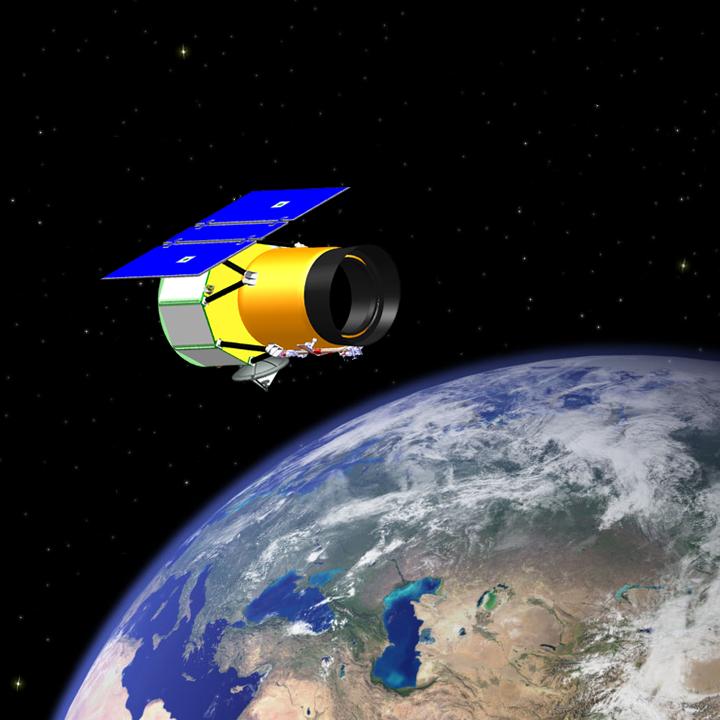
An artist’s concept of WISE — a rendering, not a photograph. The survey it carried out found thousands of new stars and brown dwarfs and no Planet X, and NASA has published what the instrument could and could not have detected. Wikimedia Commons — JPL, Public domain

The structure, which is the interesting part
A prediction that names a date is unusually honest, because it can fail. This one has failed three times and is still here, and the reason is worth setting out plainly: the cover-up is not an additional claim bolted onto the prediction. It is the component that makes the prediction unfalsifiable.
If the object were simply approaching, its non-arrival would be disconfirming. But if the object is also being hidden — by NASA withholding imagery, by manipulated photographs, by a chemtrail layer thickening the sky so that ordinary people cannot look up and see it — then nothing a person observes can count against the theory. Seeing nothing is what you would expect to see.
That is the function the chemtrail element serves, and it is why it was added. It answers the one question that would otherwise end the discussion: if a planet entered the inner solar system, where is it?
What would actually be observable
The objection from astronomers is not an assertion of authority. It is about what a body of that size does.
A planet massive enough to tip the Earth's axis would have been perturbing the orbits of the outer planets for a long time before it arrived, and those orbits are measured to extraordinary precision — precisely because small discrepancies in them are how Neptune was found in the first place. There is no such perturbation.
It would also be bright. NASA's Wide-field Infrared Survey Explorer surveyed the sky in infrared, which is how you find cold objects that emit little visible light, and found thousands of new stars and brown dwarfs and no Planet X. NASA has published what WISE could and could not have detected, which is the relevant question and is answerable from the instrument's specifications rather than from anyone's good faith.
And it would be visible to amateurs. An approaching planet months from a close pass is not a thing that requires a space agency's telescope. It is a thing any astronomy club, in any country, with no relationship to NASA, would see — and the theory requires every one of them, worldwide, to be either deceived or complicit.
The volume of it
David Morrison, who answered public questions for NASA's Ask an Astrobiologist, received more than five thousand messages about Doomsday 2012 and Nibiru, and described getting around five a day over a period he had expected to be brief. He estimated the material ran across something like two million websites.
His summary of the case against was three points: there is no evidence the object exists; if it did exist it would have disrupted the outer planets long ago; and people have predicted its arrival before and been wrong.
That last point has since gained two more instances.
Where it stands
No evidence has been produced that Nibiru exists, and the specific dates the theory has named have all passed without incident.
What the case is useful for is the mechanism. It began as a falsifiable claim with a date, failed, and survived by acquiring a concealment component that makes observation irrelevant — after which the absence of the planet became evidence of how well it was being hidden. That is a conversion a theory can only make once, and it is the point at which it stops being a claim about the sky and becomes a claim about the people who look at it.