
The crash
At about 4:25 on the morning of 18 June 2013, Michael Hastings's Mercedes-Benz C250 Coupé went into a palm tree in Hancock Park, Los Angeles. A witness described the car travelling at maximum speed, throwing sparks and flames, fishtailing before it hit. The engine was thrown fifty to sixty yards from the point of impact.
He was 33. He had written the 2010 Rolling Stone profile of General Stanley McChrystal that ended McChrystal's command in Afghanistan, and by 2013 he was writing on surveillance and national security. LA Weekly reported he was preparing new material on the CIA.
The day before he died he emailed colleagues to say he was onto a big story, that he needed to go off the radar for a while, and that the FBI might come and interview them.
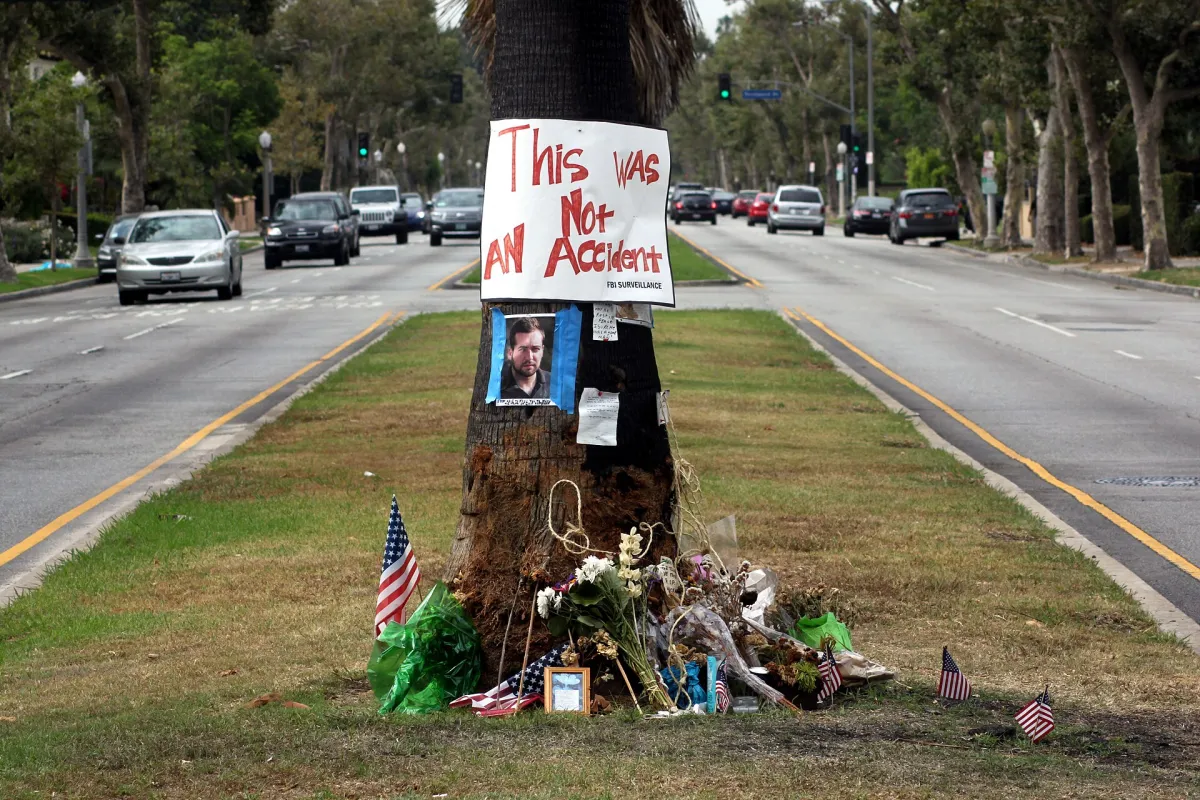
The palm tree Hastings’s car struck, with a memorial left by members of the public. The sign is theirs — it records what passers-by believed, not a finding of any investigation. Wikimedia Commons — Lord Jim, CC BY 2.0

Why this one has lasted
Most crash-conspiracy entries in this archive have a motive and nothing else. This one has three things that are genuinely unusual, and it is worth setting them out at full strength before anything else.
The email is real. It says what it says, it was sent the day before, and its recipients confirmed it.
A serious person said so on the record. Richard Clarke, who ran counterterrorism at the White House under three presidents, said publicly within days that what was known about the crash was consistent with a car cyber attack, and that intelligence agencies know how to remotely seize control of a car. That is not an anonymous claim; it is a named former official with the background to be taken seriously.
And the capability was subsequently proved. In July 2015 the security researchers Charlie Miller and Chris Valasek remotely took control of a Jeep Cherokee being driven on a public highway — steering, brakes and transmission, from a laptop miles away, with a journalist in the driver's seat. It was published, demonstrated, and led Fiat Chrysler to recall about 1.4 million vehicles.
So the thing the theory requires is not science fiction. Two years after Hastings died, somebody did it on purpose and wrote it up.
What that does and does not establish
A capability existing is not evidence that it was used, and the gap between the two is where this case actually sits.
The 2015 demonstration worked against a particular attack surface: the Uconnect head unit in certain Fiat Chrysler vehicles, which had a cellular connection reachable from the internet and insufficient separation from the vehicle's control bus. That is a specific flaw in a specific platform, found by researchers who spent a year looking for it.
Hastings drove a 2013 Mercedes C250. No comparable remote compromise of that vehicle has been published, demonstrated or claimed by anyone, including by the researchers who have spent the decade since 2015 looking for exactly this class of flaw across manufacturers. Clarke's statement was about what agencies can do in general, offered days after the crash and before any examination of the car; it was not a finding about this Mercedes.
What the investigation found
The Los Angeles Police Department said two days after the crash that there were no signs of foul play, and found no evidence of tampering with the vehicle. The coroner ruled the death accidental, with massive blunt force trauma consistent with a high-speed crash, and death effectively instantaneous.
Toxicology found traces of methamphetamine and THC. The coroner's own assessment was that these were unlikely to have had an intoxicative effect — a finding worth quoting accurately, because it is used in both directions and it supports neither. It does not establish that drugs caused the crash, and it does not clear the question either.
The part that complicates the story in the other direction
The context around those last days is documented and it is not the context the theory assumes.
His brother Jonathan said Michael appeared to be in a manic episode, resembling one he had experienced some fifteen years earlier, and that the family had been trying to arrange an intervention. Two of his siblings had arrived in California the day before the crash with the aim of getting him into detox, after what the investigation described as a relapse following years of sobriety.
That is a man in acute crisis, with his family already in the city trying to get him help, driving at extreme speed through a residential street at half past four in the morning. It is an explanation that accounts for the speed without requiring anything to have been done to the car.
It also sits uneasily beside the email, and this entry is not going to pretend otherwise. A person in a manic episode may well send a message about a big story and going off the radar. A person being followed may send exactly the same message. The email does not discriminate between those readings, which is the problem with treating it as evidence.
Where it stands
No evidence has been produced that Hastings's car was interfered with. The LAPD examined it and found none; no researcher has demonstrated a remote attack against his model; no participant, document or technical finding has emerged in the years since.
What the case does establish, and what makes it worth keeping rather than dismissing, is narrower: that by 2015 remote control of a moving car was a demonstrated fact rather than a fear, and that a former senior counterterrorism official was willing to say in 2013 that it was possible. Those are real, and they are the reason this did not stay a fringe claim.
They are also not about this crash. The distance between this can be done and this was done here is the whole of the case, and nothing has crossed it.