
Overview
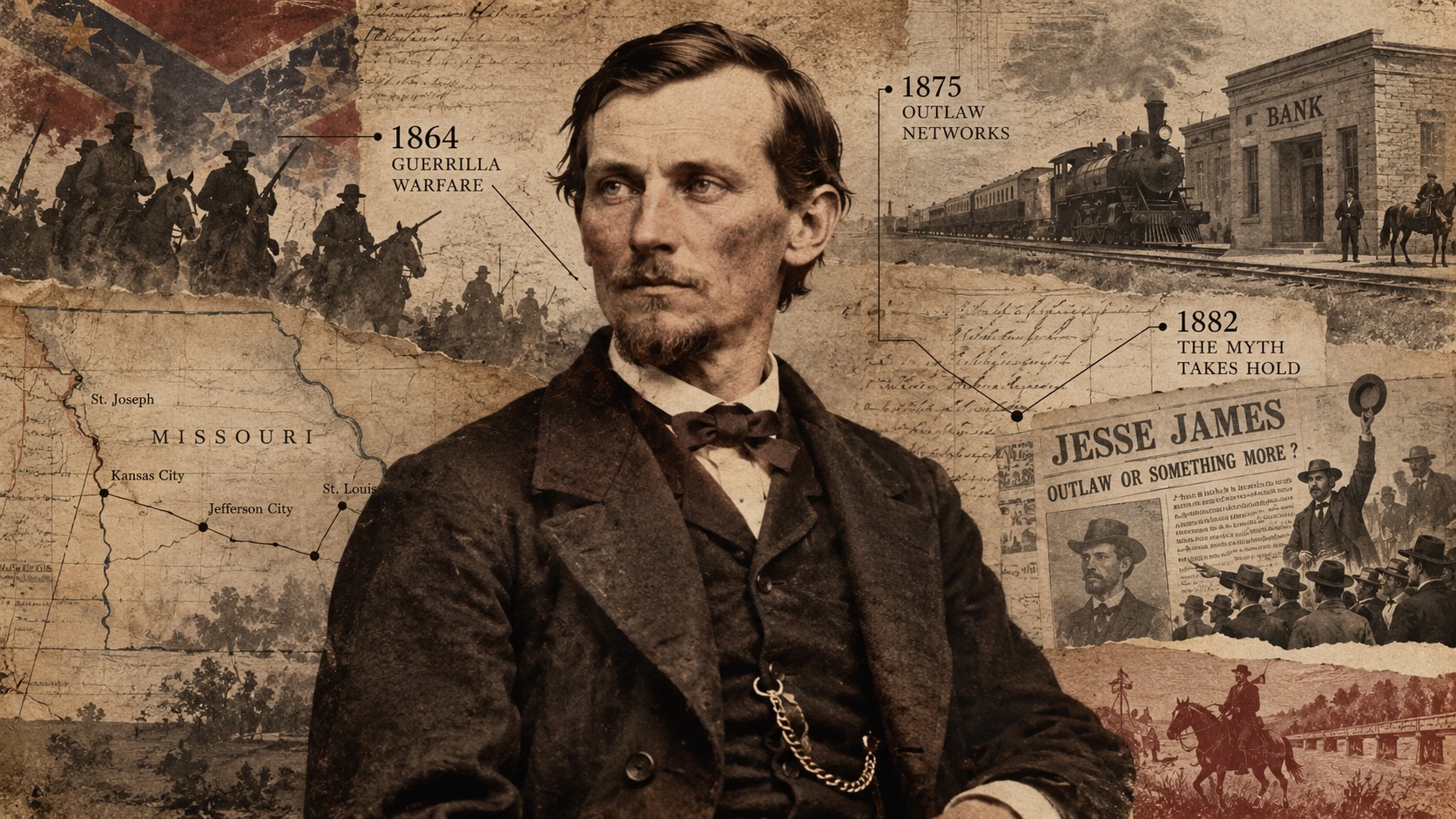
The Jesse James Confederate intelligence theory reframes one of America's most celebrated outlaws as something far more purposeful than a renegade bank robber: a covert operative whose postwar crimes allegedly served the strategic interests of a defeated but unreconciled Confederacy. In this telling, James's robberies of Union-aligned railroads and banks were not random acts of greed but calculated strikes against the economic infrastructure of Reconstruction, possibly coordinated through shadowy ex-Confederate networks. The Robin Hood image that attached itself to James during his lifetime — that of a noble bandit who stole from the powerful and sympathized with the poor — is recast not as spontaneous folklore but as deliberate political cover.
The theory draws genuine historical credibility from two well-documented facts: Jesse James really was a hardened Confederate guerrilla before he was an outlaw, and Southern journalists and sympathizers really did shape his public image in ways that served Lost Cause ideology. Where the theory becomes speculative is in asserting that these connections were organizational rather than cultural — that James answered to a command structure, operated as a disciplined agent, and that his violence was mission-directed rather than opportunistic.
Background
Jesse Woodson James was born in 1847 in Clay County, Missouri, a border state that experienced some of the Civil War's most vicious irregular combat. As a teenager he joined the guerrilla band led by William Quantrill and later "Bloody Bill" Anderson — Confederate-aligned partisans known for extreme brutality, including the 1863 massacre at Lawrence, Kansas. James participated in this world of bushwhacking, ambush, and revenge killing from roughly age sixteen. His older brother Frank James fought alongside him. By the war's end, both had been steeped in a culture that viewed Union soldiers, federal agents, and anyone perceived as a collaborator as legitimate targets.
After Appomattox, Jesse James — like thousands of ex-Confederates in Missouri — returned to a state under uneasy federal occupation. He was not pardoned, never formally surrendered on terms he accepted, and allegedly continued to be harassed by Union militia. These conditions are historically documented and form the foundation on which the later mythology was built.
The Theory and Its Claims
The core claim of the Confederate intelligence theory is that the James-Younger gang's criminal career was not simply tolerated by former Confederate networks but actively directed by them. Proponents often invoke the Knights of the Golden Circle, a secretive antebellum organization that had advocated for Southern expansion and was alleged to have continued operating underground after the war, as a possible organizing structure. According to this version of events, James's bank and train robberies targeted institutions that symbolized or funded Reconstruction, funneled proceeds to ex-Confederate causes, and were planned with a strategic logic invisible to outside observers.
A related strand of the theory concerns James's death — or alleged non-death. The official account holds that James was shot in the back of the head by gang member Robert Ford on April 3, 1882, in St. Joseph, Missouri, and buried in Kearney, Missouri. Survival legends, however, have persisted for well over a century. Some accounts claim James faked his death with the complicity of Ford and sympathetic officials, living on under an assumed name. As the legend holds, this escape was facilitated by the same covert Southern network that had protected him throughout his outlaw years. These claims have inspired numerous books and have led descendants of various men to petition for DNA testing of remains, producing contested results that have neither definitively confirmed nor refuted the official account.
Origins of the Myth
The Robin Hood image of Jesse James took shape largely through the work of John Newman Edwards, a former Confederate officer and influential Missouri newspaper editor. Edwards wrote admiringly of James in the Kansas City Times during the 1870s, portraying him as a noble victim of Yankee persecution forced into outlawry. Historians regard Edwards's journalism as a key mechanism by which James was transformed, in public perception, from a violent criminal into a romantic rebel. This documented relationship between James and his media advocates is the strongest factual anchor of the broader theory — Southern networks did actively construct his legend, and James was not an unwitting beneficiary.
Whether that collaboration extended to operational coordination of the gang's criminal activities is a separate question, and one the historical record does not resolve in favor of the theory.
Evidence and Skepticism
Mainstream historians who have studied the James gang — and the period is well researched — generally conclude that James was a product of wartime Missouri's culture of violence who never fully transitioned out of it, rather than an agent with ongoing strategic handlers. The robberies targeted whatever was profitable and accessible: small-town banks, express cars on trains, county fairs. The victims were often rural Missourians, not exclusively symbols of federal power. There is no recovered correspondence, no organizational ledger, and no deathbed confession that establishes a functioning command relationship between James and any postwar Confederate structure.
The Knights of the Golden Circle connection, which appears in many versions of the theory, suffers from an evidentiary problem common to secret society claims: the organization's alleged postwar activities are largely undocumented precisely because it was supposedly secret. Historians find no evidence of a coherent KGC operating as a criminal coordinating body in the 1870s.
The survival legends face a more concrete evidentiary problem. A body was identified by James's mother and buried; subsequent DNA analysis of remains attributed to James, while debated in its methodology and chain of custody, has not produced results that historians regard as overturning the death record.
Legacy
Whatever the limits of the covert-operative theory, its cultural persistence reveals something real about how Americans have processed the Civil War's unfinished aftermath. Jesse James became a vehicle for Lost Cause sentiment, for agrarian resentment of industrial capitalism, and for outlaw romanticism — all at once. The theory that his crimes were purposeful rather than merely predatory is, in a sense, a further mythologization: it grants James the dignity of ideology and planning, transforming him from a violent opportunist into a coherent historical actor.
That transformation is itself historically significant. The construction of Jesse James as a Confederate hero-in-exile tells us more about the postwar South's psychological need for dignified resistance than it does about James's actual motivations. The man who was genuinely shaped by guerrilla warfare, genuinely celebrated by former Confederate journalists, and genuinely killed in a Missouri farmhouse in 1882 has proven capacious enough to contain all of these projections — which is perhaps the most conspiratorial thing about him.