
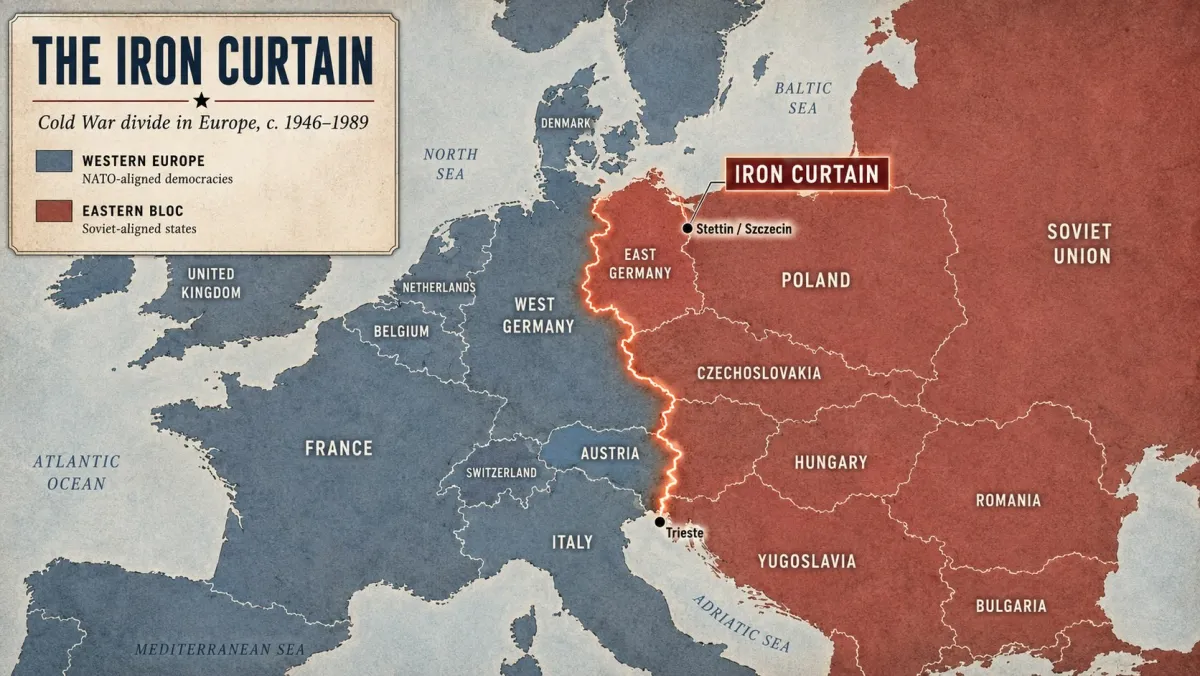
Overview
The "Iron Curtain as Physical Wall" theory imagined Europe’s postwar division not only as a political reality but as a hidden engineered barrier. In some versions, a giant magnetic field stretched across the East-West divide. In others, the barrier was electrified, radio-controlled, or based on secret Soviet technology that repelled metal, disabled vehicles, confused compasses, or physically harmed anyone attempting to cross. The theory represented a literalization of the Cold War’s most famous metaphor.
Historical Context
When Winston Churchill described an "iron curtain" descending across Europe in 1946, he was speaking metaphorically about political and military separation. But the early Cold War quickly surrounded that metaphor with real material practices: borders hardened, crossings became restricted, surveillance expanded, and electronic warfare—including jamming and signal interference—became a genuine field of concern.
That environment encouraged literal interpretations. To ordinary observers, radio jamming, blocked communications, closed frontiers, and the new language of electromagnetic warfare could seem like pieces of one larger hidden machine. By the time the Berlin Wall rose in 1961, many rumors about invisible barriers had already circulated in lesser forms, preparing the cultural ground for a visible wall to confirm older fears.
Core Claim
The metaphor concealed a real technological barrier
Believers said "Iron Curtain" was not only a phrase but a hint about the true nature of the East-West divide.
Soviet science had produced a hidden border mechanism
The theory often attached itself to new fears about radar, radio waves, magnetism, and electrical control.
The barrier preceded visible walls
In this reading, the Berlin Wall was merely a public simplification of a more sophisticated and already existing system of separation.
Documentary Record
The historical record strongly supports the metaphorical origin of the phrase "Iron Curtain." It also strongly supports the existence of early Cold War jamming, electronic warfare, surveillance, and increasingly restrictive border control regimes. What is not clearly established is a literal continental "magnetic wall" between East and West.
The theory is therefore best understood as a fusion of real elements: metaphor, radio jamming, sealed borders, and fear of hidden scientific weapons. The exact wording varied from rumor to rumor, and the public record under that exact phrase is limited, but the structure is consistent with early Cold War speculation about invisible technologies operating behind the frontier.
Why It Spread
The phrase invited literalization
"Iron Curtain" already sounded like a physical object.
Invisible technologies were becoming politically central
Radar, radio, jamming, and electromagnetic terms entered public discourse faster than most people could understand them technically.
Borders were becoming harder to read
The line between metaphorical closure and physical closure grew thinner as checkpoints, patrols, fences, and electronic systems expanded.
The Cold War rewarded technological speculation
Many people believed the Soviet bloc possessed secret weapons or scientifically advanced control systems hidden from the West.
Legacy
The theory survived in later stories about electrified frontiers, radar fences, invisible beams, and mind-altering or disabling energy systems along national borders. Historically, it belongs less to a single proven device than to the transition from metaphor to apparatus: the period when political division, electronic warfare, and rumor about invisible force all merged into one image of an unseen continental wall.