
Overview
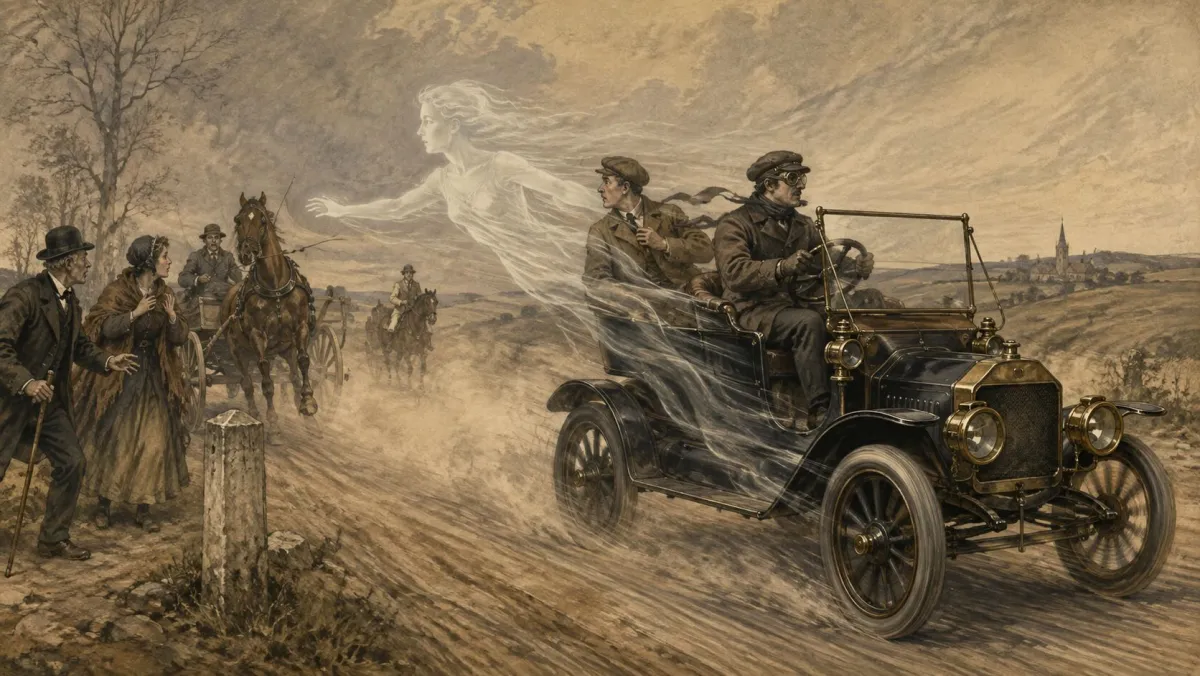
The "Automobile" as soul-catcher theory imagined the motor car not just as a machine of transport but as a force that could outrun the human self. In this view, the body could be carried forward faster than the soul could follow.
Historical basis
Early motoring generated intense social alarm. Critics objected to speed, dust, noise, smell, danger to pedestrians, disruption of animal traffic, and the breakdown of older rhythms of travel. Roads that had long belonged to walkers, horse riders, and carts suddenly became spaces of mechanical acceleration.
Although much of this criticism was practical, the cultural shock of motorized speed also invited metaphysical language. When a technology changes the felt experience of time and motion, ordinary moral criticism often expands into spiritual imagery.
From horse pace to machine pace
Horse-drawn travel was familiar, organic, and bounded by the limits of animal movement. The automobile shattered those expectations. It removed the visible effort of the creature doing the work and replaced it with concealed combustion and mechanical speed. That made the car seem inhuman in a literal sense: it moved without living motive power.
In that context, the idea that going "faster than a horse" might leave the soul behind expressed a broader worry that technology was exceeding the proper speed of human life.
The soul-loss motif
The soul-loss motif has appeared in many modernity narratives, especially where new transportation compresses time and space abruptly. Rather than a technical claim, it usually serves as a cultural diagnosis: acceleration makes people less whole, less present, or less human.
In the automobile context, it could be voiced as satire, superstition, pastoral complaint, or anti-modern warning. The image of the car as a "soul-catcher" intensified the claim by suggesting that the machine did not merely outpace the soul but captured or detached it.
Moral and bodily dimensions
The theory also intersected with early debates about nerves, overstimulation, and bodily stress. Rapid travel was sometimes said to exhaust the senses or disorganize perception. Spiritual language and medical language therefore overlapped: what one person called nervous shock, another might call spiritual dislocation.
Evidence and assessment
The historical record strongly supports a major cultural backlash against early motoring and a wider critique of speed as socially and psychologically disruptive. It also shows that modern vehicles attracted quasi-spiritual language about dehumanization and estrangement. What is not well documented is a single formal doctrine about the soul literally being left behind at a specific speed threshold. The theory is best understood as a folkloric crystallization of anti-speed sentiment.
Legacy
The soul-catcher idea persists because it captures a broader truth about modernization panics: when machines move faster than inherited habits can explain, spiritual metaphors rush in to describe the gap.