
Overview
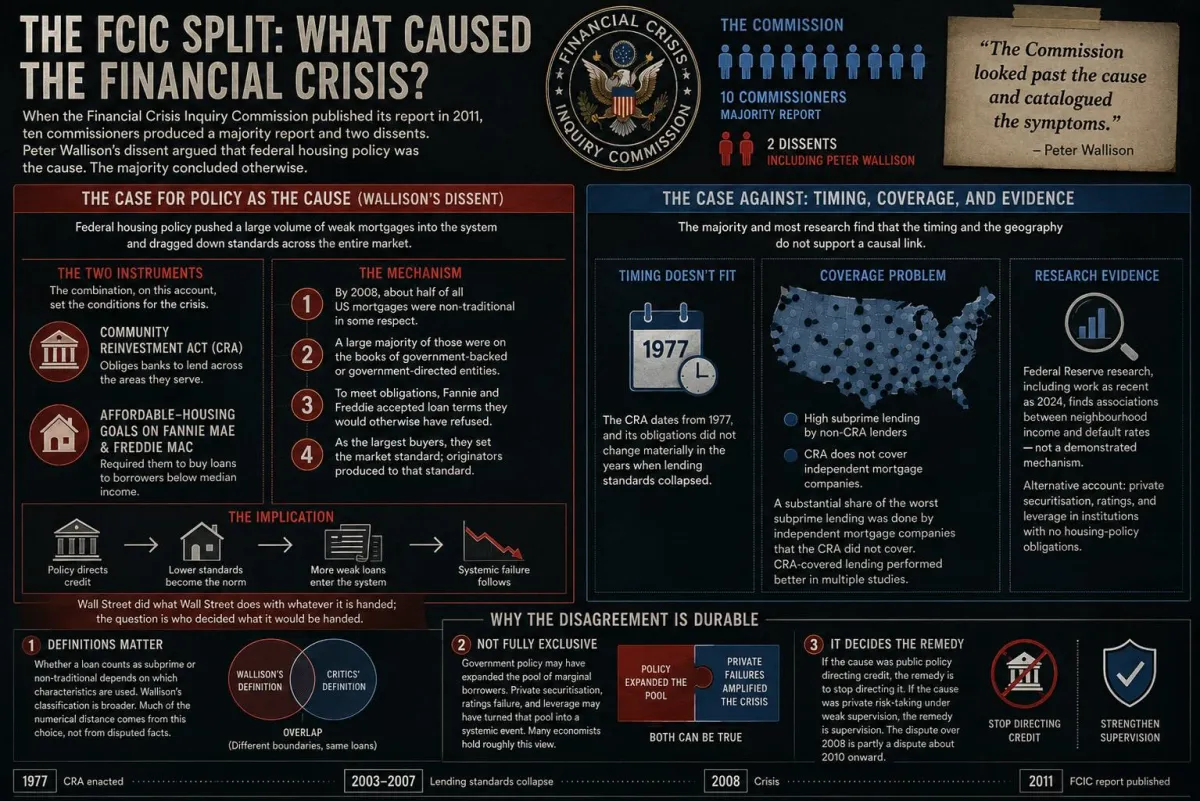
When the Financial Crisis Inquiry Commission published its report in 2011, it did not speak with one voice. Ten commissioners produced a majority report and two dissents. The sharper of the two came from Peter Wallison, who argued that the majority had looked past the cause and catalogued the symptoms.
His position, set out at length, was that federal housing policy was the condition without which the crisis would not have happened. The two instruments he named were the Community Reinvestment Act, which obliges banks to lend across the areas they serve, and the affordable-housing goals imposed on Fannie Mae and Freddie Mac. Between them, on his account, they pushed a very large volume of weak mortgages into the system and dragged underwriting standards down across the whole market.
The majority reached the opposite conclusion, finding little support for the idea that either programme materially contributed. The disagreement has not narrowed much since.
The case for policy as the cause
The argument is essentially about volume and timing. Wallison's contention is that by 2008 roughly half of all US mortgages were non-traditional in some respect, and that a large majority of those sat on the books of government-backed or government-directed entities. If the weak loans were concentrated where public policy was pushing hardest, the inference runs, the policy is not one factor among many but the mechanism.
The supporting claim is about standards. Once Fannie and Freddie were obliged to buy a rising share of loans to borrowers below median income, the argument goes, they had to accept documentation and down-payment terms they would otherwise have refused. Because they were the largest buyers in the market, what they accepted became what originators produced, and private lenders followed a floor that the government had lowered.
On this reading the private-label securitisation boom is downstream. Wall Street did what Wall Street does with whatever it is handed; the question is who decided what it would be handed.
The case against
The majority's objection, and that of most researchers who have tested it, is that the timing and the geography do not fit.
The Community Reinvestment Act dates from 1977, and the obligations it imposes did not change materially in the years when lending standards collapsed. A statute that had been in force for three decades is an awkward candidate for the cause of something that happened in a five-year window.
More pointed is the coverage problem. A substantial share of the worst subprime lending was done by independent mortgage companies that the CRA did not cover at all. If the Act were driving the deterioration, the institutions bound by it should have produced the worst loans; several studies find the opposite pattern, with CRA-covered lending performing better than comparable lending outside it.
Researchers at the Federal Reserve, revisiting the question repeatedly including in work published as recently as 2024, have generally found that the evidence for a causal link amounts to associations between neighbourhood income and default rates rather than a demonstrated mechanism. Their alternative account puts the weight on private securitisation, the ratings applied to it, and leverage in institutions that had no housing-policy obligations at all.
Why the disagreement is durable
Part of it is definitional. Whether a loan counts as subprime or non-traditional depends on which characteristics are used, and Wallison's classification is broader than the one his critics use. A great deal of the numerical distance between the two camps comes from that choice rather than from disputed facts, which is why each side can present figures that appear to settle the matter.
Part of it is that the two accounts are not fully exclusive. It is possible to hold that government policy expanded the pool of marginal borrowers and that private securitisation, ratings failure and leverage turned that pool into a systemic event. Several economists occupy roughly that position, and it satisfies neither camp.
And part of it is that the question decides what should be done next. If the cause was public policy directing credit, the remedy is to stop directing it. If the cause was private risk-taking under weak supervision, the remedy is supervision. The dispute over 2008 has always partly been a dispute about 2010 onward.