
Overview
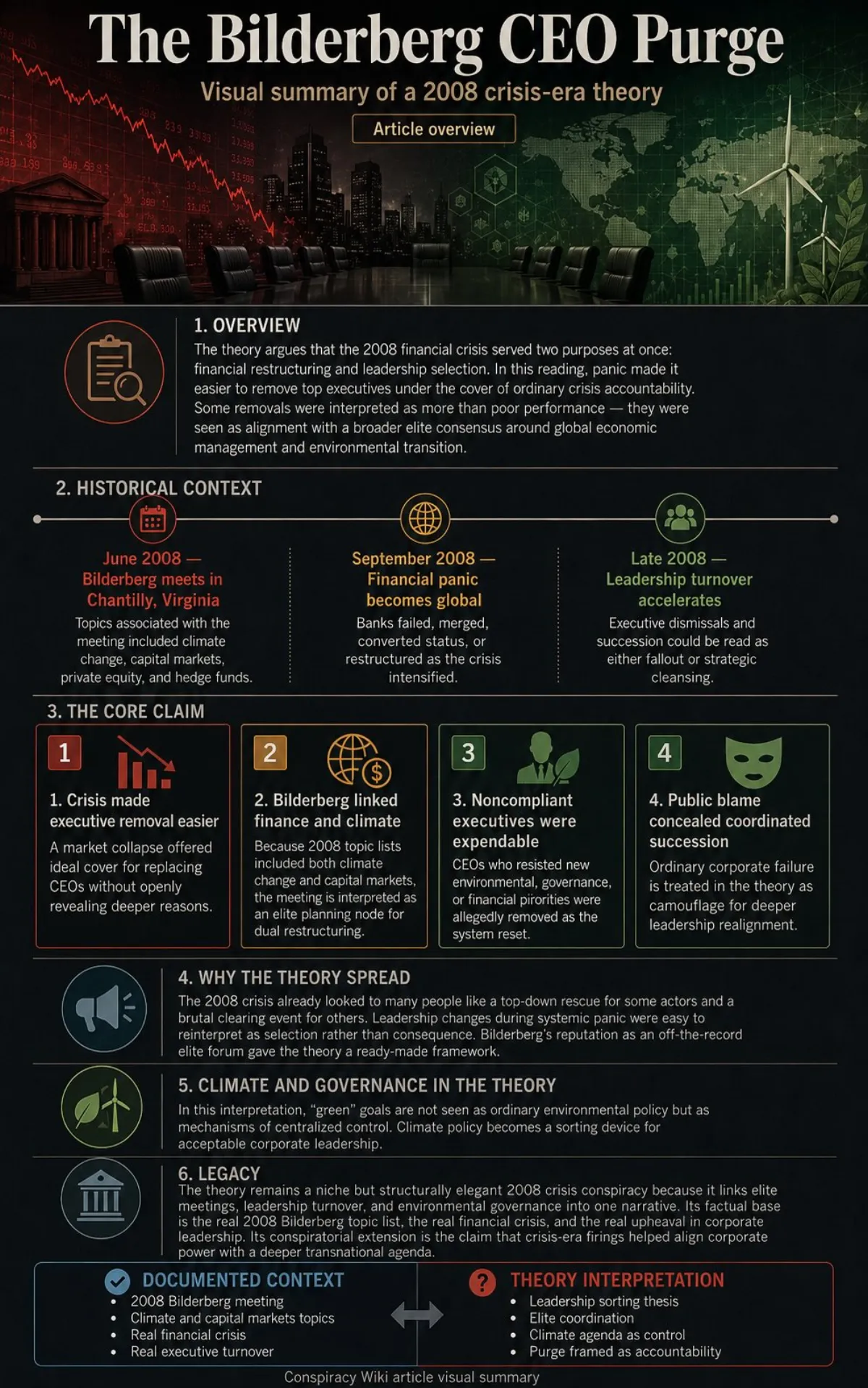
The Bilderberg CEO Purge theory argues that the 2008 crisis served two purposes at once: financial restructuring and leadership selection. It claims that the panic atmosphere made it easier to replace high-level executives under the cover of ordinary crisis accountability. According to the theory, some of those removals reflected not merely performance failure, but noncompliance with a larger elite consensus taking shape around global economic management and environmental transition.
The Bilderberg meeting enters the theory because its 2008 agenda publicly included both climate change and capital markets, creating a symbolic bridge between finance crisis and elite environmental planning.
Historical Context
The 2008 Bilderberg meeting took place in Chantilly, Virginia, in June 2008, before the most famous September phase of the crisis. Topic lists later associated with the meeting included climate change and current affairs related to capital markets, private equity, and hedge funds. Public participant lists also show the continued presence of major political, financial, and corporate figures.
Meanwhile, the crisis itself accelerated leadership turnover across finance and business. Large banks failed, merged, converted status, or restructured. In such an environment, dismissals and succession could easily be read as strategic cleansing rather than organic fallout.
The Core Claim
The theory usually includes several linked ideas:
crisis made executive removal easy
A market collapse offered ideal cover for replacing CEOs without openly revealing deeper reasons.
Bilderberg linked finance and climate
Because 2008 topic lists included both climate change and capital markets, the theory reads the meeting as an elite planning node for dual restructuring.
noncompliant executives were expendable
CEOs who resisted new environmental, governance, or financial priorities were allegedly removed as the system reset.
public blame concealed coordinated elite succession
The appearance of ordinary corporate failure is treated as camouflage for deeper leadership alignment.
Why the Theory Spread
The theory spread because the 2008 crisis already looked like a top-down rescue for some actors and a brutal clearing event for others. When leadership changes occur during systemic panic, they are easy to reinterpret as selection rather than consequence.
It also spread because Bilderberg has long symbolized off-the-record elite consensus building. Once climate change appeared alongside capital-markets discussion in the same 2008 meeting environment, conspiracy culture had all the ingredients it needed.
Climate and Governance in the Theory
This theory often reflects a broader New World Order reading in which “green” goals are not seen as environmental in the ordinary sense, but as mechanisms of centralized control. In that frame, climate policy becomes a sorting device for acceptable corporate leadership.
Legacy
The Bilderberg CEO Purge theory remains one of the more niche but structurally elegant 2008 crisis conspiracies because it links elite meetings, leadership turnover, and environmental governance into one continuity. Its factual base is the real 2008 Bilderberg topic list, the real crisis, and the real upheaval in corporate leadership. Its conspiratorial extension is that crisis-era firings helped align high-level corporate power with a deeper transnational agenda rather than simply punishing failure.