
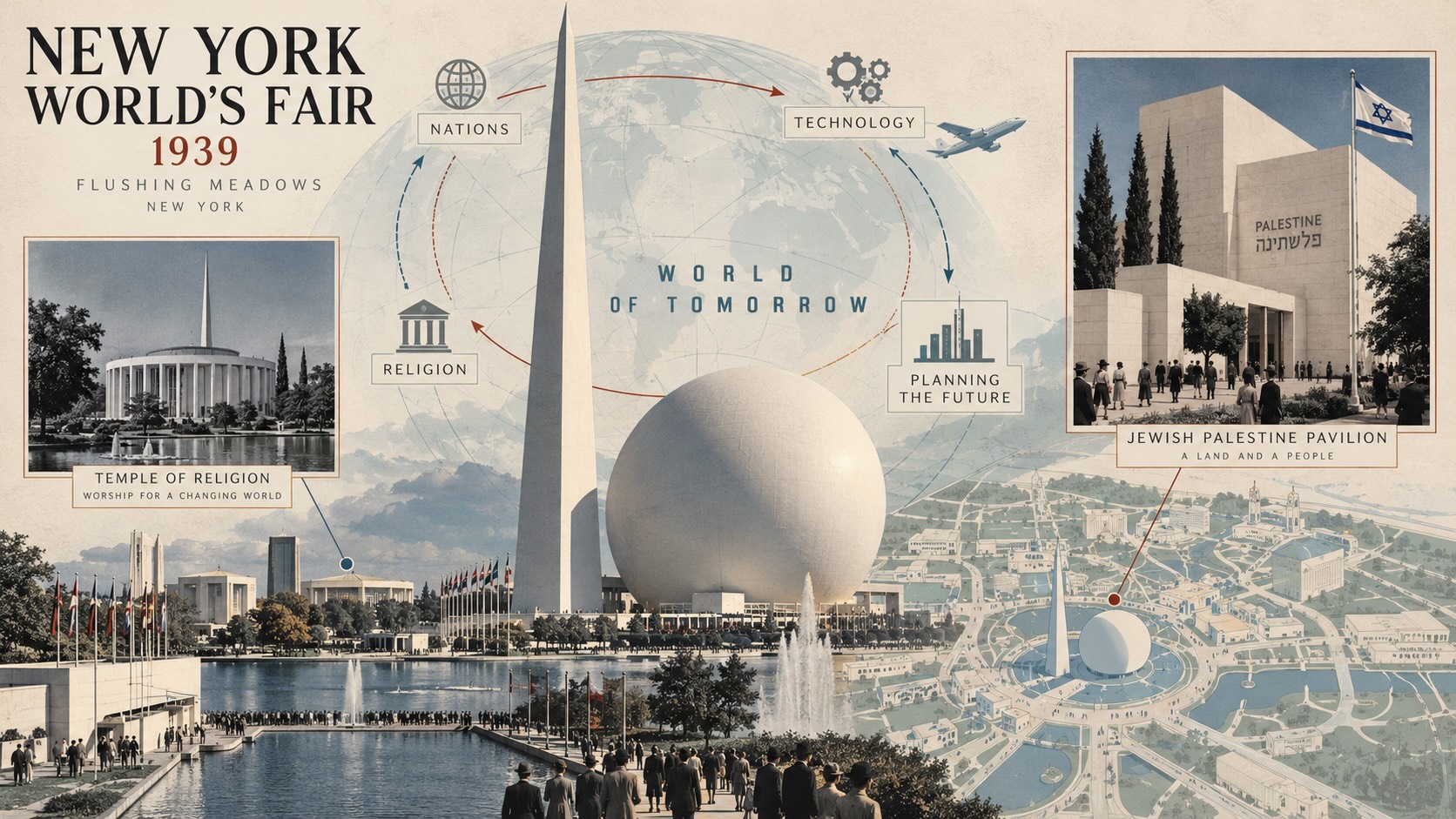
Overview
The Zionist World Fair theory argued that the 1939 New York World’s Fair was not merely futuristic entertainment or civic optimism during the Depression. It was a visual program for global reorganization. In this reading, the “World of Tomorrow” was a planned world.
The theory did not depend on one exhibit alone. It treated the fairgrounds as a whole symbolic environment in which technology, religion, nations, and future planning were brought into one map-like space.
Historical Background
The 1939 New York World’s Fair opened in Flushing Meadows under the theme “The World of Tomorrow.” It included national pavilions, a Temple of Religion, corporate visions of planned modernity, and the famous Trylon and Perisphere as central symbolic structures. It also included the Jewish Palestine Pavilion, an explicitly political and cultural exhibit designed to promote awareness of Jewish life and aspirations in Palestine.
These elements are historically documented. The theory’s work was to connect them into one system.
The Jewish Palestine Pavilion
The Jewish Palestine Pavilion is central to the “Zionist” version because it was real, official, and openly advocacy-oriented. It promoted the idea of Jewish state-building and presented Palestine as a site of national future. For critics already inclined toward grand unification theories, this meant the fair contained not just neutral display but political blueprinting.
The pavilion therefore served as a bridge between ordinary world-fair spectacle and theories of hidden global reordering.
Trylon, Perisphere, and Masonic Reading
The fair’s two most famous forms—the Trylon and the Perisphere—were highly abstract and instantly symbolic. Anti-Masonic interpreters found such geometry especially suggestive. Their very simplicity made them easy to recode as initiatory or technocratic signs.
In the strongest version of the theory, the fair’s visual center was not simply modern design. It was ritual architecture announcing a new planetary order.
From Future Planning to World Government
World’s fairs had long used models, maps, and spectacles to imagine future life. The 1939 fair intensified this tendency by presenting transportation systems, planned communities, and consumer-technological futures in integrated form. The theory turned that integration into governance. A world pictured together was a world meant to be ruled together.
This is how the theory moved from architecture to politics. The fair was not just showing tomorrow. It was legislating it symbolically.
Temple of Religion and Secular-Sacred Fusion
The presence of a Temple of Religion helped the theory enormously. When religion itself appears within a managed future-city exhibition, the line between spiritual space and world-planning space can seem to dissolve. In conspiratorial interpretation, that dissolution is deliberate.
Thus the fair becomes not only a technological map but a sacred-political map, a place where global order is given ritual form.
Why the Theory Persisted
The theory persisted because world’s fairs really do condense aspiration, symbolism, design, and geopolitics into one dramatic site. The 1939 fair in particular took place on the eve of global war, which made its futurism seem retrospectively ominous.
It also persisted because the Jewish Palestine Pavilion provided a real political-national project inside a broader environment already saturated with universalist imagery.
Historical Significance
The Zionist World Fair (1939) theory is significant because it transforms a major exposition into a total systems diagram of future governance. It treats world-fair spectacle as pre-legislation in symbolic form.
As a conspiracy-history entry, it belongs to the family of exhibition-blueprint theories, in which large public displays are believed to reveal the planned architecture of future political order under the guise of culture, progress, and international cooperation.