
Overview
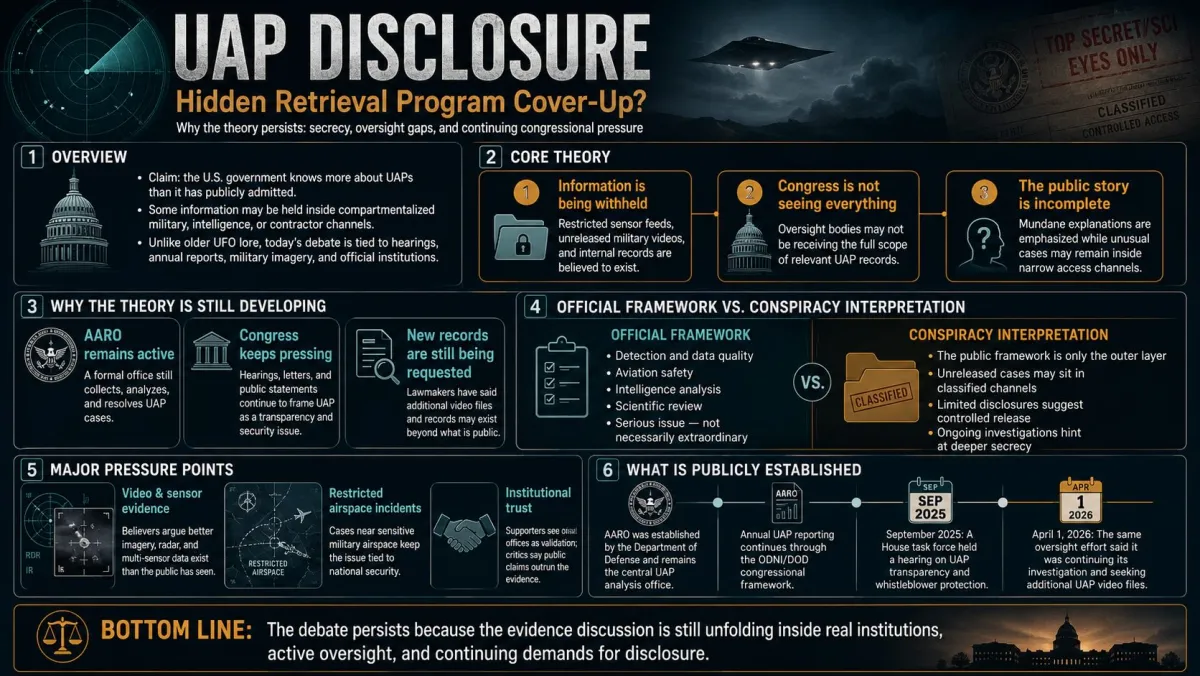
This entry concerns the modern UAP disclosure controversy: the belief that the United States government knows more about unidentified anomalous phenomena than it has publicly admitted, and that some of that information may be held inside compartmentalized military, intelligence, or contractor channels.
Unlike older UFO narratives built mainly on folklore or isolated witness testimony, the current version of the theory developed around official institutions, formal hearings, annual reports, military imagery releases, and congressional demands for more disclosure. That has made it one of the most active and still-unfolding conspiracy subjects in the United States.
Core Theory
The central claim is not always identical from one source to another, but most versions share the same basic structure.
Information is being withheld
Supporters argue that key UAP data remains classified or tightly controlled. They point to restricted sensor feeds, unreleased military videos, and the existence of internal records not broadly available to the public.
Congress is not seeing everything
A major version of the theory says that even where some reporting exists, the full scope of relevant records has not been provided in a transparent or complete way to oversight bodies. This concern became a major theme in congressional discussion about UAP transparency and whistleblower access.
The official public story is incomplete
Another version of the theory holds that public-facing explanations focus on mundane identifications, air-safety concerns, or data limitations while more unusual cases remain buried inside narrow access channels.
Why the Theory Is Still Developing
This theory remains active because it is not based only on historical claims. It is tied to institutions and processes that are still operating.
AARO remains active
The All-domain Anomaly Resolution Office exists specifically to collect, analyze, and resolve UAP cases. Its continued existence reinforces the idea that the issue is considered real enough to warrant a formal government structure.
Congress is still pressing the issue
Congressional interest has not ended. Hearings, letters, and public statements continue to frame UAP as both a transparency issue and a potential security issue involving sensitive airspace and military readiness.
New records are still being requested
The theory has continued to develop because lawmakers have publicly stated that additional video files and records may exist beyond what has already been shown publicly.
Official Framework Versus Conspiracy Interpretation
The official framework presents UAP as a problem of detection, data quality, aviation safety, intelligence analysis, and scientific review. In that framework, the issue is serious but not necessarily extraordinary.
The conspiracy interpretation treats that same framework as incomplete. To believers, the language of anomaly resolution and case management may describe only the visible outer layer of a larger classified reality. In that reading, ongoing investigations, limited disclosures, and repeated references to unreleased material are not signs of normal bureaucratic caution but of a controlled disclosure process.
Major Pressure Points in the Current Debate
Video and sensor evidence
One of the strongest recurring themes is the claim that better imagery, radar data, and multi-sensor records exist than what the public has seen. This remains central because congressional investigators have specifically requested access to additional video files.
Restricted airspace incidents
The theory draws strength from repeated discussion of UAP in or near sensitive military airspace. Even without a publicly accepted extraordinary explanation, those incidents keep the subject linked to national security rather than only to popular culture.
Institutional trust
The modern UAP theory is also about credibility. Supporters often argue that official offices exist because the phenomenon is more serious than prior dismissals allowed, while critics argue that the public discussion often outruns the available evidence.
What Is Publicly Established
Several parts of the story are public and documented.
AARO was established by the Department of Defense and remains the central office for UAP-related analysis. Annual reporting on UAP is required through the congressional framework referenced in the ODNI and DOD reporting process. A House task force held a hearing on UAP transparency and whistleblower protection in September 2025. On April 1, 2026, that same oversight effort publicly stated that it was continuing its investigation and seeking additional UAP video files.
What Remains Unresolved
The enduring force of the theory comes from what has not been settled.
Are unreleased records merely sensitive, or significant?
No public consensus exists on whether withheld materials are being protected for routine classification reasons or because they would materially change public understanding of the issue.
Is the gap about bureaucracy or concealment?
One interpretation sees slow disclosure as normal interagency friction. The stronger conspiracy interpretation sees the same delays as evidence of deliberate concealment.
Will current inquiries produce a decisive shift?
Because congressional and departmental activity is still ongoing, the theory remains open-ended. Its next stage depends on whether more records, videos, or testimony become public and whether those disclosures clarify or deepen the mystery.
Significance
This is one of the rare modern conspiracy theories that operates in parallel with official institutions rather than entirely outside them. It survives because it is fed by real hearings, real offices, real reporting requirements, and persistent claims that the public record remains incomplete. As long as investigations continue and access disputes remain unresolved, the theory is likely to remain active.