
Overview
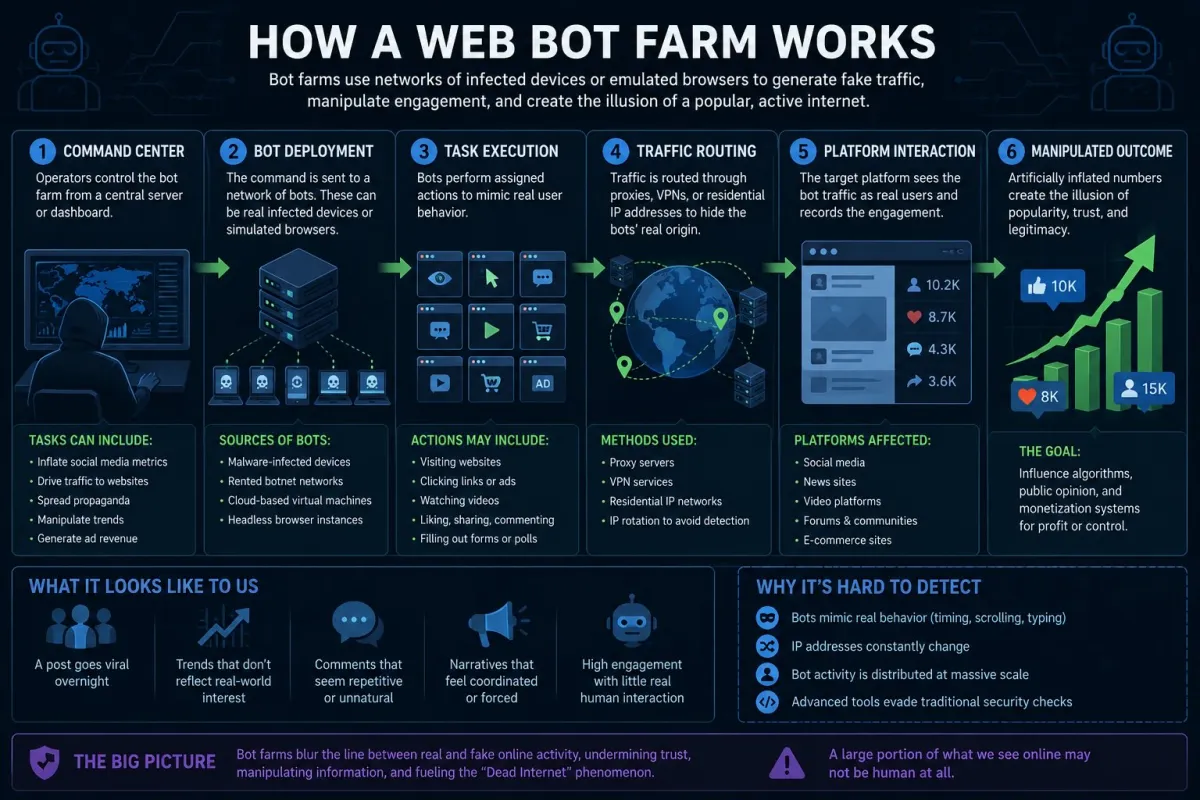
The Dead Internet Theory is one of the defining internet-native conspiracies of the late 2010s and 2020s. It argues that what users experience online as public conversation is increasingly synthetic: bots, SEO sludge, repost loops, AI images, managed trends, and algorithmic curation standing in for genuine human presence.
Historical Context
The theory took shape in an environment already transformed by bots, recommendation systems, engagement farming, and industrialized content production. In 2021, The Atlantic traced the theory’s “ur-text” to an Agora Road Macintosh Cafe thread titled “Dead Internet Theory: Most of the Internet is Fake,” where the idea was framed as the internet having effectively died in 2016 or early 2017.
The same article described the theory as wrong in its strongest form but resonant because it contains a “morsel of truth.” That truth is partly quantitative. Imperva’s 2023 Bad Bot Report said 47.4% of internet traffic in 2022 was automated traffic, with human traffic continuing to decline as a share of total measured activity. Later mainstream commentary, including The Guardian, treated the theory as exaggerated but newly relevant in the age of generative AI and growing bot visibility.
Core Claim
Most apparent online activity is synthetic
Believers argue that social-media accounts, traffic, and even entire communities are largely automated or machine-assisted.
The replacement was purposeful
In stronger versions, governments, corporations, or intelligence-linked actors deliberately amplified bots to shape perception and reduce authentic social life.
2016 marked the transition point
The theory often uses the mid-2010s as the moment when online reality tipped from messy-human to algorithmically managed.
Why the Theory Spread
Bots really are common
The theory gained traction because its basic atmosphere corresponds to a measurable rise in automated traffic and visible bot behavior.
AI made the theory feel newly literal
Once text, images, and comments could be generated cheaply at scale, the difference between paranoid metaphor and observable trend narrowed.
Many users feel the web has become repetitive and sterile
Perceived drops in spontaneity, originality, and human weirdness gave the theory emotional credibility even where documentary proof remained weak.
Documentary Record
The public record strongly supports that the Dead Internet theory exists as a recognizable online conspiracy theory, that its key modern articulation spread through a 2021 forum post, and that large shares of internet traffic are automated. Imperva’s data show a substantial bot share of total traffic, and mainstream coverage recognizes that users increasingly encounter bot-like or AI-mediated behavior.
What the public record does not support is the strongest version of the theory: that the majority of online people and discourse are part of a coordinated manipulation system replacing human society wholesale. That broader claim remains speculative.
The 2025–2026 Evidence
By the mid-2020s the "morsel of truth" had become harder to wave off. An analysis of roughly 900,000 newly created web pages in April 2025 found that about three-quarters carried AI-generated text, leaving only about a quarter entirely human-written. Estimates circulated that a large share of accounts on some platforms were likely automated and that more than half of long-form posts on professional networks were AI-generated. These figures come from different methods and definitions and should not be treated as fixed constants, but the direction is consistent.
The sharpest edge of the trend is the synthetic persona. Virtual "influencers" — convincing faces and voices with no human behind them — are cheaper to run and easier to control than real ones, and a venture-funded industry has grown up to mass-produce them, with one video-generation and face-swap tool reported to have raised well over a hundred million dollars at a billion-dollar-plus valuation in early 2026. None of this requires a coordinated psyop; it is a market, and it is booming — which is part of why the leaner version of the theory keeps inching toward the measurable even as its totalizing form stays unproven.
Variants: "AI Slop", the "Confirmed Edition", and the 2024–2026 Peak
As generative AI spread, the theory hardened into several overlapping variants. A "confirmed edition" recast the older suspicion as a numerical claim — that by 2024 machine-written text, bot traffic, and synthetic social behavior had tipped past authentic human participation, sometimes pinned at a dramatic "90%." The label did not signal mainstream confirmation; it meant believers felt the metrics had finally caught up to the theory.
The same period gave the theory a vivid new vocabulary in "AI slop" — cheap, repetitive, often surreal machine-generated material optimized for visibility rather than meaning, spreading across search results, feeds, and content farms. More restrained versions dropped the state-manipulation claim and focused on platform economics: recommendation systems reward volume regardless of whether the source is human, and generative tools have collapsed the cost of manufacturing text, images, voices, and entire social identities. The 2024–2026 stretch is often described as the theory's peak, when it shifted from a fringe metaphor about bots into a broad umbrella for anxieties about authenticity and synthetic consensus.
Historical Meaning
This theory matters because it translates a real structural change—the automation of attention—into a civilizational claim that the web itself has died. It is less a single allegation than a diagnosis of digital unreality.
Legacy
The Dead Internet Theory has become the master conspiracy of the AI web. It provides a language for describing why so much online life feels repetitive, synthetic, and strategically managed, even when the evidence does not support its most totalizing form.