
Overview
The 2002 World Cup, co-hosted by South Korea and Japan, was the first held in Asia. South Korea, coached by Guus Hiddink, became the first team from the continent to reach a World Cup semifinal. Their run was thrilling — and intensely disputed, because two of their knockout victories featured officiating decisions that many observers, especially in Italy and Spain, considered indefensible.
The Italy Match
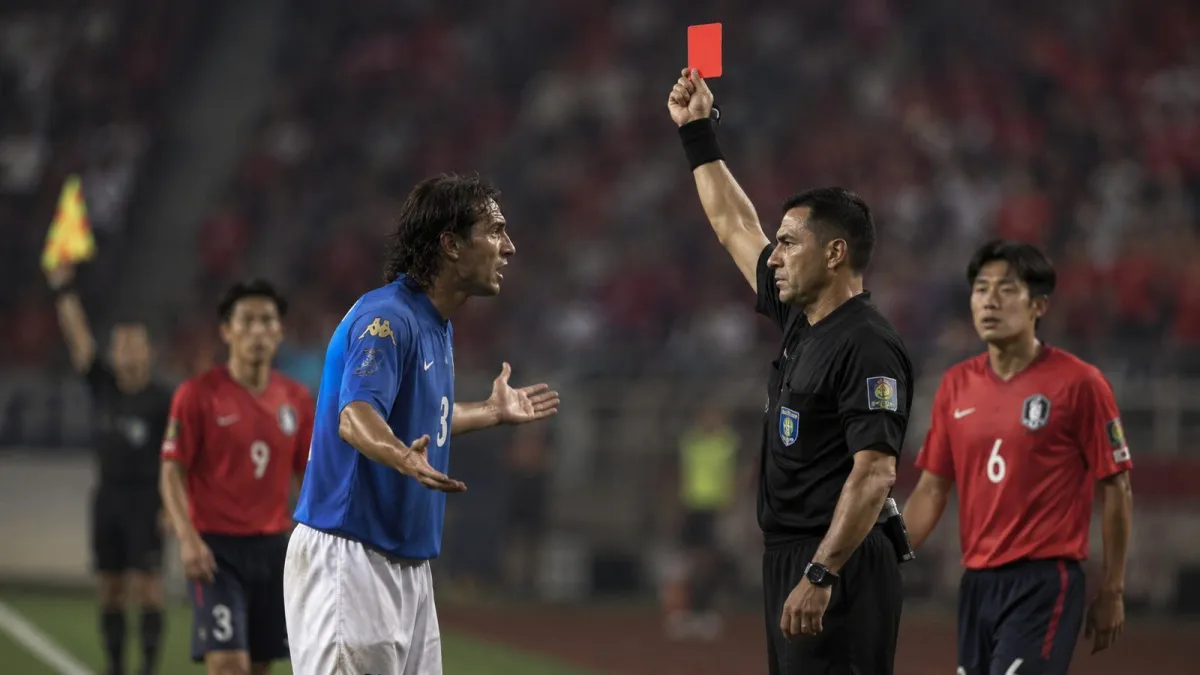
In the round of 16, South Korea beat Italy 2–1 with a golden goal in extra time. The match, refereed by Ecuador's Byron Moreno, became infamous: Italy's Francesco Totti was sent off for a second yellow card for an alleged dive that replays suggested was a genuine penalty, and a Damiano Tommasi "golden goal" was disallowed for offside in a call widely regarded as incorrect. Italian players and media reacted with fury, alleging the host nation had been favoured.
The Spain Match
In the quarterfinal, South Korea beat Spain on penalties after a 0–0 draw refereed by Egypt's Gamal Al-Ghandour. Spain had two goals disallowed during the match — one for a ball ruled to have gone out of play before a cross, another for a contested foul — both decisions that Spanish players and commentators bitterly disputed.
The Theories
The recurring pattern of decisions against strong European sides, in matches the hosts went on to win, gave rise to several theories:
- That officials consciously or unconsciously favoured the co-hosts to keep a popular underdog story — and Asian television audiences — alive.
- That commercial interests in a successful host run influenced the tournament's atmosphere.
- In the strongest versions, that decisions were corruptly arranged.
The Referee's Later Career
Byron Moreno's subsequent career deepened suspicion in the eyes of theorists. He was suspended in Ecuador over controversial domestic matches and eventually left officiating. In 2010 he was arrested at New York's JFK airport attempting to smuggle heroin and was later imprisoned in the United States. While entirely unrelated to the 2002 World Cup, the conviction was widely cited by those who believed the Italy match had been crooked.
Counterpoints
No investigation ever established corruption in the 2002 knockout matches, and FIFA stood by the results. Defenders note that South Korea were a genuinely well-organised, athletic side under a world-class coach; that 2002 predated video review, when major officiating errors were common in every round; and that aggrieved nations frequently see conspiracy in decisions that go against them. The Spain and Italy calls are widely regarded as serious errors rather than proven fixes.
Legacy
The 2002 knockout rounds remain a touchstone in debates about refereeing standards and host-nation bias, and are frequently cited as part of the case for the video assistant referee (VAR) technology later introduced to the World Cup.