
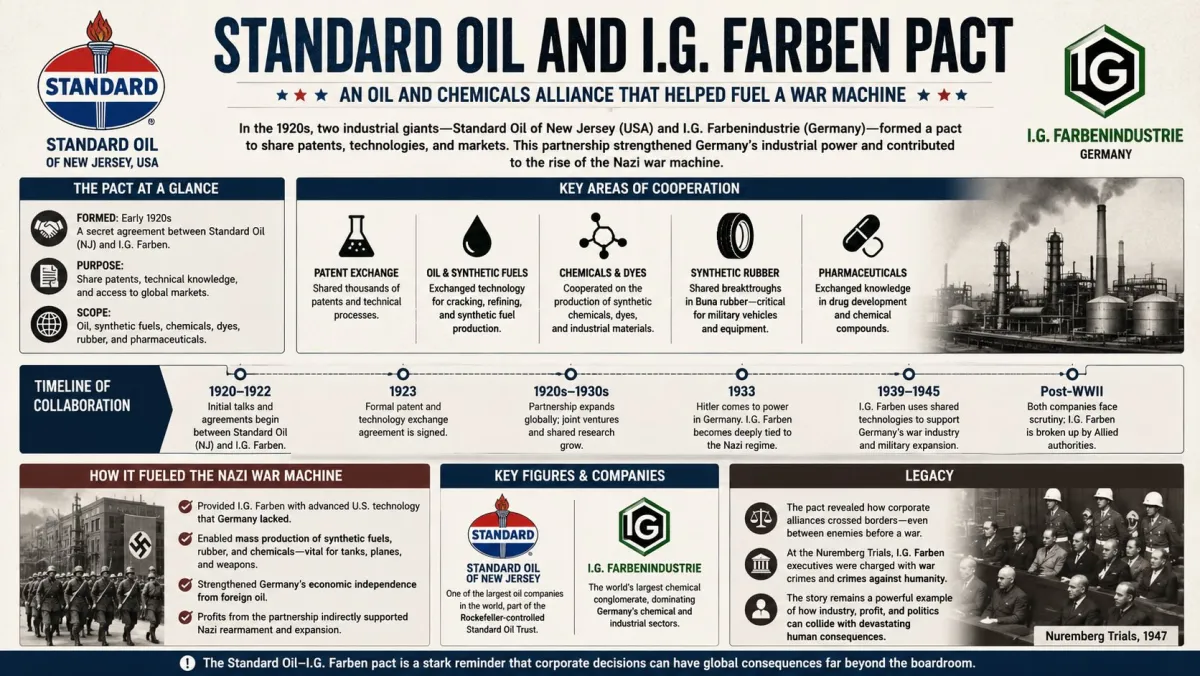
Overview
The Standard Oil I.G. Farben Pact theory is one of the most durable corporate-war conspiracies of the twentieth century. It begins from a documented foundation of interwar commercial cooperation and then extends that foundation into wartime mutual protection.
Historical Context
Standard Oil and I.G. Farben were deeply involved in prewar international business relationships. These included patent-sharing, licensing, and strategic commercial arrangements tied to chemical production and synthetic fuels. Such ties were controversial even before the United States entered the war because they suggested that global industry could transcend national rivalry.
I.G. Farben was not an ordinary German firm. It sat close to the center of the Nazi war economy, especially through synthetic-fuel and chemical production. Germany’s ability to sustain mechanized war despite limited domestic petroleum depended heavily on synthetic fuel output. That fact later made I.G. Farben a natural focus of both strategic bombing and postwar moral condemnation.
Core Claim
Commercial agreements continued as a hidden wartime understanding
Believers argued that prewar business arrangements did not truly end with war, but continued in disguised or protected form.
Strategic oil and chemical assets were spared by design
The strongest version claimed there was an elite understanding that vital plants would not be fully destroyed because both sides had long-term commercial interests in them.
Rockefeller interests stood above national loyalties
In this version, the oil system itself was more powerful than wartime patriotism, and business elites treated the war as secondary to industrial continuity.
Why the Theory Spread
The business ties were real
The theory did not need to invent contact between Standard Oil and I.G. Farben. Documented agreements already existed.
Synthetic fuel was central to Nazi warfare
Because I.G. Farben’s fuel and chemical facilities mattered enormously, any delay or inconsistency in bombing could be read suspiciously.
Postwar outrage sought moral explanation
Once the scale of Nazi crimes and industrial collaboration became more visible, the existence of any prewar corporate ties looked much darker in retrospect.
Documentary Record
The historical record strongly supports the existence of Standard Oil–I.G. Farben business relationships before and during the period leading into the war. It also supports the importance of I.G. Farben facilities to German fuel production and documents Allied bombing of major synthetic-fuel targets. That last point is crucial: the record does not support a simple claim that these facilities were never attacked. The conspiratorial version is not the existence of business ties, but the claim of a secret treaty ensuring reciprocal protection from destruction.
Historical Meaning
This theory is significant because it occupies the border between real cartel history and wartime mythology. The existence of actual corporate cooperation gives the story unusual staying power, even where its most dramatic claims go beyond the evidence.
Legacy
The theory has remained influential because it encapsulates a larger suspicion: that multinational industrial power can survive, outlast, and even manipulate nation-state conflict. It often reappears in later forms centered on oil majors, pharmaceutical firms, and global patent cartels.