
Overview
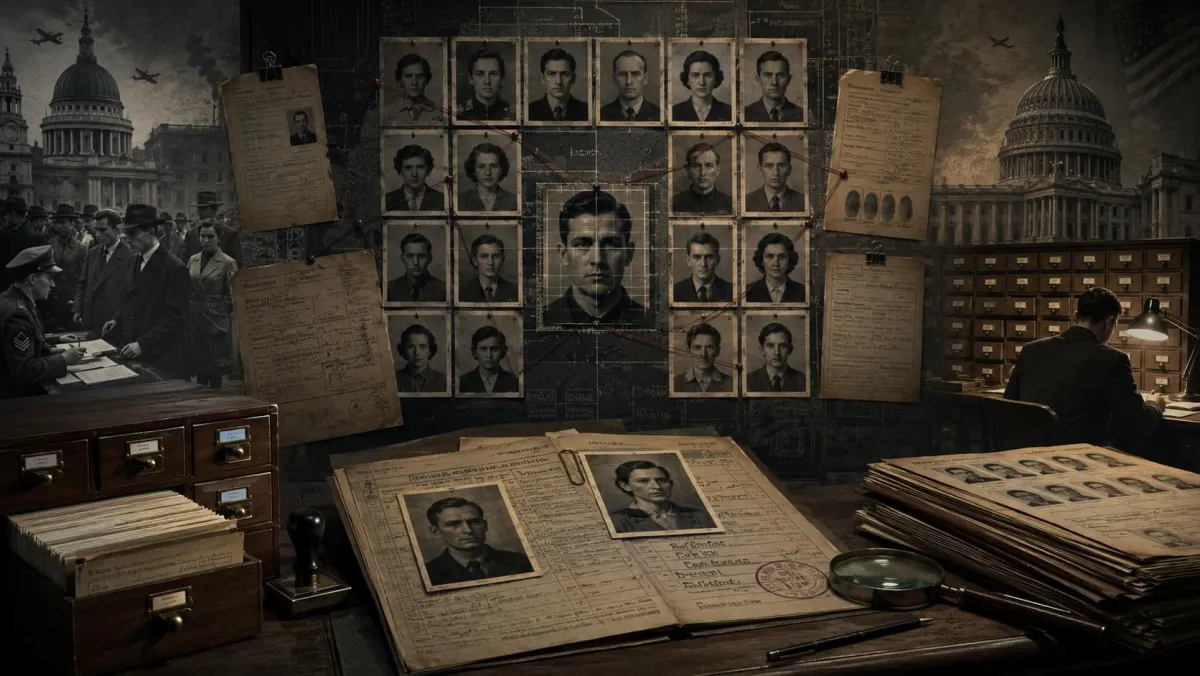
This theory held that the expansion of photo-based identification during wartime was a cover for mass face registration. It argued that once governments required photographs for documents, they were not merely verifying identity but building a searchable visual file of the population.
Origin of the Theory
The theory grew from the intersection of photography, bureaucracy, and war. As governments expanded registration systems, identity documents, rationing, border control, and internal movement controls, citizens encountered new demands for documentation. Photography, once personal or commercial, increasingly entered the administrative sphere.
This shift gave rise to the suspicion that the state was not only documenting movement but assembling a criminal-style archive of ordinary people. In rumor form, the distinction between passport file, police file, and wartime register collapsed.
Core Claims
Every Face Registered
The central claim held that war created the political justification needed to collect photographs and biometric likenesses on a mass scale.
Civilian and Criminal Files Merged
Supporters argued that ordinary administrative photographs would eventually be cross-used for policing, blacklist systems, and surveillance.
Temporary Emergency Made Permanent
The theory stressed that wartime measures rarely disappeared and that photo identification would become a long-term instrument of governance.
Hidden National Index
Many versions described a concealed archive or master file linking face, name, address, status, and movement history.
Historical Context
Passport photographs had already become part of official procedure before and during the First World War, and wartime registration systems during the Second World War expanded state record-keeping in many countries. Britain’s 1939 Register and wartime identity cards provided an especially important historical backdrop for these suspicions.
In the United States, passport and immigration documentation also gave administrative photography a more systematic governmental role. Once people understood that governments were collecting likenesses, it was a short step to suspect wider uses beyond the stated purpose.
Why the Theory Spread
The theory spread because it translated an abstract bureaucratic process into something immediate and personal: your face, in a file, held by the state. It also resonated with a longstanding fear that governments use war to normalize measures that would be unacceptable in peacetime.
Variants
Some variants focused on passports and border files. Others emphasized national registration, ration books, draft records, or refugee and enemy-alien controls. Later versions projected the same logic forward into driver’s licenses, mugshots, CCTV, facial recognition, and digital biometric databases.
Historical Significance
This theory is historically significant because it anticipated later debates over biometric surveillance. Even in its early form, it treated wartime identification not as neutral administration but as the first stage of a permanent face-indexing state.