
Overview
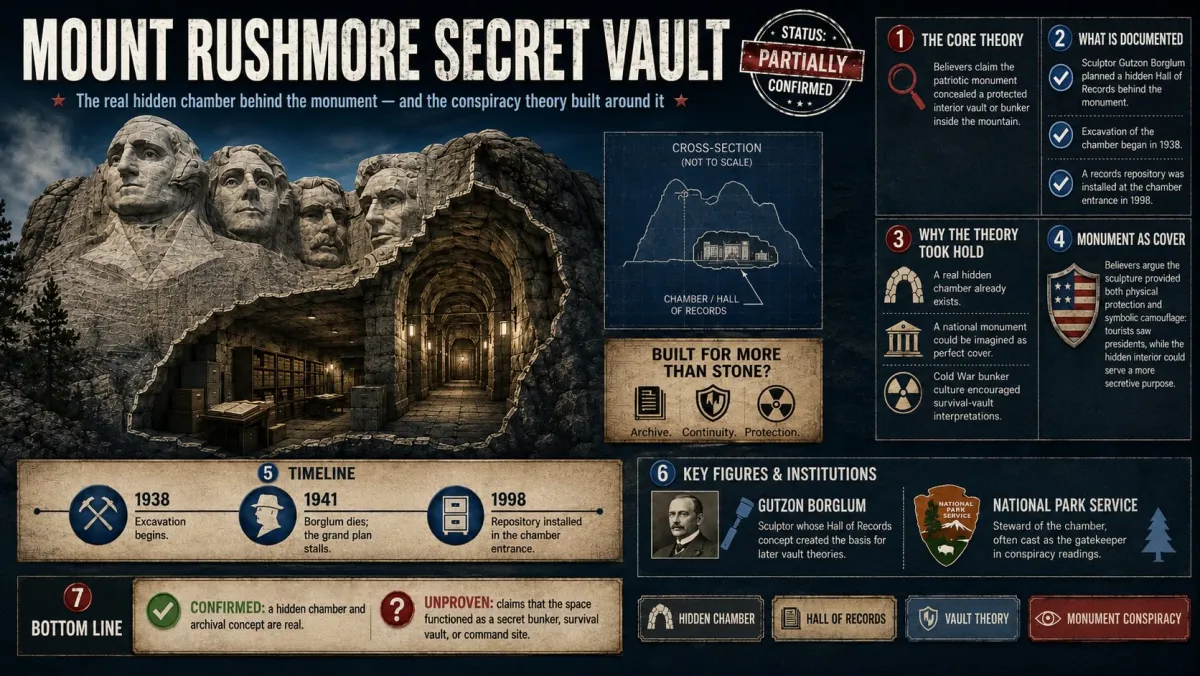
The Mount Rushmore Secret Vault theory argued that the monument’s visible patriotic purpose hid a second function in the rock behind it. The carving, in this reading, was both sculpture and camouflage. While the public saw presidents, the government or its planners saw protected interior space.
This theory never had to invent the chamber from nothing. A chamber really exists. That is why the theory has proven so durable.
Historical Background
Gutzon Borglum envisioned a Hall of Records behind the sculpted heads where foundational American texts and explanations of the monument would be stored for future civilizations. Work on the chamber began, but the larger plan was abandoned because of funding, practical difficulties, and Borglum’s death. In 1998, a repository containing records was placed in the entry of the chamber.
These facts are documented and central. The theory’s power lies in expanding from “real hidden chamber” to “hidden chamber with a larger purpose.”
Why the Doomsday Bunker Variant Emerged
Once the public learned there was a chamber behind the monument, speculation naturally broadened. A hidden interior in a mountain near a nationally symbolic site could easily be reimagined as a continuity vault, protected archive, or survival bunker. The Hall of Records name itself almost invites this leap.
The doomsday version turns cultural preservation into civilizational emergency planning. The vault is no longer for historical texts alone. It is for national survival.
Monument as Cover
The strongest version of the theory says the sculpture provides perfect concealment. A public landmark attracts tourists, reverence, and photography, not suspicion of underground operations. A chamber hidden inside such a site would therefore enjoy both physical hardness and symbolic immunity.
This is a common pattern in monument conspiracy: the more patriotic the façade, the more plausible the hidden-state reading becomes.
Borglum’s Ambition and Later Reinterpretation
Borglum’s original Hall of Records was grand in imagination. He wanted a significant repository explaining American history and ideals to future generations. The theory uses that ambition as proof that hidden interior space was always meant to serve more than sculpture.
Later continuity-of-government thinking, Cold War bunker culture, and secret-record fascination all made it easy to project twentieth-century survival logic backward onto Borglum’s unfinished chamber.
Why the Theory Persisted
The theory persisted because unlike many monument rumors, this one begins with a real chamber and a documented hidden-space plan. It does not depend on proving that something is there. It depends on redefining what the already-existing chamber was really for.
It also persisted because mountain interiors, archives, and national symbols form an unusually strong combination in American conspiracy culture.
Historical Significance
The Mount Rushmore Secret Vault theory is significant because it expands a genuine archival concept into a theory of hidden state continuity. It suggests that public monumentality may conceal protected interior functions related to recordkeeping, survival, or command.
As a conspiracy-history entry, it belongs to the family of monument-bunker theories, in which symbolic public architecture is believed to double as concealed emergency infrastructure.