
Overview
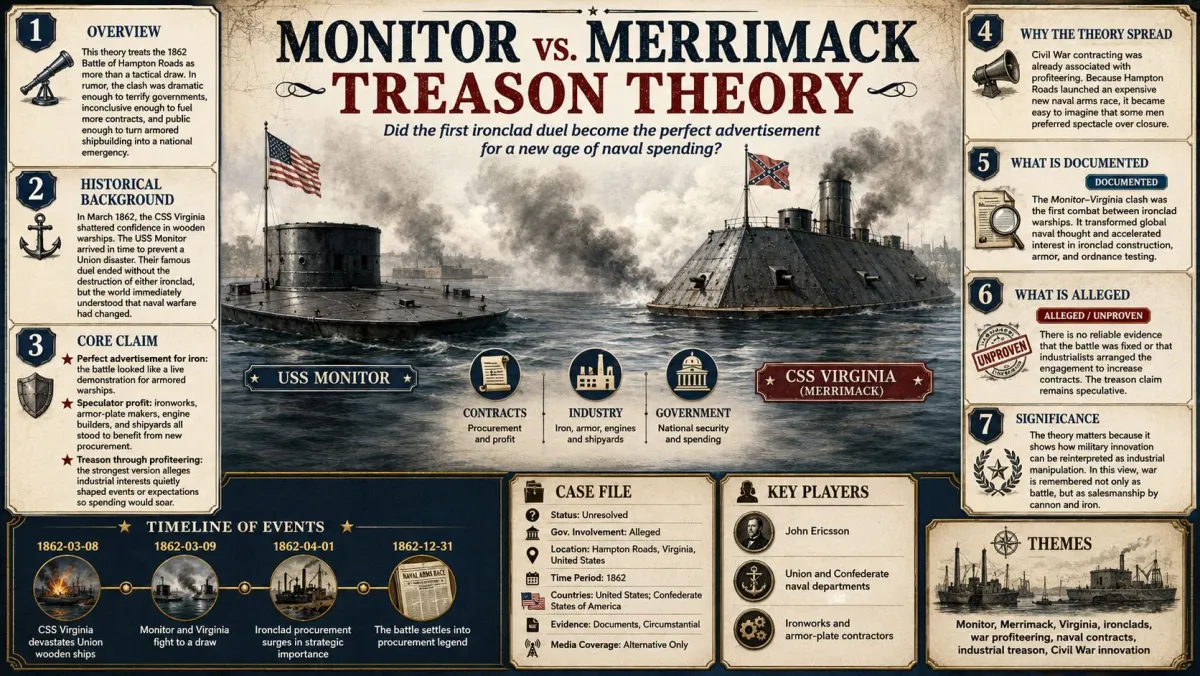
The “Monitor vs. Merrimack” treason theory treats the first battle of ironclads as more than a tactical draw. In this reading, it was a perfect demonstration event: dramatic enough to terrify governments and admirals, inconclusive enough to guarantee more contracts, and public enough to transform armored shipbuilding into a national emergency.
The theory did not need literal collusion between North and South to survive in rumor. It only needed one thing: the obvious fact that after Hampton Roads, ironclad procurement accelerated and industrial interests stood to gain.
Historical Background
The battle at Hampton Roads in March 1862 marked the first clash between ironclad warships. The Confederate CSS Virginia shattered the age of wooden naval certainty, and the arrival of the USS Monitor prevented disaster for the Union. The next day’s duel ended without destruction of either ironclad, but the world understood immediately that naval warfare had changed.
That shift is the factual core of the conspiracy theory. Once a battle creates a whole new procurement age, people naturally ask who profited most from its inconclusive outcome.
Core Claim
The central claim is that indecision served industrial interests too well to be innocent.
Perfect advertisement for iron
One version says the battle functioned like a live demonstration that guaranteed future naval armor contracts.
Speculator profit from new procurement
Another version argues that investors and contractors connected to iron works, armor plate, engines, and shipbuilding had every incentive to want a dramatic but unresolved result.
Treason through profiteering
The strongest form claims that one or more industrial interests quietly shaped events, information, or expectations so that ironclad spending would soar regardless of the military result.
Why the Theory Spread
The theory spread because Civil War contracting was already associated with profiteering. The public knew that war made fortunes. Once Hampton Roads transformed naval policy, it became easy to imagine that some men had financial reasons to prefer spectacle over closure.
The battle’s draw also helped. Had one ironclad immediately destroyed the other, the lesson might have been simpler. Instead, the clash suggested a new and expensive arms race.
What Is Documented
The battle between the Monitor and Virginia in March 1862 was the first combat between ironclad warships. It decisively altered global naval thought and triggered rapid interest in ironclad construction and ordnance testing. Historians and naval institutions consistently emphasize its transformative effect on procurement and design.
What Is Not Proven
There is no reliable evidence that the battle was fixed or that industrialists arranged the engagement to increase contracts. The stronger treason claim remains speculative and appears to belong mainly to the later logic of war-profiteering suspicion rather than to documented Civil War operational reality.
Significance
The theory remains important because it shows how military innovation can quickly be reinterpreted as industrial manipulation. Once war and procurement become tightly linked, even a historic naval duel can be remembered not as battle first, but as salesmanship by cannon and iron.