
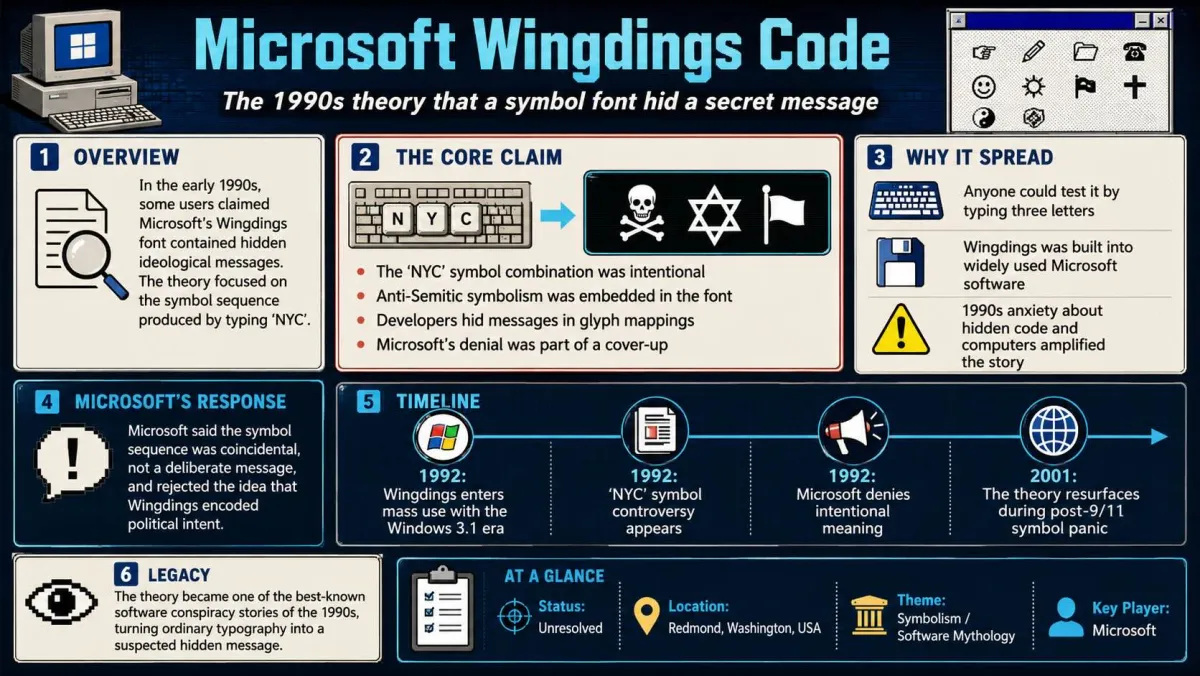
Overview
The Microsoft Wingdings Code theory emerged almost immediately after Wingdings entered popular use in the early 1990s. The most famous trigger was the claim that typing the letters “NYC” in Wingdings revealed a hidden statement through symbols rather than words. Because New York City has long been associated in popular imagination with a large Jewish population, the appearance of a skull-and-crossbones next to a Star of David created a highly charged interpretive field.
The theory expanded rapidly because Wingdings was not a niche font. It lived inside one of the most widely used software ecosystems in the world. If a hidden code existed, it would have been embedded inside everyday office computing.
Historical Context
Wingdings appeared in the Windows 3.1 era in 1992 and quickly became one of the most recognizable symbol fonts in Microsoft software. It was designed as a collection of pictographic glyphs rather than as an alphabet in the usual sense. Users experimenting with random letter combinations often stumbled onto symbol strings that looked meaningful, eerie, or suggestive.
This environment was ideal for conspiracy thinking. A font built from symbols invites interpretation, and once people believed that some combinations looked purposeful, the software itself became suspect.
The Core Claim
The theory usually includes several linked ideas:
the “NYC” combination was intentional
The developers allegedly chose the specific mapping knowingly rather than arriving at it by chance.
anti-Semitic symbolism was embedded in the font
The skull-and-crossbones plus Star of David combination was interpreted as hostile or threatening rather than arbitrary.
developers communicated through glyph arrangement
The font was said to contain internal messages hidden in plain sight, visible only when the right letters were typed.
Microsoft denial was part of the concealment
The company’s public insistence that the result was coincidental became, in conspiracy reading, part of the cover story.
Why the Theory Spread
The theory spread because it had all the right ingredients: a major software company, a hidden message, a provocative symbol combination, and a simple reproducible test anyone could perform at home. Unlike many conspiracy claims, this one did not require a secret archive or whistleblower. It required only typing three letters and looking at the screen.
It also spread because the early 1990s were full of cultural anxiety about software, hidden code, and the invisible logic inside personal computers. Wingdings turned those anxieties into something visual.
Microsoft’s Response and the Theory’s Survival
Microsoft denied that the “NYC” sequence was intentional and reportedly considered whether to alter the mapping after controversy surfaced. The company’s broader position was that the arrangement was coincidental and that symbolic-font layout was not designed to encode political messages.
This did not end the theory. The fact that Microsoft addressed it at all helped keep it alive, because public denial often strengthens rather than weakens symbolic conspiracies.
Legacy
The Wingdings Code theory remains one of the classic software-conspiracy stories of the 1990s because it transformed typography into intent. Its factual base is the real 1992 controversy over the “NYC” symbol sequence and Microsoft’s real denials. Its conspiratorial extension is that the mapping was a deliberate ideological statement smuggled into mass-market software by insiders who expected few people to notice.