
Overview
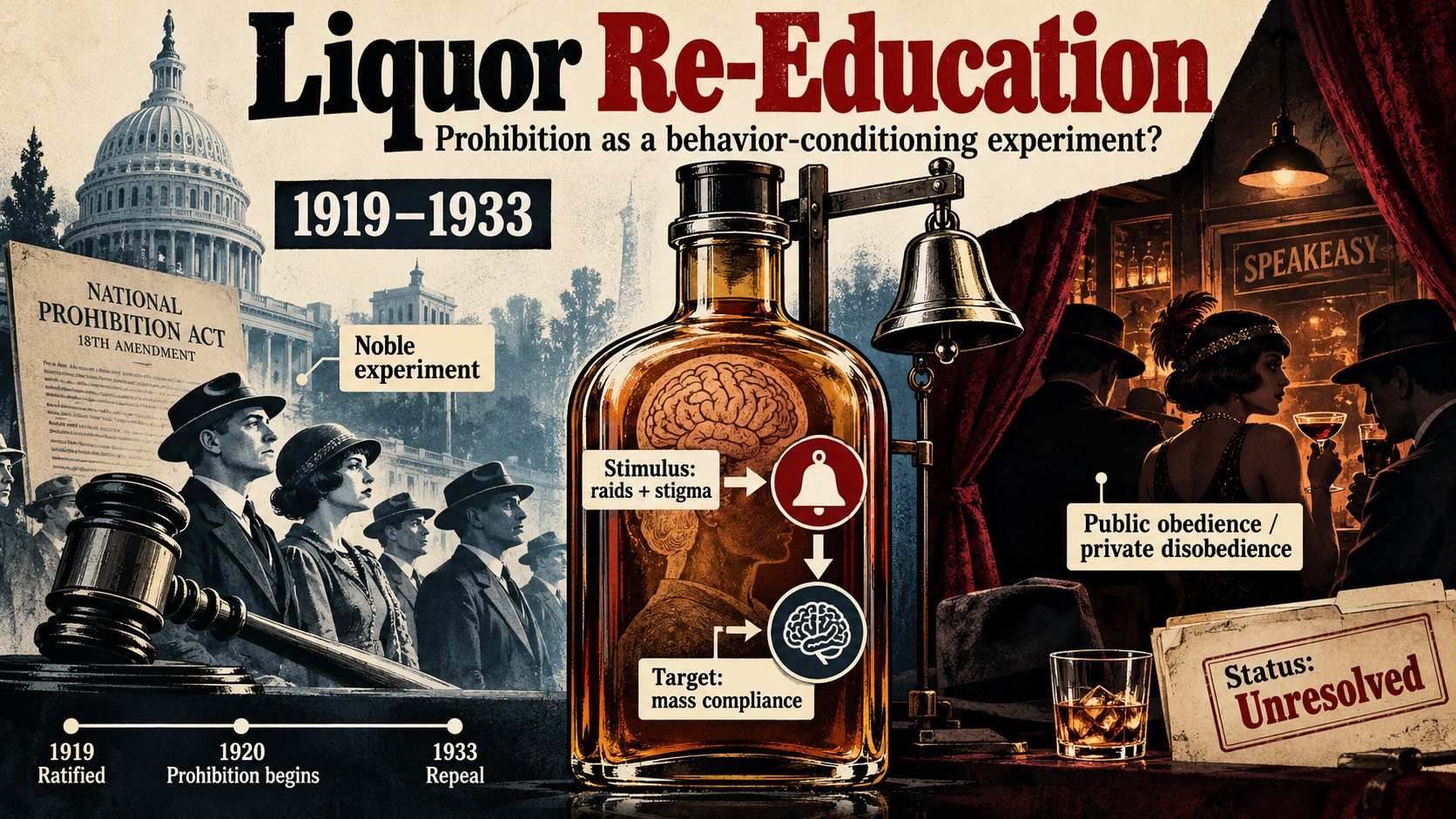
The Liquor Re-Education theory interpreted Prohibition as a mass conditioning program rather than a straightforward anti-alcohol reform. Instead of asking whether alcohol should be legal, the theory asked a different question: what happens when a government imposes a broad rule that millions privately reject but are expected to publicly obey?
This theory did not need Prohibition to succeed in ending drinking. In fact, the persistence of illegal drinking could be reinterpreted as part of the test. What mattered was how citizens adapted—whether they concealed behavior, internalized stigma, altered public language, complied selectively, or accepted the general right of the state to regulate intimate custom.
Why Pavlov Entered the Theory
The Pavlovian layer was mostly a retrospective addition, but it gave the theory a strong conceptual frame. Ivan Pavlov’s work on conditioned responses became influential in the wider culture of psychology, and American behaviorist thinking also gained visibility in the early twentieth century. Once the language of conditioning was available, Prohibition could be reread as a real-world experiment in stimulus, punishment, reward, and habit restructuring.
In this version, enforcement actions, raids, social pressure, sermons, propaganda, and legal risk functioned like repeated conditioning stimuli. The citizenry was treated as the subject population. The target was not just alcohol consumption but predictable compliance under moralized legal pressure.
The “Experiment” Language
The theory drew particular energy from the fact that Prohibition was repeatedly described as an "experiment." Herbert Hoover called it a "noble experiment" and a "great social and economic experiment." Supporters used the phrase positively, but critics and later theorists reinterpreted it literally. If it was an experiment, they argued, then someone was observing outcomes and learning how behavior changed under coercive law.
That literal reading is central to the theory. It turned a rhetorical phrase into a hidden-policy clue. In the conspiratorial version, Prohibition was less a mistake than a pilot program in modern governance.
Progressive Reform and Behavioral Governance
Historically, Prohibition did emerge from Progressive-era reform culture, which often assumed that law could improve society by reshaping conduct. Reformers sought cleaner politics, healthier homes, better labor discipline, and reduced vice. This created fertile ground for later theories about social engineering.
The Liquor Re-Education theory takes those reform ambitions and extends them. It proposes that alcohol was chosen precisely because it was a daily habit, widely practiced, symbolically loaded, and easy to police unevenly. If the state could regulate something so ordinary, it could learn how people respond when their private customs are legally recoded as deviance.
Public Performance and Private Disobedience
One reason the theory endured is that Prohibition produced a split between public and private behavior. Many Americans publicly endorsed dry politics while privately drinking, serving guests, or tolerating violations. This gap between formal compliance and lived behavior looked, to believers, like evidence that the law’s real function was pedagogical and disciplinary rather than purely eliminative.
The law created categories of respectability, shame, and hypocrisy. That made it possible to observe not only who drank, but who adapted. The theory therefore treated Prohibition as an early laboratory of behavioral governance.
Why It Lasted
The Liquor Re-Education theory lasted because it fits later anxieties about propaganda, conditioning, and the hidden purposes of law. Once twentieth-century states increasingly used surveys, psychology, public messaging, and behavioral expertise, older experiments in moral legislation began to look newly suspicious.
Prohibition became especially useful for this interpretation because it was national, intimate, highly visible, and difficult to enforce. It generated exactly the kind of compliance patterns a later theorist could imagine being studied.
Historical Significance
The theory is important because it reframes one of the most famous American reform projects as a study in obedience rather than abstinence. It treats Prohibition as the point where moral law and behavior science begin to overlap in the public imagination.
As a conspiracy-history entry, the Liquor Re-Education theory belongs to the family of social-conditioning narratives: the belief that governments sometimes impose laws less to solve the stated problem than to learn how populations behave when compelled to submit to an implausible rule.