
Two separate questions
Almost everything written about Karen Silkwood runs two questions together, and they have very different answers. Keeping them apart is the whole job of this entry.
The first is whether she was contaminated with plutonium through her employer's fault. That question went to a jury, and it was answered.
The second is whether she was killed. That question has never been answered, and the evidence does not settle it.
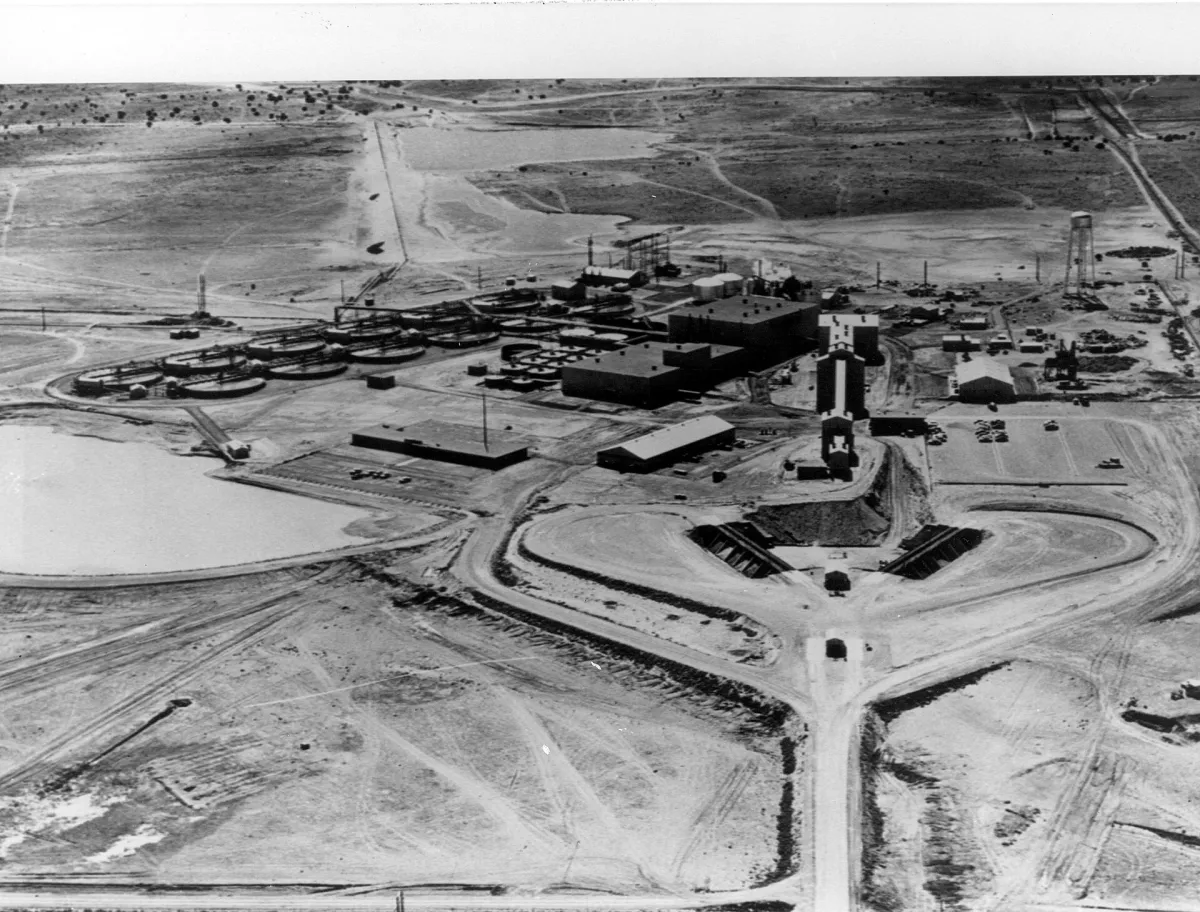
A Kerr-McGee uranium mill at Grants, New Mexico. Silkwood worked at the company’s Cimarron plutonium plant in Oklahoma, which this photograph does not show. Wikimedia Commons — ENERGY.GOV, Public domain

The contamination
Silkwood was a laboratory analyst at Kerr-McGee's Cimarron plant near Crescent, Oklahoma, which fabricated plutonium fuel pins for use as reactor fuel. She was active in her union on safety at the plant and had raised complaints about handling practices and about the quality control of the fuel pins themselves.
In November 1974, over a three-day period, she was found to be contaminated with plutonium. Not merely on her skin: testing established contamination inside her body. Her apartment was then checked and found contaminated at levels high enough that most of her personal possessions had to be destroyed.
How plutonium got into her flat has never been established. The two obvious explanations point in opposite directions — that she carried it home from the plant, or that it was put there — and each has been argued at length by people with an interest in the answer.
The crash
On 13 November 1974, Silkwood left a union meeting and drove toward Oklahoma City to meet a New York Times reporter and a national union official. She was reportedly carrying documentation about safety and quality control at the plant.
Her car left the road and she was killed.
No such documents were recovered from the vehicle.
The Oklahoma Highway Patrol concluded it was a single-car accident and that she had fallen asleep at the wheel. The toxicology supports that reading: methaqualone, a sedative, was present, at what was described as a therapeutic level.
An investigator retained by the union, A. O. Pipkin Jr., reached a different view on two grounds. He argued that the steering wheel was bent back at the sides in a way indicating she had been awake and braced at the moment of impact rather than slumped. And he reported fresh paint chips on the rear bumper, consistent with having been struck from behind.
Both readings rest on the same car, examined by people retained by opposing interests, and neither has ever been resolved. The sedative is a real fact that favours the accident finding, and the rear-bumper evidence is a real fact that does not. Anyone who tells this story with only one of those in it is telling half of it.
What is not in dispute is the documents. She was carrying them at the union meeting, and none of them were in the car.
What the courts actually decided
This is the part most often misreported, usually in the direction of making the legal outcome about her death. It was not. The litigation was about the contamination.
Her father, Bill Silkwood, brought an action as administrator of her estate under Oklahoma tort law, seeking recovery for the injuries the contamination had done to her person and her property. In 1979 a jury found that Kerr-McGee had caused the contamination and awarded $505,000 in damages together with $10 million in punitive damages — a very large sum for the time, and a finding that the company's conduct had been considerably worse than careless.
On appeal the award was gutted. The judgment was cut to $5,000 and the punitive damages reversed, on a point of federal law: that Congress's regulation of nuclear safety preempted a state from punishing a licensee this way. Five hundred and five thousand dollars to five thousand is the scale of that reversal.
On 11 January 1984 the Supreme Court reversed it back, five votes to four, holding that federal control of nuclear safety did not shield a company from punitive damages under state law and reinstating the jury's verdict. Silkwood v. Kerr-McGee is a significant decision in American preemption law for that reason, and it is cited today in contexts with nothing to do with plutonium.
The case ended in 1986 with a settlement of $1.38 million rather than a retrial, and with no admission of liability.
Why the distinction matters
Read as a story about an assassination, the Silkwood case is unproven and always will be. The physical evidence from the crash supports two readings, the people who examined it were not disinterested, and the one piece of hard documentary evidence — the papers she was carrying — is absent, which is suggestive and is not proof.
Read as a story about what happened to a worker who complained, it is established, in court, against the company, and upheld at the highest level. A jury found that her employer had contaminated her. A majority of the Supreme Court held that a state could punish a nuclear licensee for it.
The second story is the stronger one, and it is the one that changed anything. It is also the one that gets lost, because an unproven killing is more compelling than a proven contamination, and because the film made of her life ends where the uncertainty is.
Something similar appears elsewhere in this archive. Attaching a case to the most dramatic available claim makes it easy to dismiss in full, when the less dramatic claim is the one that was proved and the one that cost the company money. Silkwood's estate did not win because anyone established she was run off the road. It won because the plutonium was in her body and a jury decided whose fault that was.