
Overview
The Hollywood Blacklist Double Cross theory argues that the blacklist was not simply a punitive ban on suspected or accused left-wing figures in the entertainment industry. In this reading, it was also a selection and redeployment mechanism. While the public saw ruined careers, lost credits, and exile, believers claim some of the supposedly excluded people were quietly absorbed into covert government work.
The theory often focuses on the discrepancy between visible disappearance and continued activity. If blacklisted writers kept writing through fronts, pseudonyms, or overseas work, conspiracy narratives ask whether some of that hidden labor might have gone not to private survival alone, but to state propaganda or intelligence-linked projects.
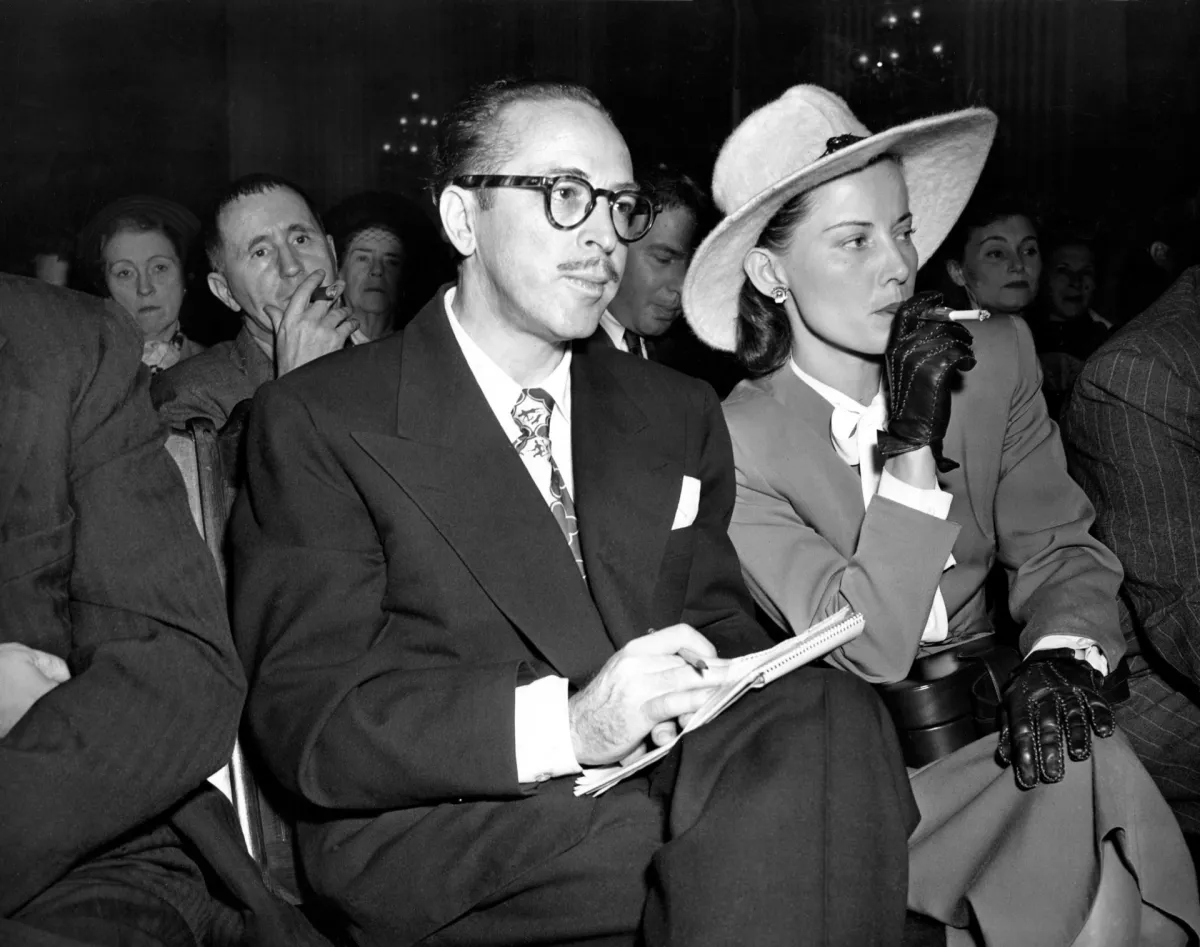
Wikimedia Commons — Unknown author, Public domain
.png)
Historical Context
The Hollywood blacklist emerged from the anti-communist politics of the late 1940s, especially the 1947 House Un-American Activities Committee hearings and the wider Red Scare. The Hollywood Ten became the most famous early victims. Over time, many more writers, directors, actors, and others found themselves unemployable or informally excluded. Some wrote under aliases, some worked abroad, and some disappeared from public screen credit entirely.
At the same time, Hollywood did have real wartime and postwar relationships with government information and intelligence structures. During World War II, film talent worked with the Office of War Information and the Office of Strategic Services. Those real precedents made later covert-absorption theories easier to imagine.
What the October 1947 Hearings Put on the Record
The hearings that produced the blacklist were not secret. They ran in public in Washington in October 1947, were covered by newsreel cameras, and were printed in full by the Government Printing Office, so the exchanges that ended ten careers can still be read line by line.
The transcript shows a committee that controlled the room tightly. When screenwriter John Howard Lawson tried to read a prepared statement, chairman J. Parnell Thomas ruled it out and, after Lawson kept talking, instructed the room: "Officers, take this man away from the stand." Dalton Trumbo was handled the same way two days later; told his own statement was "not pertinent to the inquiry," he answered the committee's questions with questions of his own and insisted, "I will refuse to answer none of your questions, sir." Chief investigator Robert Stripling put the same formula to witness after witness — "Are you now, or have you ever been, a member of the Communist Party?" — and the ten men who would not answer it were cited for contempt of Congress.
The committee also subpoenaed studio payroll records. MGM's files, read into the record by a committee investigator, showed Trumbo earning $76,250 in 1943, $95,000 in 1945, and $85,000 in 1947 up to the first week of October. Those numbers matter to the double-cross question because they establish what the blacklist actually cost the men it hit: not obscurity, but the top of the screenwriting pay scale.
The Waldorf Statement
The blacklist itself was created not by Congress but by the studios, and it was announced rather than concealed. On 24 November 1947 roughly fifty executives from the Motion Picture Association of America, the Association of Motion Picture Producers, and the Society of Independent Motion Picture Producers met at the Waldorf-Astoria in Manhattan. After two days, association president Eric Johnston read out their decision.
The statement promised that the studios would "forthwith discharge or suspend without compensation those in our employ" among the ten, and would not rehire any of them until he had purged himself of contempt and sworn he was not a Communist. It then went further than the ten: "We will not knowingly employ a Communist or a member of any party or group which advocates the overthrow of the Government of the United States by force." The producers acknowledged what they were doing — "There is the danger of hurting innocent people. There is the risk of creating an atmosphere of fear" — and asked Congress to pass legislation that would make the job easier.
Three years later the machinery spread to broadcasting. In June 1950 three former FBI agents operating as American Business Consultants published Red Channels, a booklet naming 151 people in the radio and television industry, and the networks and sponsors used it as a hiring filter. Actor Sam Jaffe, listed in it, was kept out of radio, television, and motion pictures for seven years. Lionel Stander, who told the committee in 1953 that a "fanatic group of subversives" had blacklisted artists, remained unemployable until 1965.
Core Claim
The theory usually works through several linked ideas:
The Blacklist Was Public Theater
The visible punishment of artists served to reassure the public and the industry that a purge was underway.
Selected Talent Was Too Useful to Waste
Skilled screenwriters, language specialists, political thinkers, and propaganda craftsmen were allegedly redirected rather than discarded.
Pseudonyms and Fronts Concealed More Than Private Work
Because some blacklisted writers continued working anonymously, theorists argue that the same invisibility could have covered covert contracts or government briefs.
State Cultural Work Needed Experts
The early Cold War's information battles, psychological operations, and cultural fronts required precisely the kinds of people who knew how to build persuasive narratives.
Why the Theory Spread
Several historical features gave the theory traction:
Hidden Continued Output
The fact that some blacklisted artists still produced work under other names created an atmosphere in which invisible labor seemed normal.
Real State-Hollywood Ties
Government collaboration with filmmakers during and after World War II provided a documented bridge between entertainment labor and political operations.
Moral Ambiguity
Because the blacklist combined coercion, survival, betrayal, and secrecy, it was easy to imagine double lives behind public stories.
Intelligence Culture
The early Cold War created an environment in which "disappeared from view" and "reassigned quietly" sounded institutionally plausible.
The Black Market in Scripts
The hidden labor at the centre of the theory is the best-documented part of the story, because the people doing it kept their paperwork. Trumbo's files, held with the Hollywood blacklist collections at the Wisconsin Center for Film and Theater Research, describe a man running a small illicit business rather than a man on a payroll. The centre's account of the collection notes that "Trumbo's bank accounts were empty or overdrawn by the early 1950s," and that when he came home from prison in 1951 he sold his California ranch and moved his family into exile in Mexico.
From there he built what the archive calls the Hollywood black market: "under the counter" writing for himself, and advice circulated to other blacklisted writers on how to do the same. Two scripts he sold that way won Academy Awards for other men — Roman Holiday in 1953, credited to Ian McLellan Hunter, and The Brave One in 1956, credited to a "Robert Rich" who did not exist. Trumbo admitted in 1959 that he had written the second, Otto Preminger announced that year that Trumbo would write Exodus, and Kirk Douglas soon confirmed that Trumbo had written Spartacus. Both films carried his name in 1960, and the blacklist did not survive them.
What that record shows is a trade in cut-rate scripts between blacklisted writers and independent producers who wanted cheap talent — commercial, precarious, and driven by unpaid bills. Nothing in the surviving correspondence points to a government client.
The Documented Route Back
There was a way off the blacklist, and it was the opposite of covert. Edward Dmytryk, the director among the Ten, served a six-month sentence for contempt of Congress and issued a statement attacking the Communist Party before he left prison. He came back to Hollywood and found no work. He then asked a producer friend to arrange a meeting with, in his phrase, "the toughest anti-Communists in town," which brought him into contact with the projectionists' union official Roy Brewer, and in 1951 he testified again — this time answering.
Screenwriter Richard Collins took a similar path: he went to the FBI in March 1950, acknowledged his Party membership, and offered full cooperation, then appeared before the committee in 1951 and described, under oath, a visit from fellow writer Paul Jarrico. Gale Sondergaard, testifying in the same round, refused to answer and told the committee it was "doing incriminating work much more than investigating work." She did not work in films again for two decades.
Rehabilitation, in other words, ran through a public ritual recorded in printed hearing transcripts. It was humiliating and it was traceable, which is why the historical record of who returned, and on what terms, is unusually complete.
The Covert Record That Does Exist
There is a documented case of an American intelligence agency shaping the content of Hollywood films in this period, and it points away from the blacklisted. In 1953 an executive at Paramount sent a series of reports to a CIA contact addressed only as "Owen." Fourteen of them, dated 24 January to 9 March 1953 and stamped "Secret—Security Information," survive in the C. D. Jackson papers at the Eisenhower Presidential Library; the historian David Eldridge published them in 2000 after their declassification in a CIA review on 11 October 1992.
The correspondent was Luigi Luraschi, Paramount's head of censorship and foreign affairs. His letters rate studio personnel by political reliability, warn the agency not to trust one executive's apparent change of heart, and treat a colleague's membership in the Motion Picture Alliance for the Preservation of American Ideals — the group most active in enforcing the blacklist — as evidence he was sound. Eldridge's assessment is that the plan may never have been fully formulated and its impact was limited. The point for this theory is who was doing it: the covert channel into the studios ran through a censorship executive on the enforcing side of the blacklist, not through the writers it had expelled.
Historical Anchor and Theory Extension
The historical anchor includes the blacklist itself, the use of fronts and pseudonyms, and the real existence of federal cultural and wartime information work involving Hollywood talent. The conspiracy extension claims that some blacklisted figures were not merely surviving in secret, but serving in covert government roles.
The distance between the two is a specific kind of document. Covert employment leaves contracts, cover arrangements, security clearances, and payment records, and a great deal of that material from the 1950s has since been declassified — the Luraschi letters among it. No such file naming a blacklisted screenwriter as a government contractor has been produced, and the claim rests instead on inference from the gap between what the public saw and what the writers were privately doing. That gap has an accounting, and it is in the papers the writers left behind.
Legacy
The Hollywood Blacklist Double Cross theory endures because it converts a public story of exclusion into a hidden story of recruitment. It preserves the tension of the blacklist while replacing ruin with clandestine utility. The documented history is harsher and less tidy: men at the top of their profession losing everything, selling scripts under invented names to keep the lights on, and returning only by naming the colleagues who had not.