
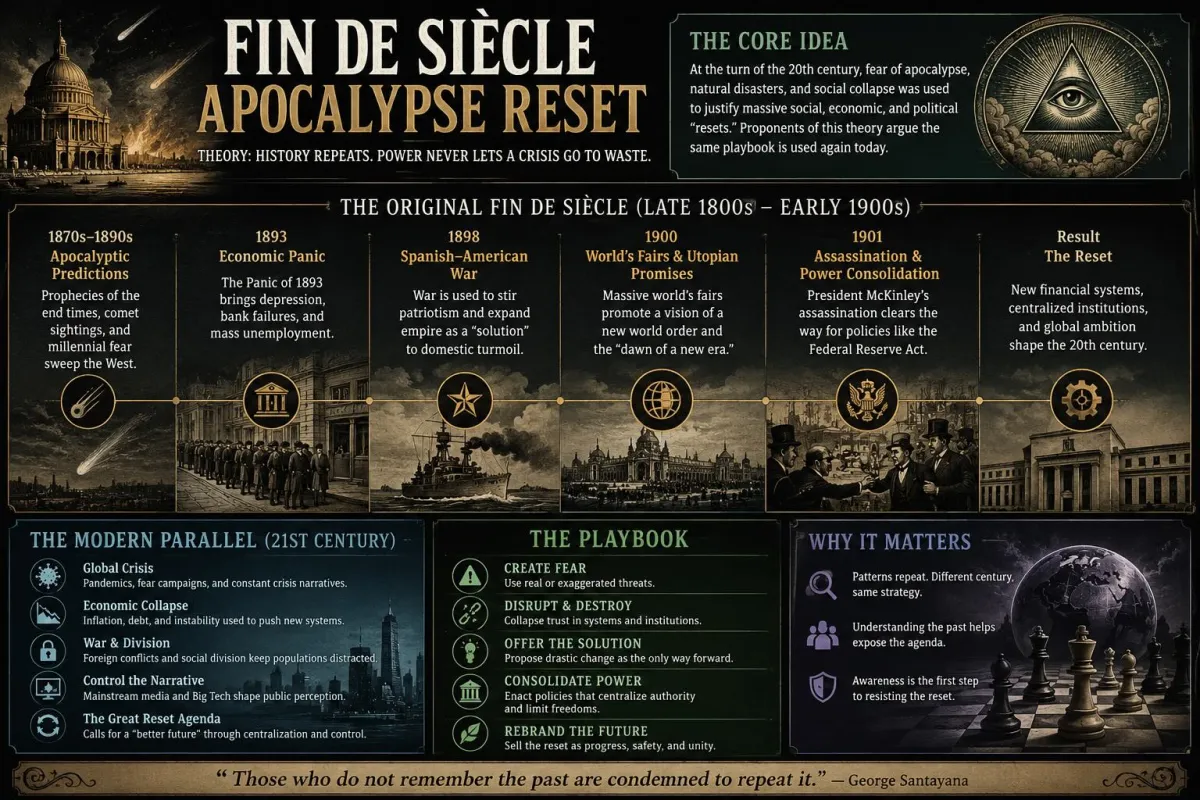
Overview
The “Fin de Siècle” apocalypse theory is best understood as a fringe technological myth nested inside a much broader end-of-century mood. It imagined that modern time itself had become too artificial, too over-mechanized, too dependent on systems that might fail when the century rolled into “00.”
Unlike later computer-based millennium scares, this rumor belongs to the world of clock towers, synchronized rail timetables, electrical modernization, and cultural decadence. It treats the century-turn not only as a date but as a mechanical threshold.
Historical Background
The fin de siècle was widely experienced as an age of exhaustion, decadence, and strange expectation. Literature, journalism, and social criticism often cast the period as unstable, overcivilized, and haunted by endings.
At the same time, modern life depended more and more on precise timekeeping. Railways, telegraphy, factories, and urban administration all relied on synchronized clocks. That made time itself newly infrastructural—and therefore newly vulnerable in imagination.
Core Claim
The central claim was that the century-rollover would break more than calendars.
Clock failure
One version said that mechanical clocks or public time systems would fail at the passage into 1900, either physically or symbolically.
World reset
Another version expanded the idea from clocks to civilization: if timekeeping failed, transport, work, finance, and social order would also collapse.
Hidden elite preparation
A stronger conspiratorial form held that governments and elites already knew the transition would be dangerous and were quietly preparing while dismissing public concern.
Why the Theory Spread
The theory spread because the fin de siècle was already culturally apocalyptic. Even without a specific clock-failure belief, people were primed to imagine the end of an age in material as well as spiritual terms.
The rise of mechanical and synchronized time made the clock a natural symbol. If the century was ending, what better emblem of that ending than the world’s timepieces stalling or resetting together?
What Is Documented
The broader fin-de-siècle climate of apocalyptic, decadent, and end-of-era thinking is very well documented. Scholars consistently describe the late nineteenth century as saturated with anxiety about decline, shock, and rupture. What is much less well documented is the exact widespread claim that all mechanical clocks would fail because of the “00” in 1900.
What Is Not Proven
There is no strong evidence that a large, organized global movement genuinely expected all clocks to fail at the dawn of 1900. The precise rumor appears to be a thinly documented fringe elaboration on broader end-of-century anxiety.
Significance
The theory remains important because it marks a moment when millennial dread began to attach itself not only to prophecy but to systems. Even in fragmentary form, it prefigures later fears that a simple date change could reveal the fragility of an entire technical civilization.