
Overview
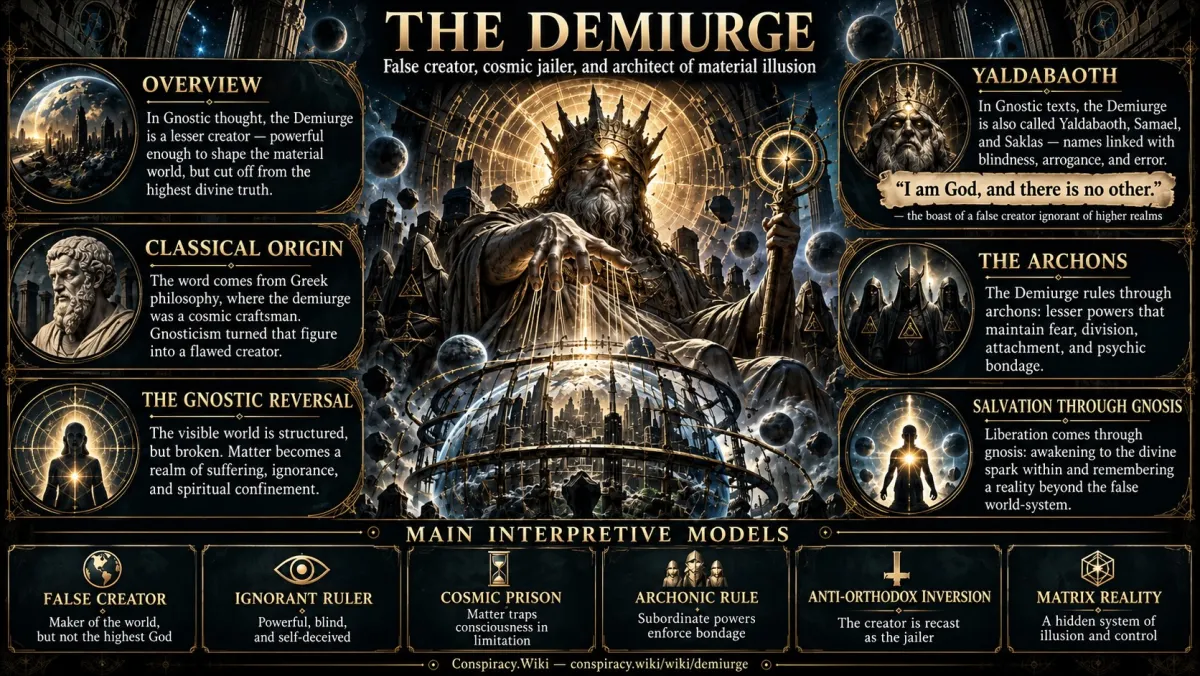
The Demiurge is one of the most important figures in Gnostic cosmology and one of the most enduring symbols in esoteric conspiracy thought. In its broadest sense, the term refers to a creator or maker of the world. But in the Gnostic framework, the Demiurge is not the highest God. He is a lesser being who fashions the material cosmos while remaining cut off from the fullness of the true divine realm.
This distinction is the heart of the theory. The world appears ordered, structured, and intelligently arranged, yet it is also marked by suffering, ignorance, decay, violence, and death. The Demiurge explains this contradiction. He is seen as powerful enough to build a world, but not wise or pure enough to create a world aligned with the highest divine truth.
Classical Origin of the Idea
The word “demiurge” comes from the Greek term for a craftsman or artisan. In Platonic philosophy, especially in the Timaeus, the Demiurge is a cosmic maker who shapes disorder into order according to eternal patterns. In that older philosophical setting, the Demiurge is not evil. He is an ordering intelligence, subordinate to ultimate reality but still beneficent in function.
This earlier meaning matters because later Gnostic systems did not invent the word from nothing. They took a philosophical creator figure and transformed him into something darker and more tragic. The result was one of the most radical reinterpretations in religious thought: the creator of the visible world became not the highest God, but the problem.
The Gnostic Reversal
In Gnostic cosmology, the Demiurge is usually the being responsible for the material universe and for the structures that keep souls bound to it. He is not the supreme source of all being, but a lower ruler who mistakes himself for that source. This is why he often appears as arrogant, blind, and jealous.
The theory says that the visible world is not ultimate reality. Matter is a confinement zone, a realm of forgetfulness and fragmentation. Human beings contain a divine spark from a higher order of existence, but that spark is buried within the psychophysical structure shaped by the Demiurge and his subordinate rulers.
In this sense, the Demiurge is not simply a mythological villain. He is the explanation for why reality feels both patterned and broken, lawful and oppressive, beautiful and imprisoning.
Yaldabaoth, Samael, and Saklas
Among the most influential Gnostic texts, especially the Apocryphon of John, the Demiurge is given specific names. He is called Yaldabaoth, and also Saklas and Samael. These names convey ignorance, blindness, and error. He emerges not as the original God, but as the product of a rupture higher up in the cosmic order, especially in relation to Sophia.
Yaldabaoth is often described as declaring, “I am God, and there is no other God beside me,” not because this is true, but because he is ignorant of the realms above him. This boast becomes one of the central moments in the myth. It is the declaration of cosmic ignorance mistaken for absolute authority.
For conspiracy-oriented readers, this is one of the most explosive elements in the Demiurge tradition. It implies that the ruler of the visible world is not only false, but unaware of his falseness, and that much of religious history may be built around obedience to a mistaken creator.
Sophia and the Birth of the Demiurge
The Demiurge does not stand alone in Gnostic myth. His origin is usually tied to Sophia, a divine emanation whose separation, error, or unauthorized generative act produces the lower creator. This means the Demiurge is not primal. He is derivative. He exists because of a disturbance in the higher order.
This origin story is essential because it explains why the Demiurge has power without fullness. He can create structure, but not true divine life. He can form the material world, but not restore the lost unity from which he is cut off. He is therefore a partial creator, an imitator, and a ruler of reflections.
The Material World as a Prison
One of the strongest theories surrounding the Demiurge is that the material cosmos is not a gift but a containment system. Matter is understood as dense, binding, and forgetful. Time, mortality, labor, reproduction, law, punishment, and social hierarchy all become parts of the Demiurgic order.
Under this interpretation, the world is designed to absorb consciousness into cycles of fear, desire, identity, and survival. Human beings become attached to names, roles, bodies, possessions, and institutions, forgetting their origin in the higher pleromatic realm.
This prison model is one reason the Demiurge became so important in later esoteric and conspiracy thought. He is not just a mythic figure from ancient texts. He becomes a model for understanding systems of control, illusion, and false authority in every age.
The Archons
The Demiurge is frequently accompanied by archons, lesser rulers or powers who help administer the material realm. In Gnostic thought these archons govern the world, the heavens, or the psychic structures that keep human beings bound to ignorance.
The archons extend the theory from a single false creator into a whole system of domination. The material world is not merely fallen; it is managed. There are powers, visible and invisible, whose function is to maintain confusion, fear, division, and attachment.
In modern conspiracy reinterpretation, archons are often treated as metaphors or entities connected to institutional power, psychological manipulation, parasitic consciousness, or non-human control systems.
Demiurge and the God of the Old Testament
Some Gnostic systems and later readers identified the Demiurge with the creator-God depicted in the Hebrew Bible. This is one of the most controversial aspects of the tradition. The lawgiving, jealous, punitive, world-ordering deity becomes, in this theory, not the supreme God but the lower ruler who demands worship and obedience while remaining ignorant of the higher realm.
This does not function as a minor theological disagreement. It is a complete inversion of orthodox religious structure. The being worshipped as creator becomes the jailer, while the true God is hidden beyond the cosmos and known only through gnosis.
Because of this, the Demiurge theory has often been treated as one of the most radical critiques ever directed at mainstream monotheism.
Salvation Through Gnosis
If the Demiurge rules through ignorance, then liberation comes through knowledge. But this knowledge is not ordinary information. It is gnosis: awakening to one’s true origin beyond the material world and beyond the authority of the false creator.
In this framework, salvation does not come primarily through legal obedience, ritual correctness, or submission to worldly structures. It comes through remembering who one truly is, where the divine spark comes from, and how the visible order has concealed its own limits.
The Demiurge therefore functions as both enemy and catalyst. He is the ruler whose world must be seen through in order for awakening to occur.
Demiurge in Esoteric Conspiracy Thought
In modern esoteric conspiracy culture, the Demiurge is often reinterpreted as:
- the architect of the simulation,
- the false god behind institutional religion,
- the ruler of matrix-like reality,
- the intelligence behind materialism and spiritual amnesia,
- or the cosmic source of hierarchical control systems.
In these readings, the ancient myth is updated without losing its structure. Governments, media systems, economic machinery, technological dependence, and identity programming are all cast as reflections of Demiurgic control. The prison is no longer only metaphysical; it becomes social, psychological, and planetary.
Main Interpretive Models
1. False Creator Model
The Demiurge created the material universe but is not the highest God. He is a lower maker mistaken for the supreme source.
2. Ignorant Ruler Model
The Demiurge is powerful but blind, believing himself absolute because he does not know the realms above him.
3. Cosmic Prison Model
The material world is a confinement system designed to trap divine sparks in matter, time, and forgetfulness.
4. Archonic Administration Model
The Demiurge rules through subordinate powers, the archons, who help manage bondage, illusion, and psychic control.
5. Anti-Orthodox Revelation Model
Traditional creator religion is inverted: the God commonly worshipped as creator is actually the lesser ruler, while the true God remains beyond the cosmos.
6. Matrix Reality Model
In modern conspiracy thought, the Demiurge becomes the hidden architect of a false reality system maintained through deception, hierarchy, and spiritual amnesia.
Legacy
The Demiurge remains one of the most compelling figures in esoteric thought because he explains a world that feels ordered yet wounded. He accounts for why existence appears intelligently made yet morally distorted. In Gnostic and later conspiracy frameworks, he stands as the false lord of surfaces: creator of structure, ruler of matter, maker of laws, and guardian of the prison. Against him stands the hidden Source above all systems and the awakening knowledge that human consciousness does not belong to this lower order forever.