
Israeli Intelligence Operations Inside Allied States
A set of documented cases in which Israeli intelligence, or tools built in Israel, operated inside the territory of states Israel was not at war with: a false-flag bombing campaign in Egypt that Israel eventually acknowledged, an espionage conviction in the United States, a prosecution that collapsed, and a commercial spyware industry found on the phones of officials in dozens of countries.
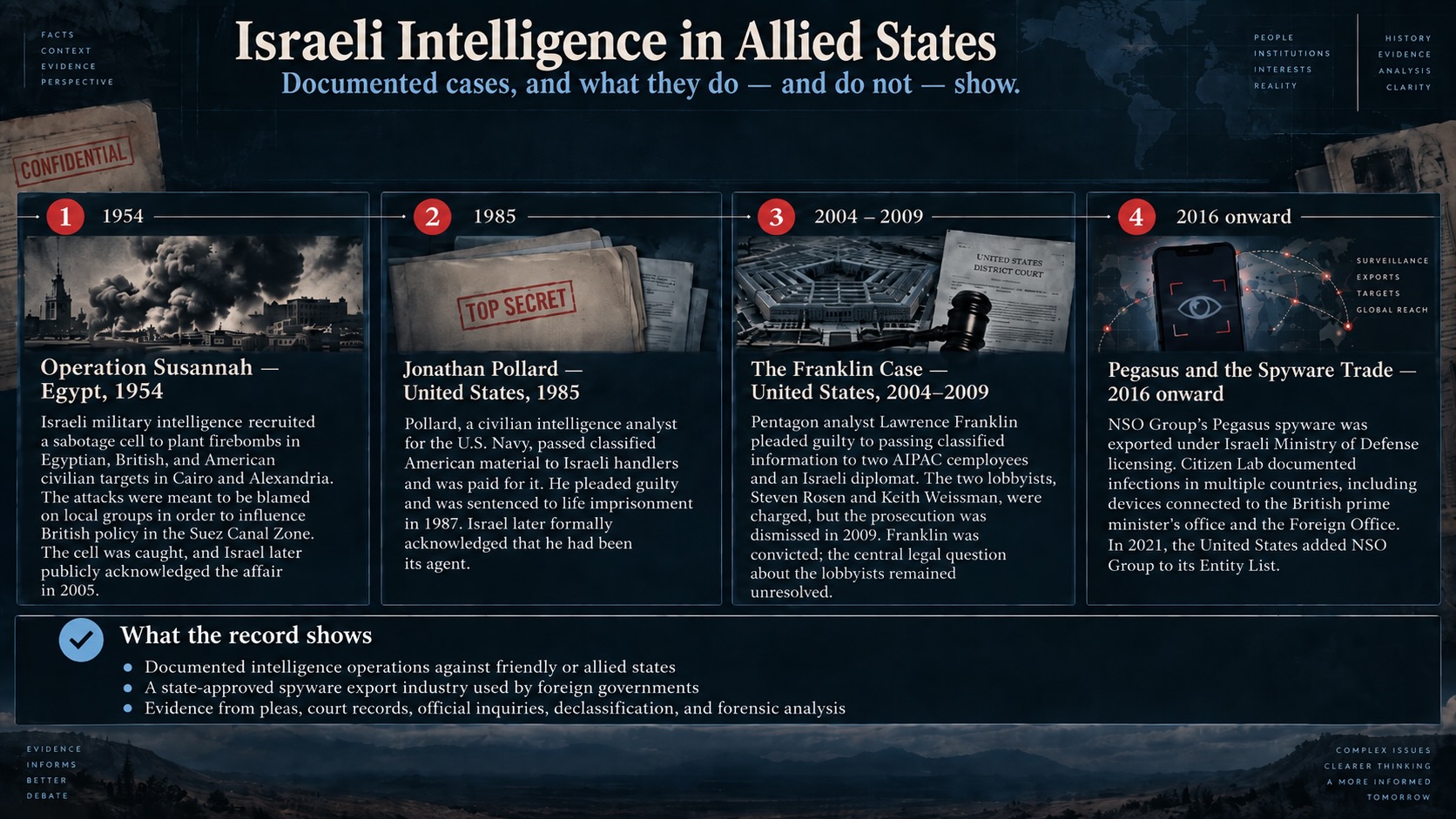
What is actually on the record
There is a documented record of Israeli intelligence operating inside states Israel was not at war with.
Each case below has a court record, an official inquiry, a state acknowledgement, or forensic evidence published by named researchers. Taken together they describe something real and bounded: an intelligence service that has run operations against friendly states, and an export industry whose products have been found on the phones of people who govern.
What "allied" means here
The word in the title is doing specific work, and it is worth setting out what it rests on, because the legal relationship between the United States and Israel is not the one the word usually implies.
The United States calls a country an ally when it has signed something. The North Atlantic Treaty binds its members to treat an attack on one as an attack on all; the United States has comparable mutual defense treaties with Japan (1960), South Korea (1953), the Philippines (1951), and Australia and New Zealand under ANZUS (1951). Each was ratified by the Senate. Each creates an obligation that a later administration cannot simply set aside.
There is no such treaty with Israel. What exists instead is a set of designations, assistance agreements and appropriations, none of which carries a defense commitment.
Major Non-NATO Ally. Israel received this designation in February 1987, in the same group as Egypt, Japan, South Korea and Australia. It is a status conferred under United States law rather than an agreement between two governments, and it grants access to particular military and economic privileges — certain defense contracts, stockpiles, loan guarantees. It does not commit the United States to Israel's defense, and the State Department describes it in those terms.
The ten-year Memoranda of Understanding. Since 1999, American military aid to Israel has been set out in successive ten-year MOUs. The current one was signed on 14 September 2016 and covers the 2019 to 2028 fiscal years, pledging $38 billion — $33 billion in Foreign Military Financing and $5 billion for missile defense. The Congressional Research Service describes their standing directly: "MOUs are not legally binding agreements like treaties, and do not require Senate ratification." Congress appropriates the money annually and may vary it.
The 1952 Mutual Defense Assistance Agreement. The name suggests more than the document does. It governs assistance rather than mutual defense, and its practical effect is a restriction: it limits Israel's use of American military equipment to defensive purposes.
The United States-Israel Strategic Partnership Act of 2014. Signed on 19 December 2014, it records the sense of Congress that Israel is a "major strategic partner" and writes into law the requirement that arms sales elsewhere in the region preserve Israel's qualitative military edge. A sense-of-Congress declaration creates no obligation, and a statute can be repealed by a later Congress; a ratified treaty cannot.
The arrangement is therefore close, expensive and long-standing, and it is not a pact. That the question remains open is visible in the advocacy around it: the same Congressional Research Service report footnotes a 2024 paper making the case for a United States-Israel mutual defense treaty, which is an argument nobody needs to make about a treaty that exists.
This matters for what follows only in one respect. Several of the cases below are commonly described as spying on an ally, and that phrasing carries an implication about obligations between the two states which the underlying instruments do not support. The cases are what they are either way.
Operation Susannah, Egypt, 1954
In the summer of 1954 Israeli military intelligence recruited a group of Egyptian Jews to plant firebombs in Egyptian, British and American civilian targets in Cairo and Alexandria — cinemas, a post office, American libraries and information centres. The attacks were meant to be attributed to the Muslim Brotherhood, Egyptian communists or unspecified local malcontents, and the purpose was to persuade Britain that Egypt was too unstable to leave, and so to keep British troops in the Suez Canal Zone.
The cell was caught. What followed in Israel was a decade of political wreckage known as the Lavon Affair, after the defence minister who was blamed and who insisted he had not authorised it. The Olshan-Dori inquiry could not establish who gave the order; a later inquiry pointed to the director of military intelligence.
The operation is unusual among such claims in that it stopped being deniable. Israel denied involvement for half a century, and in 2005 the surviving agents were received by President Moshe Katsav and given certificates of appreciation by the state. Israel's own Ministry of Defense archive now carries an exhibition on the affair.
What makes it worth setting out precisely is the target list. Two of the three countries whose property was bombed were Israel's closest allies, and the intended effect was to change British policy by making Egypt look ungovernable.
Jonathan Pollard, United States, 1985
Jonathan Pollard was a civilian intelligence analyst for the US Navy. Between 1984 and his arrest in November 1985 he passed a very large volume of classified American material to Israeli handlers, and was paid for it. He pleaded guilty in 1986 to one count of conspiracy to deliver national defence information to a foreign government and was sentenced in March 1987 to life imprisonment — the first American to receive a life sentence for spying on behalf of an ally.
Israel's position moved over time, from describing the operation as unauthorised to granting Pollard citizenship in 1995 and formally acknowledging in 1998 that he had been an Israeli agent. He was paroled in 2015 and the remaining restrictions lapsed in 2020.
The case is the clearest documented instance of Israeli espionage against the United States, and it is documented in the ordinary way: a plea, a sentence, a damage assessment and an eventual admission.
The Franklin case, United States, 2004-2009
Lawrence Franklin was a Pentagon analyst working on Iran. In 2005 he pleaded guilty to passing classified information to two employees of the American Israel Public Affairs Committee, the largest pro-Israel lobbying organisation in Washington, and to an Israeli diplomat. He was sentenced to over twelve years, later reduced to ten months of house arrest after he cooperated.
The two AIPAC employees, Steven Rosen and Keith Weissman, were charged under the Espionage Act of 1917 — an unusual use of that statute against people who were not government employees and who described their conduct as the ordinary business of gathering information in Washington. The prosecution never reached a verdict. In May 2009 the government asked the court to dismiss the indictment, saying that pre-trial rulings had raised the standard of intent it would have to prove and that a trial would inevitably disclose classified information.
The case is often cited in both directions, and the record supports being careful about it. A Pentagon official was convicted of disclosing classified material. The lobbyists were not convicted of anything, and the government abandoned the case rather than losing it, which leaves the central question about their conduct legally unresolved.
Pegasus and the spyware trade, 2016 onwards
The most consequential recent strand is commercial rather than clandestine. NSO Group is a private Israeli company whose Pegasus product takes control of a target's phone. Its exports are licensed by Israel's Ministry of Defense, which is the thread connecting a private firm to state policy.
Researchers at the Citizen Lab, at the University of Toronto, traced Pegasus operations to dozens of countries and then documented specific infections. Among them were devices connected to the office of the British prime minister and the Foreign, Commonwealth and Development Office in 2020 and 2021. Officials and politicians in a number of countries have been found among the targets, alongside journalists and human rights lawyers.
In November 2021 the United States Commerce Department added NSO Group to its Entity List, restricting American technology exports to the company on the grounds that its tools had enabled foreign governments to conduct transnational repression.
The distinction that matters here is one that gets collapsed constantly. In most documented Pegasus cases the operator was not Israel. It was whichever government had bought the licence, using it against its own citizens or its neighbours. What is attributable to Israel is the manufacture, and the export approval.
What the cases have in common
They are operations: an intelligence service running a sabotage cell, recruiting an analyst, receiving documents; a state approving the export of a weapon that other states then aim at whoever they choose. They are the sort of thing intelligence services do, and several of Israel's allies have their own entries in the same genre.
What would change the picture
The documented record is not closed, and the way it has grown is instructive: through court proceedings, declassification, official inquiries and forensic analysis of specific devices by researchers who publish their methods. Every case above became known that way, and several became known over the objections of the governments involved.
A new case would arrive the same way — an indictment, a released file, a named researcher's report on a particular phone. Claims that cannot be tested by any of those routes, and that are supported instead by the assertion that the absence of evidence demonstrates the reach of the thing being alleged, are not additions to this record, whatever they are.
Sources
- The Lavon Affair: How a false-flag operation led to war and the Israeli bomb
- The "Unfortunate" or the Lavon affair
- The Lavon Affair
- When Friends Spy on Friends: The Case of Jonathan Pollard
- Jonathan Pollard
- Feds Drop Charges In AIPAC Spy Case
- Hide and Seek: Tracking NSO Group's Pegasus Spyware to Operations in 45 Countries
- UK Government Officials Targeted with Pegasus
- Addition of Certain Entities to the Entity List
- U.S. Foreign Aid to Israel (RL33222)
- Major Non-NATO Ally Status
- United States-Israel Strategic Partnership Act of 2014 (P.L. 113-296)
- Ten-Year Memorandum of Understanding Between the United States and Israel